Why was I in the hosptial?

I wish I understood what happened.  The last thing I remember was feeling tired around one pm on Sunday. I'd been checking homework, and planning a light afternoon for the children.  The day before had been intense with a dance competition.  Preparation is huge, with making sure their clothes are right, hair done, etc, transportation, whether to take the little ones….  I was feeling quite overwhelmed with the work and the singular responsibility.  I am too alone here.  But Sunday started fine. We held art classes on the roof because of renovations downstairs,  I spent time online, and had a head massage.  Then as I said, around noon-1 pm I felt tired.  I cleared the couch in the office and lay down for a nap.  This is not unusual.


I woke up 16 hours later in the intensive care unit of Kolkata Hospital.  In the distance I recognized familiar faces.  There was total commotion around me and I kept being told i must stay a few days and rest.  But no one could tell me why, was it a stroke?  I pieced together that no one was able to wake me, that the children tried banging pans (I recall hearing them) that they tried getting me up but my speech was not understandable.  By late evening, everyone was scared.  They were not able to get any local doctor to see me so they decided to go to the hospital.  The local ambulance was busy so they wrapped me in sheets and carried me out to the car and then to the ER.  I was initially admitted to a general floor and then moved to ICU because the staff said I was too difficult — but I was totally asleep with only an iv running, so I suspect some other reason.  Once in ICU I woke to the clashing of beds, metal, yelling, general chaos, the antithesis of peace.  I could see friends watching from a distance.  They were frightened.  I understood that.  I don't know that I was frightened.  I felt more of a, :OK what do I have to do now?" mentality.  I could get no answers from docs.  All they would tell me is to rest a few days.  My friends told me what had happened and that they had talked to my children in the US,  Then they were told to leave,and then I discovered my cell phone battery was dead.  I said I was leaving, and they said I'd have to sign myself out.  I agreed.  it took hours and I couldn't call anyone because I didn't even have their numbers.  All this time I couldn't get anyone to tell me about my condition.  The hospital finally reached Seema to settle the bill, as she had signed me in, and then I left.  I got to see my reports which suggested dehydration only.  There was no recorded BP or respiration.

I came home to very happy kids and staff.  They had been so frightened.  Yesterday morning, the morning I'd become ill, a board member stopped by to remind me that if I die there is no one to cover.   I told him I was constantly aw\are of that but there was nothing I could do at the moment.    I desperately need a second in command, one to train up but there is NOTHING I can do at the moment.  In an emergency my son-in-law would immediately fly in and manage things.  It's a start.


Now I must pursue what is wrong with my health, and I will do that. It didn't feel like a stroke.  I knew I was tired and went to sleep.  I had no aftermath.  It actually felt more like a poisoning of sorts because I could hear everything but couldn't respond.  I was so helpless.  But I didn't eat anything unusual….


For the moment urgent work to do. The most urgent is preparing application for a grant for computer equipment and supplies for the handicapped children.  I am determined they will learn to talk to us, to tell us about themselves, not just learn to answer questions posed to them.  I want to hear from them.


The room painting will be done in two days.  I had to repair broken and leaking walls… repairs I paid for long ago but were never done and the workmen absconded.

The girls did well in the dance and will go to next higher level of competition.  Four girls also scored in sports day and will represent the school.  I will drink lots of water with salt and sugar and try not to be stressed!


ADDENDUM

I was looking through the bills to figure out what was done and saw two medications.  Then I remembered Seema handing me two pills, which in my stupor I thought were my regular anti cancer meds.  But they were hosp meds for hypertension and I had one of each kinds, which I also can't figure out.  Anyway, I'm getting clearer about what happened.  there are certain levels of stress that used to set off migraine headahces.  I learned eventually to anticipate them, and I did so just a few days ago.  it's when i feel totally trapped by things that MUST be done and alone because there is no one to help, and I'm being told I must do even more.


I love this home.  I love the children.  I love my life here.  I have to keep working to make it better. 


“When You Walk Through A Storm…”

From Rodgers & Hammerstein musical CAROUSEL


When you walk through a storm
Hold your head up high
And don't be afraid of the dark.
At the end of a storm
Is a golden sky
And the sweet, silver song of a lark.
Walk on, through the wind,
Walk on, through the rain,
Though your dreams be tossed and blown.
Walk on, walk on with hope in your heart,
And you'll never walk alone,
You'll never walk alone.


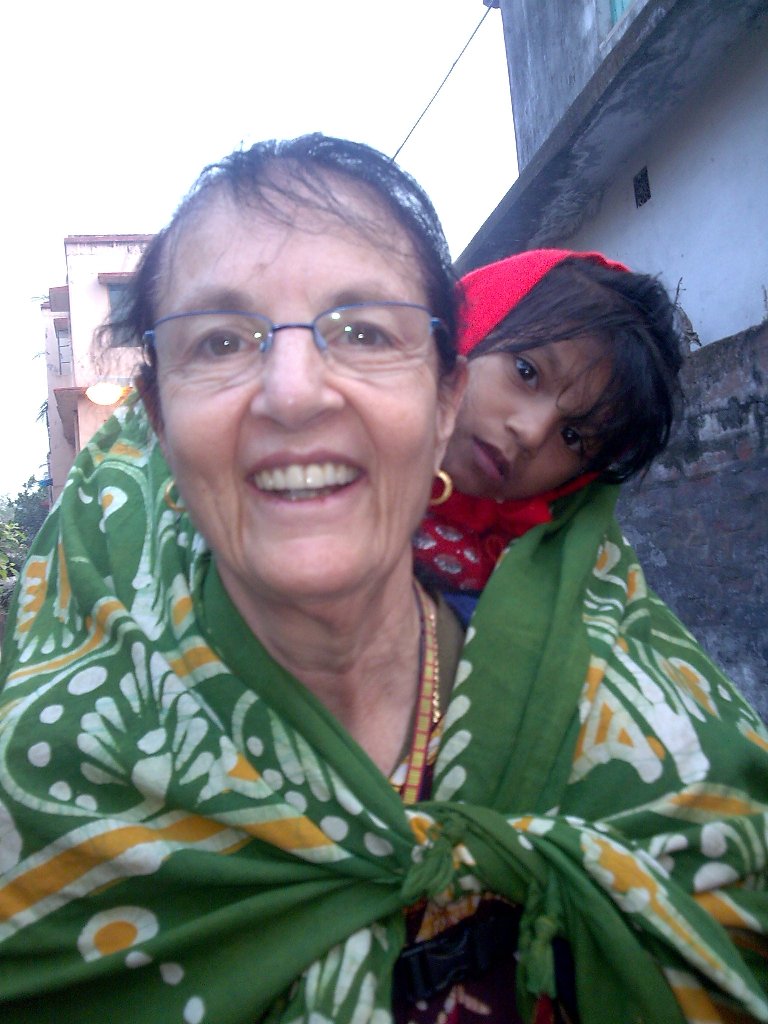
This song came to me this morning as I walked home from taking the girls to school, Ganga on my back.  The song comforts and strengthens me. 

 24-11-08 wal alone 006w

It also has a past for me, real and symbolic.  It's the song with the high notes I couldn't reach and was therefore ridiculed by the teacher and kicked out of the school Glee Club.  I can still hear her booming voice, "WHO IS THAT SINGING IN THE BACK ROW WHO CANNOT REACH THE NOTE?"  Meekly I said, "me" and she sent me from the room. "YOU ARE OUT OF GLEE CLUB!"  As that was some 55 years ago, I can safely assume I will never get over the shame I felt, and the loss, and the self label, "I can't sing."


Most of my life though I have walked alone.


This morning I sang softly to Ganga, and like most little children made no complaint about my voice.  She was just happy to have me back home after four days away.  She has been a brave and strong little one, worried, keeping an eye on my office, waiting for me to walk through the door.  But unlike past times, she didn't run fevers or cry inconsolably.  She waited, for her off-tune, walking-along Mummy to come home.


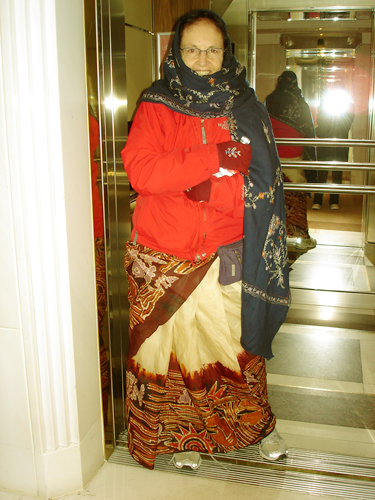
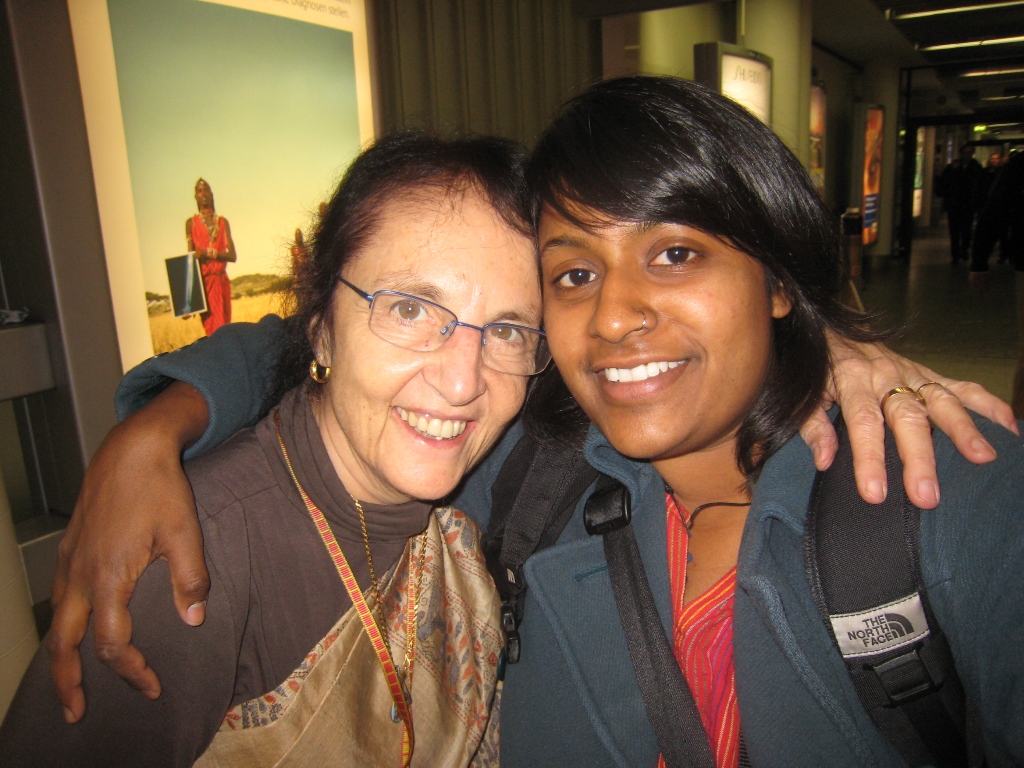
I was in Frankfurt Germany for three days, visiting with Cici, my younger daughter.  She is OK about being talked about on my blog.  We talk and visit through Facebook.  She is never embarrassed by my writing.  She loves to share my work with her friends.  She loves that I am part of their worlds too.  And this is true, that I am.  I believe that her generation is different, better in some way that will be evident in the future.  They are not so cynical.    But she IS embarrassed when I wear a saree in Frankfurt, rather a normal reaction. The first reason is that I gained weight so my western clothes didn't fit.  I never got shopping because of chaos here.   But I guess I just wanted to wear a saree,  one of those things in my head, a kind of adolescent wish to be accepted as I am by my daughter.  She was good spirited about it. I gave her permission to post on Facebook the most embarrassing picture. But the one she put up was small and mild.  Below you will see what/who she had to walk beside as we explored Frankfurt and talked, and talked. 

N101225_35829124_2517[1]


If you look closely at this picture you will also see the untied shoe laces.  She was kind and tolerant, and never told me directly what she felt.  She just told me what her friends back home told her when she reported on my appearance!

Mom01


Wearing a saree in Frankfurt, just wearing a saree leaving Kolkata, was  a much more powerful experience than I had anticipated.  I wasn't just a tourist leaving Kolkata for Germany, but clearly had a base, an attachment, my own internal sense of belonging.  Indians smiled at me.  I smile at Indians but they don't "recognize" me when I am in Western clothes.  I am a stranger.  But with a saree on, with my Nike sneakers (common dress for traveling non-fashion conscious older Bengali women) I really look more "familiar," and so my smile is returned.   In India I have worn a saree exclusively since February 2004.  I started because my daughter didn't know how to wear a saree and neither did her Indian friends raised in the US.  So I wanted to be a mom who could teach her to wear a saree (for the once a year occasion when she wanted to).  I figured the best way to learn was to wear it every day when I was in India.  I really loved wearing it, and it meant a lot to the people I was with, as it means a lot to my children at Shishur Sevay.  In the US I would probably be seen as a pretender or a wannabe — totally politically incorrect, but here in India it is a sign of respect for India, a sign of not separating myself away.


As a white skinned mother of a dark-skinned Indian child, we were rarely taken for mother and daughter.   But now in Frankfurt, in a saree, the assumption was that we were together, mother daughter or aunty, but of the same family/community/world.  For me that was a wonderful feeling.  There is a pride in walking with one's children, and the acknowledgment felt wonderful.  In one store the people assumed she was my daughter.


Frank_3243w


Kolkata has become home.  I have children here, children who called twice a day to ask what I was doing, to talk to their Cici did, to ask when I was coming home, and once to tell me homework had been done, and could they watch TV (yes, of course).  I am torn, with children on both sides of the oceans.


I'd spent months working on coverage for while I was away.  Most of it worked.  Some didn't.  I am alone with the responsibility for my children, which is why I now more often use the first person, "my."  It is as important to the children as it is to me that in my absence they are well cared for.


Thus the song, thus filling my heart with hope, listening for the silver song of the lark, and holding my head up high.

Rejected for Adoption

The girls at Shishur Sevay were all rejected for adoption. Some describe being lined up along a wall and looked at — and not being chosen.   The girls with disabilities didn’t even make it to the line-up, as it true also for the older and darker girls.  In a sense, this is the real definition of an orphan, a child no one wants, a child who is legally free for adoption, but rejected.


Yesterday we had 25 visitors from the US, families with their Indian adopted children, returning to the places of their births and the culture of their heritage.  I always wanted Shishur Sevay to be a place where adoptees could come back and feel at home, and to feel good about what they saw.  My kids here were wonderful hosts, mixing easily with the visitors, helping in any way needed.  There was no tension and no fighting.  We were celebrating birthdays of three of our children, the ones with disabilities and no traces of their past.  I’d made 1 January the birthday for the three and decided to celebrate when our guests were here.  I found out that two of the children also had birthdays and quickly had their names added to the cake.

2Jan09Cake_4416w

The main question asked by our girls yesterday was whether these children were born speaking English.   The girls are very familiar with adoption as some of the girls in the institution with them went for adoption.   I remember in raising Cici that some people would ask, “But how did she learn to speak English?”  The day we went to pick up our last group of children, a girl initially given to us was pulled away, screaming, because she had just been picked by the agency there to go for adoption.   We were told that as she was “fair and smart” she would be adopted, and we learned later she went to a “good, wealthy family.”  

I’m the kind of person who is always wondering what is going on that I don’t see.  When I adopted in 1984 I wondered about the children not adopted. These are the children I wanted to care for in opening this home.  These are the children I have.  My feelings about international adoption are mixed.   The first problem with all adoption is that it occurs within the context of a business, a basic exchange of money for a child.  And because the business is framed as “humanitarian” there is less or no oversight as to what actually goes on.   Further, because of “privacy” concerns, there is no way to authenticate papers.  When I buy a computer I have more information about where it comes from than I do in adopting a child.  For those in the US, remember the scandals of United Way, the pinnacle of ethical donations, created so there would be proper screening and controls — while unfortunately providing a five star jet-set existence for its executives.  I’m not talking about “third world” or “poor” countries.  These problems are endemic.

A few years ago I came across an adoption orphanage where two of the toddlers were tied to their cribs, hands and feet, in cribs too small for them even to stretch out.  Another child was tied to the window pane with a rope to her foot.  The management were not embarrassed.  In fact I took pictures freely.  I have pictures of smiling staff while a child is in the background straining to see what was going on, limited by her tied hands and feet.  When this child was upset she would rock, and I was sure one day she would rock the crib over.  I held them each, promising I would do what I could to get them out of there.  I failed after many different avenues I tried, including taking the pictures to government officials, and also trying to negotiate “under the table.”  I was threatened.  I made sure there were others who would release the pictures if anything happened to me.  When we opened Shishur Sevay I kept a place for two more little ones, just in case I could get them.   I still think about them.

I am aware of the enormous difficulties of children raised in counties not of their birth and heritage.  This is particularly true for dark skinned children raised in a primarily white environment.  I am in touch with adoptees who imagine their lives, their emotional lives, better if they had remained in their country of origin.  These were some of the questions I came here to answer for myself, or at least to understand the picture better.  There is no one answer, no easy answer, for a child born into a situation where the family and community of origin will not keep the child.  It is rarely simply a matter of money.  Among the poorest, children are rarely given up.  It takes an agent who will pay, and a level of disintegration or social status protection of the family, so the child is not absorbed.


So yesterday, over lunch, I had a chance to talk to the girls, ask them what they think about adoption, about the children visiting.  They are already familiar with Indian adoptees because of Cici Didi and others who visit and stay with us.  I asked my question very carefully, first making it clear that no one was leaving for adoption.  I asked, “If you were little, do you wish you would have been adopted?”  I knew from their grins, that the answer was yes.  The lone major dissenter was a girl we home-school but send to school for examinations because she acts so badly in school.  I’ve always believed she just needs to be home, enjoying what she didn’t have before.


In India, as in most places in the world, there is a great demand for  healthy infants.  This is not true for older children or children with significant disabilities of any age.  Adoption of older children can be very difficult.  Children traumatized with violence and abandonment do not “melt” into a family already formed.  Loyalty to their families, alive or not, fantasized or not, will keep them from giving themselves fully to their “new” families.  They do not forget, nor should they.  The past must be built upon, not buried.  It must be a foundation, not a black hole.  Moishe Holtzberg, two year old who lost his parents in the Mumbai attacks will not be expected to forget them.  Someone or someones will parent him and love him as if he were their son, but he will be allowed to honor and love his martyred parents.  It would be strange if he didn’t.  The same is true of adoptees who have known and lost their parents and families.


The adoptees visiting were surprised, and I think disappointed that these girls would not be going for adoption.  It says a lot about their adjustment and happiness, and ability to deal with duality, at least at this time in their lives.


I am often asked about adoption.  I simply could not imagine putting one of my girls on a plane to go to strangers, knowing I probably would NEVER see her, hear from her, be able to be there for her, or even know how she is.  No child should have to be torn in that way.  Most “preparation” is really indoctrination and threats.  The older adopted child is forced to turn to absolute strangers who do not know her language at a time when she is most in need of comfort, reassurance, and information as to what is going on. My girls here love and care for their Gods.  They take their strength from their prayers, pujas, rituals.  What happens when everything is changed, lost, and even your Gods are no longer there?  And there is no one to ask, no one to tell…

Sometimes I think if children must be moved, they should go in groups, and stay in groups, and have contact with “home” and be able to visit “home.”  The natural questions for the Indian adoptee raised in the US, “Am I American or am I Indian?” would still be there but there would be context as to what “being Indian” means as well as what “being American” means.


I came to India with hope that there would one day be many Shishur Sevays, and maybe there will be, because this is a very good way for the unchosen to grow up in their country and culture of heritage.  Love, the ability to love, the fortune to be loved, are essential in our lives if we are to have any peace or satisfaction.  We cannot order it up, nor even predict where it will be found.  We are a family here, a funny family — we each play our parts (me- several at once) — and any child we might lose would create a great gap and give us great pain.  As I write I hear the girls upstairs in classical song class.  Today we visited the home of one of our massis to see her new grandson.  This is how I imagined it, a weaving together of connections, of people we know, of people we become attached to and who become attached to us.  We have love here.  That’s a lot.

An Ordinary Miracle

The following is the introduction, statement of the Founder for the Annual Report 2007-2008, now overdue of course!


From Mother and Founder,

Childlife Preserve Shishur Sevay


An Ordinary Miracle


Once upon a time there was an old little house on a tiny piece of land in Panchabatatala, where New Alipore meets Behala in Kolkata, West Bengal, India,

South Asia

, Planet Earth, The Milky Way Galaxy, in the Universe.   Then a miracle happened, and it became home to 12 orphan girls, twelve girls suffering from various forms of social deprivation, nutritional deprivation, emotional deprivation, educational deprivation, and four of whom suffer severe physical disabilities. 


The miracle is that this house is now one of laughter and joy, and big dreams for the future.  This required enormous determination and plain stubbornness.  It required a deep and unshakable belief that children and flowers bloom when they are fed, protected, and loved.


The ordinary is that we are meeting the most ordinary needs of children, shelter, food, health care, immunizations, clean water and clean toilets.  Education is intensive, not unlike that of Indian families in most places.  The children have school, then tuition, then cultural programs, dance, song, art..  Their needs are pretty simple, but they lack the parental and familial advocates to insure they have these necessities.  And the society does not make meeting their needs a priority. 


Many forces combined for me to become mother to these children; a sense of destiny, the voices of the children calling to me, my Kolkata born daughter – and an awareness of hungry and abandoned children from the earliest times I can remember.  My grandmother, herself an immigrant to

America

, used to take me to the ocean, point out over the water and tell me never to forget the hungry children across the world.  In Kolkata I feel close to her spirit and her strength.


In this second Annual Report 2007-2008, we will write of Shishur Sevay in the context of Indian and international shared values and commitments to children.  We will show that what we give to our children is no different from what the international community including India agree are the rights of children; put simply, what they should have.  That’s all we are really doing, giving them what they should have, what we all know they need, but still do not give.


I look at the blossoming of our handicapped children, so far beyond our expectations.  They are each centers of love, giving and receiving unconditionally.  They are the heart of our home.  For the big girls, they are like the siblings they lost.  We all celebrate each advancement, standing alone, rolling over, drawing a picture, beating a drum to rhythm, trying to talk, and always glowing when they are held.  Our handicapped children have also started school.  Each morning, dressed in their proper uniforms they go off to their teachers, their education, their bit of normality of what should be the life of a child.  They have a life!  In fact their lives are full, with teachers, aunties, didis, and a lot of mother’s love.


I am a dreamer and the dream grows.  But this dream must grow slowly, and it must grow from its foundation.  A tree grows by feeding its roots, not by pulling at its branches.  We are growing our saplings in the best soil we can create, with warmth, sun, food.  We provide structure for when our children are set off balance by unhealed wounds and inner winds. We treasure the blooms.


Childlife Preserve: Shishur Sevay got its name from my stay at Kaziranga Wildlife Preserve in

Assam

.  Kaziranga is home to the Indian One-Horned rhinoceros, wild elephants, and the domesticated elephants who take visitors for journeys through the tall grasses.  In the evening when the domestic elephants came to be bathed in the creek and fed, I played football with an elephant calf as he learned to be comfortable with people.


Later I found myself thinking about that place often, and wondering, “Why can’t there be a place like that for children, a Preserve, where they are not prey?”  Thus the name, Childlife Preserve.  And then because my life is a fusion of American and Bengali, there had to be a Bengali name so our home would be understood for what it is.  Shishur Sevay, in the interest/service of children.


In a world globally and locally full of violence and abuse, Shishur Sevay is an oasis, a place of growth, of healing, of love.


Dr. Michelle Harrison

Previous Older Entries Next Newer Entries

August 2026
S M T W T F S
 1
2345678
9101112131415
16171819202122
23242526272829
3031