Ganga Speaks With Her Eyes!

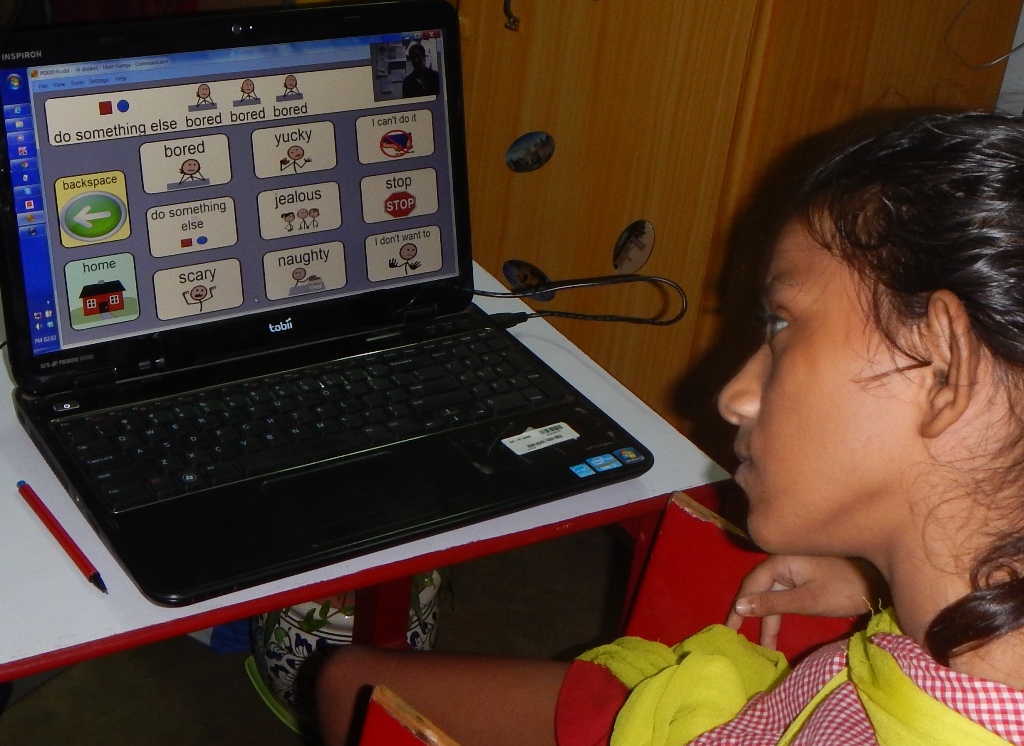
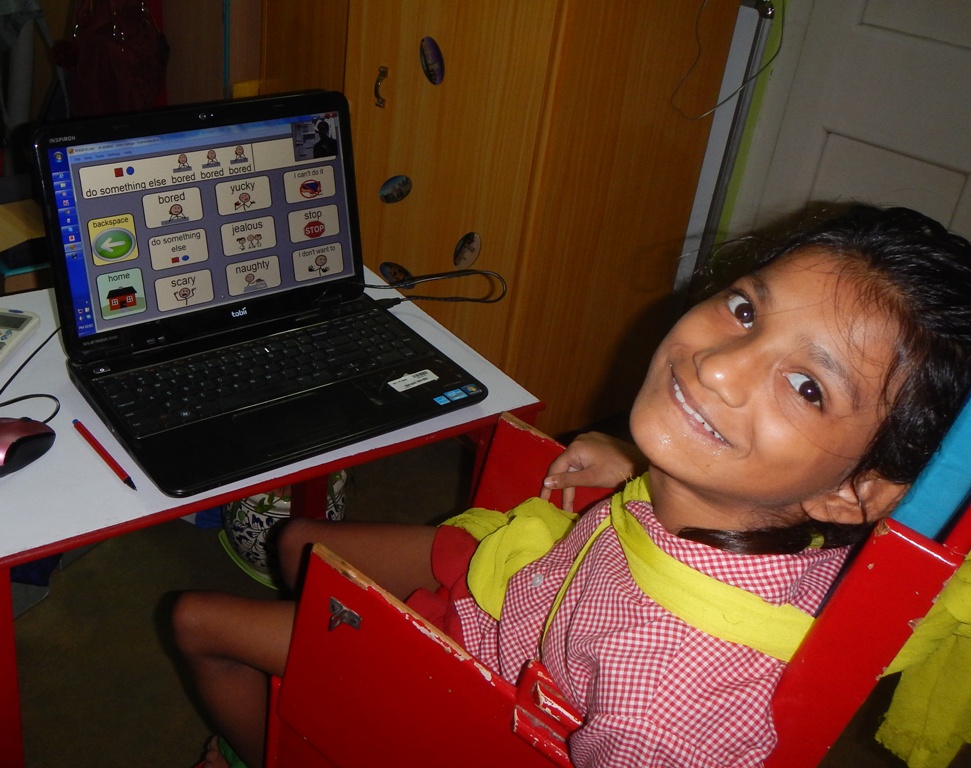
Ganga with her Tobii eye tracker

Ganga with her Tobii eye tracker

Ganga’s eyes focus on the screen, then on the boxes, and when she holds her gaze long enough, the words are said via digital voice.  This is her first day working with the materials prepared for her.  But given her dry humor and tendency for being naughty (or cheeky as our Australian friends say) this could well be what she intended to tell us. “Do something else, bored, bored, bored,” became her first words.

Buying the Tobii was a leap of faith.  I’ve had my eye on this type of technology for her.  She has worked with switches, head pointers, and specialized keyboards, but always hampered by her severe motor limitations. The eye tracker offered the ability to operate  windows  in addition to the specialized communication software.  She could eventually learn to surf the web, without ever having to use her hands or fingers.  This version of eye tracking, originally used for gaming was said to be less sensitive to head motion.   Buying without any chance to try it felt reckless.  But I kept coming back to Ganga’s current and future needs to break out of the isolation of her disabilities.  Among all our girls, she is the one who tries the hardest, loves to study the most,  cares about geography, history, and news, and understands humor and sarcasm.  I placed the order with the company in Mumbai that sells the product made in Sweden.  Apparently we were their first customers for the Tobii PCEye.

Soon after we purchased the Tobii but before it arrived, we had an amazing group of volunteers from Equal Health in Australia, all connected with early childhood education and disabilities who came to help and guide us for a week.  Their leader Kristy Tomlinson contacted her friend Amy Litton of Independent Living Center in Nedlands.  Amy Litton is a TRAINER in the use of the Tobii as well as other assistive devices.  She and her team enthusiastically offered to help Ganga.  Below is a Skype screen shot of speech pathologist Amy Litton and occupational therapist Jessica Rigden learning about Ganga.
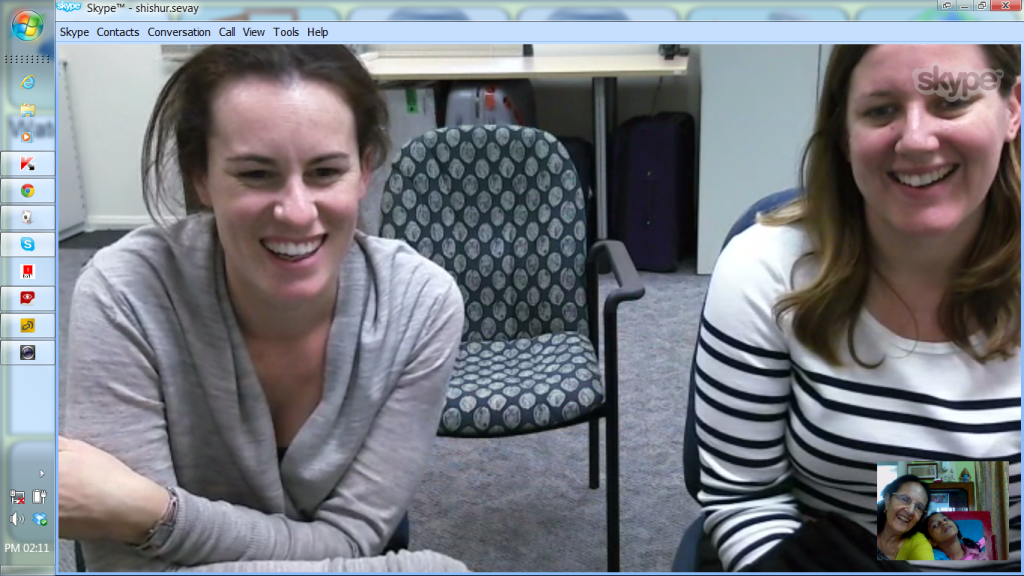
Amy Litton and Beth on Skype talking to Ganga and me about the Tobii

Amy Litton and Jessica Rigden on Skype helping Ganga with Tobii

This is a clearer picture of the Tobii PCEye Tracker, the little black device at the bottom of the screen.  The red dots are where the infared lights connect with her eyes in order to operate the laptop.

the eye tracker on the laptop at the bottom of the screen

the eye tracker on the laptop at the bottom of the screen

This is one of the personalized pages Amy and her team prepared for Ganga.
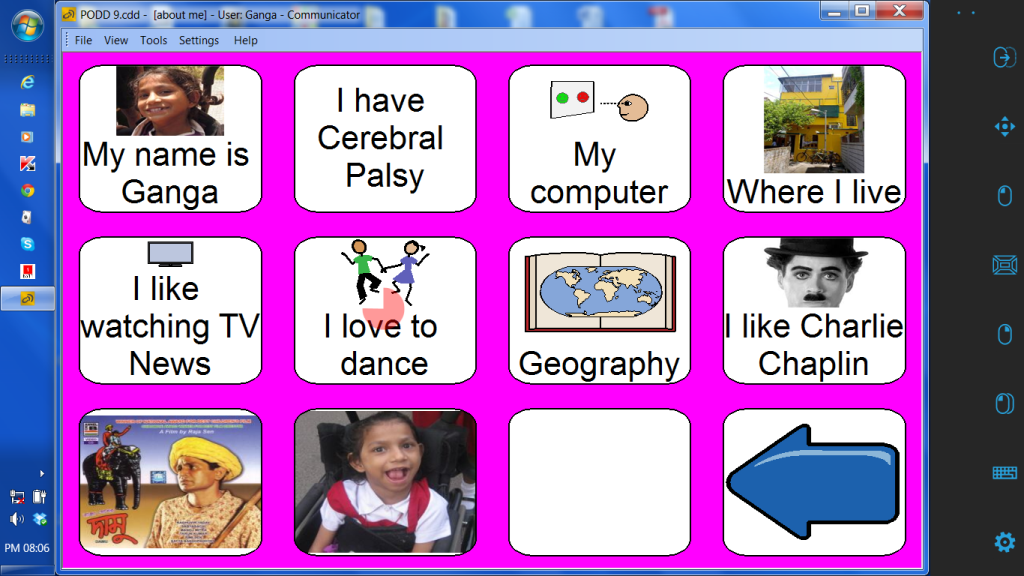
The partially complete red circle in the

The partially complete red circle in the “I love to dance” box shows that this is where Ganga’s focus is. In the picture below you will see the circle complete and the voice synthesizer will have said, “I love to dance.”
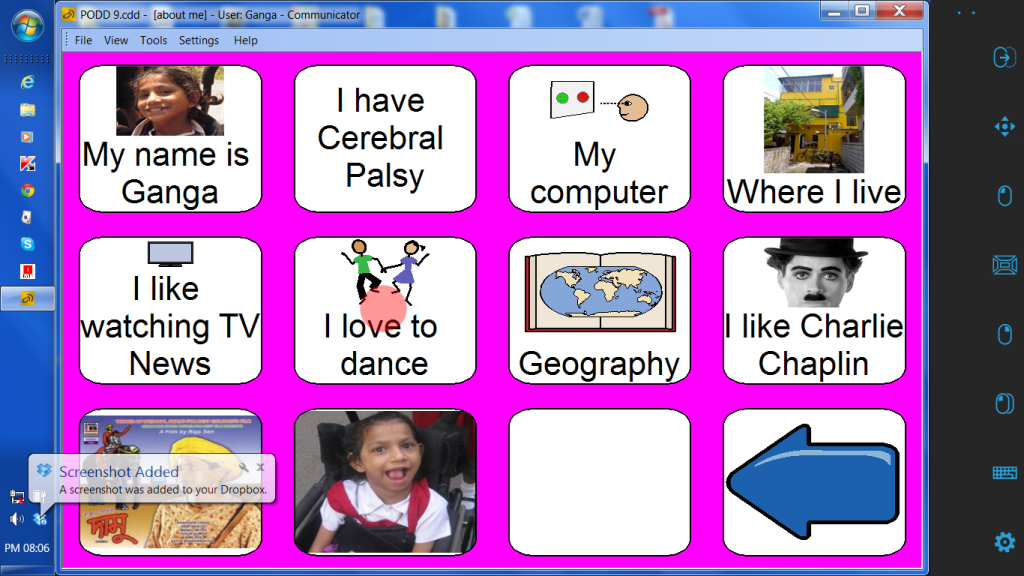
The red circle (incomplete) in the

When the circle is complete, namely when she had held her gaze long enough, the sound will play.

In both the above pictures there is a side bar on the right, representing eye tracker control of mouse functions.  Between substituting mouse functions and using the screen keyboard, the usual Microsoft and internet work can be accomplished.

A keyboard can be called up at any time and operated by eye tracking.  Ganga has already typed GAN and is focusing on the G. The red circle fills as she holds her gaze.
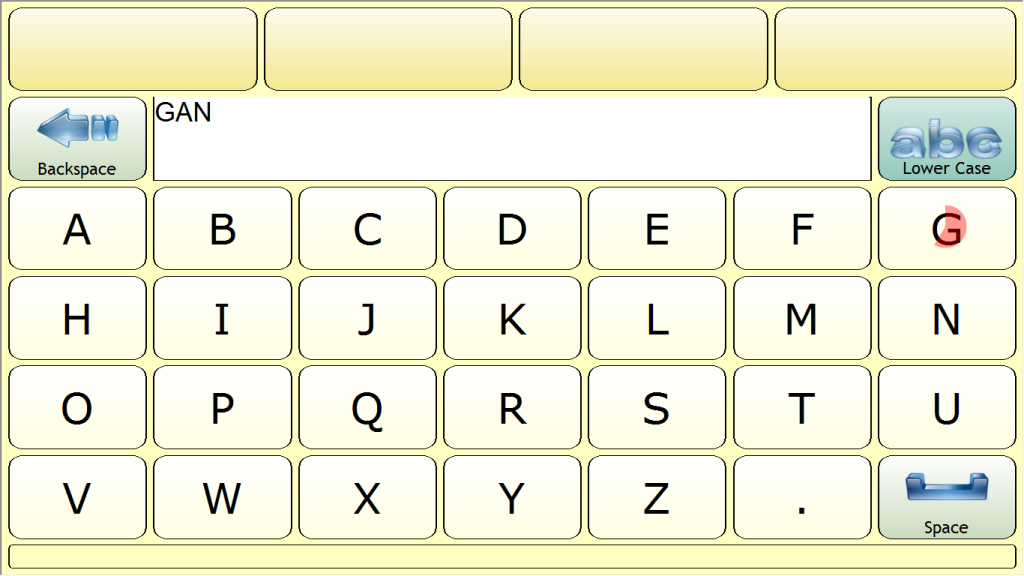
Ganga has already typed GAN and is focusing on the G.  The red circle fills as she holds her gaze.

Now Ganga has already typed GANG and is focusing on the A. The red circle fills as she holds her gaze.
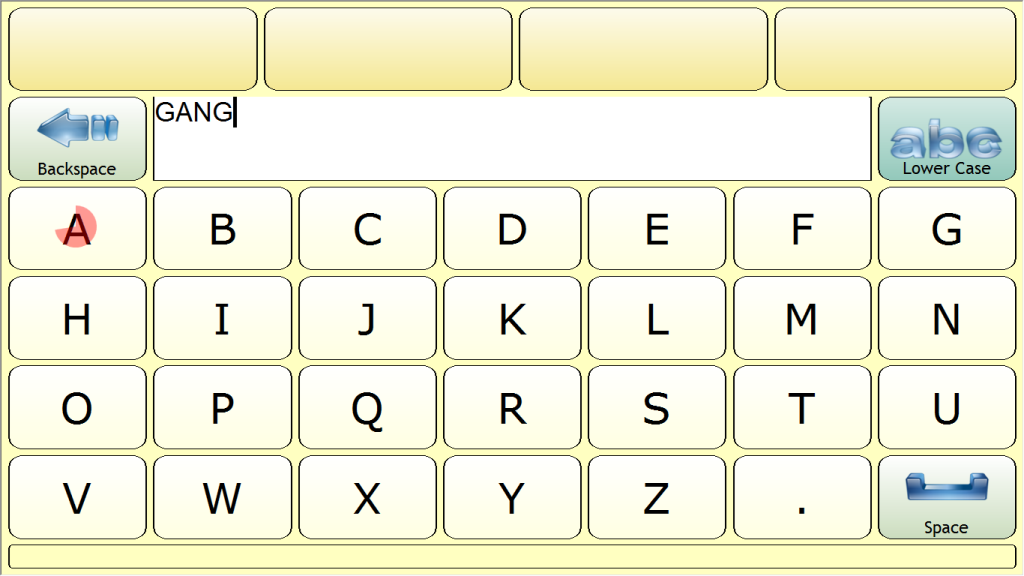
With GANG already written, she adds A.

Ganga's eyes do speak.  Here she is saying that she has done well and deserves a photograph.

Ganga’s eyes do speak. She is telling us that she has done well and now she deserves a photograph.

Good work Ganga.  So many of us are waiting to hear what you are thinking, what you dream about, what you want us to know about yourself, and some day to read the book you want to write. 
Seven Years Together at Shishur Sevay

A few nights ago I dreamed I was trying to put our records together and that required that I establish records on the moon first, which I did, and then replicated here at Shishur Sevay. I kept asking, “How can I explain to people that I had to get this done on the moon first?” I’m working on a blog post about the past seven years here. Maybe that’s the answer as to why the dream.  I’m feeling a lot of pressure, trying to write about what it’s been like, and probably holding back a lot on what it’s really been like. I’ve been to the moon and back…. that’s what was required.  It was cold and lonely and void of vegetation.

Shishur Sevay today is thriving.  It’s glowing.  It’s what I’d dreamed it would be. So here is the blog I was working on before I went to sleep, before I understood I’d been to the moon and back.  The process of building Shishur Sevay has been brutal, but the product is beautiful.

Seven Years Together

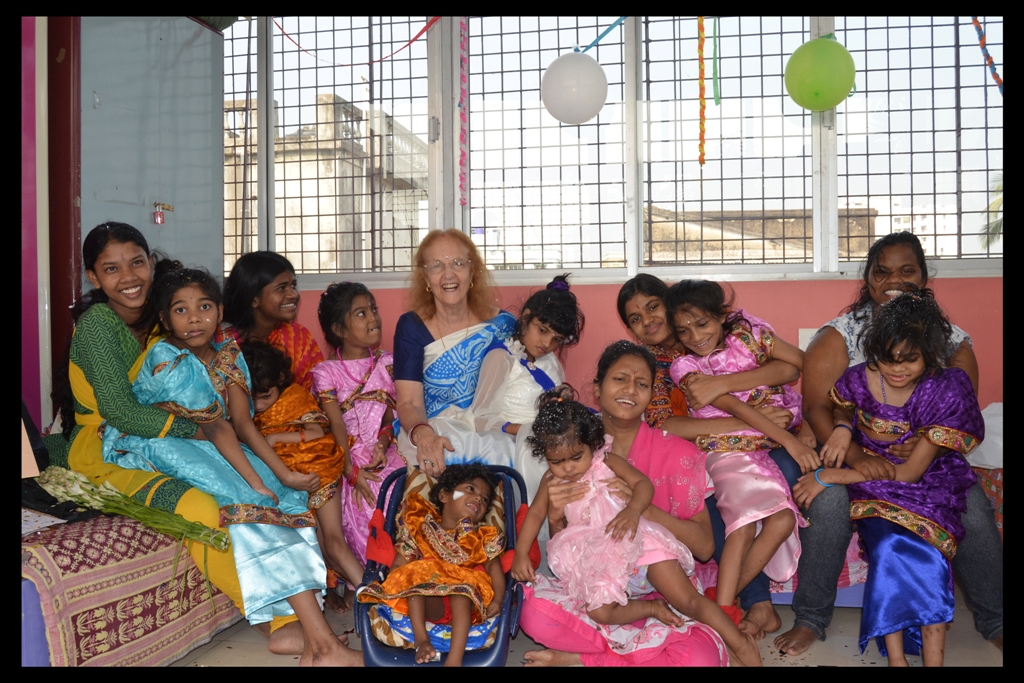
A picture of all the girls of Shishur Sevay and Dr. Harrison on her birthday

My Girls of Shishur Sevay and Me

The first twelve girls came to Shishur Sevay in February 2007, so for me this time of year is always one of reflection.  They came with an array of abilities, disabilities, and medical conditions.  All came with scars, emotional and physical.   They all were socially and educationally deprived, and had led lives filled with violence and deprivation.  Then at some point, each had lost everyone and everything: parents, siblings, extended family, and community, and eventually were placed in a government institution.  These are the children I’d sought, the ones considered not adoptable in India or abroad. They had been rejected by adoption representatives before they were sent to me for “rehabilitation” by Order of the Child Welfare Committee.   With adolescence, three of the girls became too unmanageable, with behaviors that put us all at risk. My decision to return them to government care was very difficult, and taken after many attempts over the years at various treatments and therapies, but necessary if Shishur Sevay was to be the safe place it is.  I had not expected ever to have to do that.

This year we started an inclusive school, Ichche Dana Learning Center because educating the girls in outside schools “did not work.”  The girls are beginning to put their efforts back into learning.  There were several factors interfering.  One was their early deprivation that left them far behind their classmates, while they were also older than their classmates.   Science is now giving us information on the effects of this early deprivation.

http://ecceportal.in/index.php/news2/136-more-talking-longer-sentences-help-babies-brains

At school the girls were seen as “different” because of their origins, and they felt different. Teachers lowered expectations; some gave them false high grades because they “felt sorry” for them.  Others ignored them, or queried them about their origins and caste. The Indian system of rote memory left them too frightened to learn anything but the paragraphs they had to memorize and give back, an impossible task when you don’t have the foundations of language, any language.   Ideas of self-discipline, hard mental work, and delayed gratification were as foreign to them as I was..  If work was hard it scared them.   They lived in fear.  It was time to bring them back and start anew, which is what we are doing and so far it is working very well.

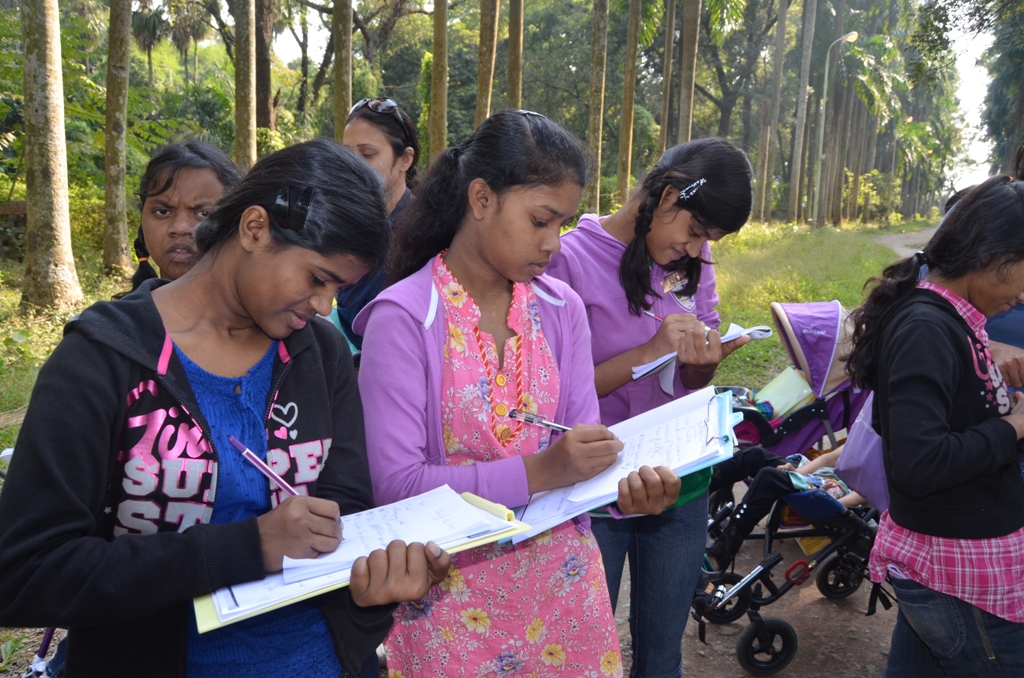
Girls taking notes at the botanical gardens.

Taking notes at the Botanical Gardens

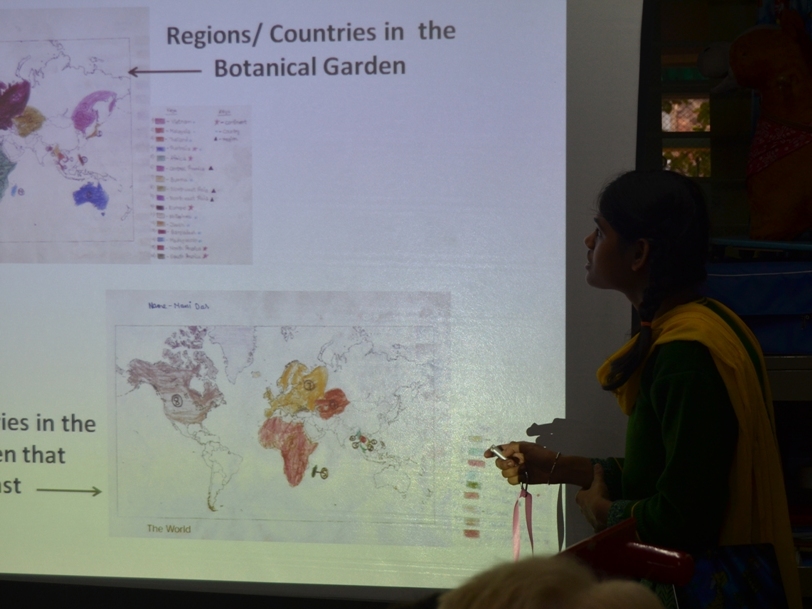
doing a presentation of trees of botanical gardens

Presentation about the trees of Botanical Gardens

The girls did a presentation of their work to volunteers from Equal Health,a team of Australian educators who were with us  in January.

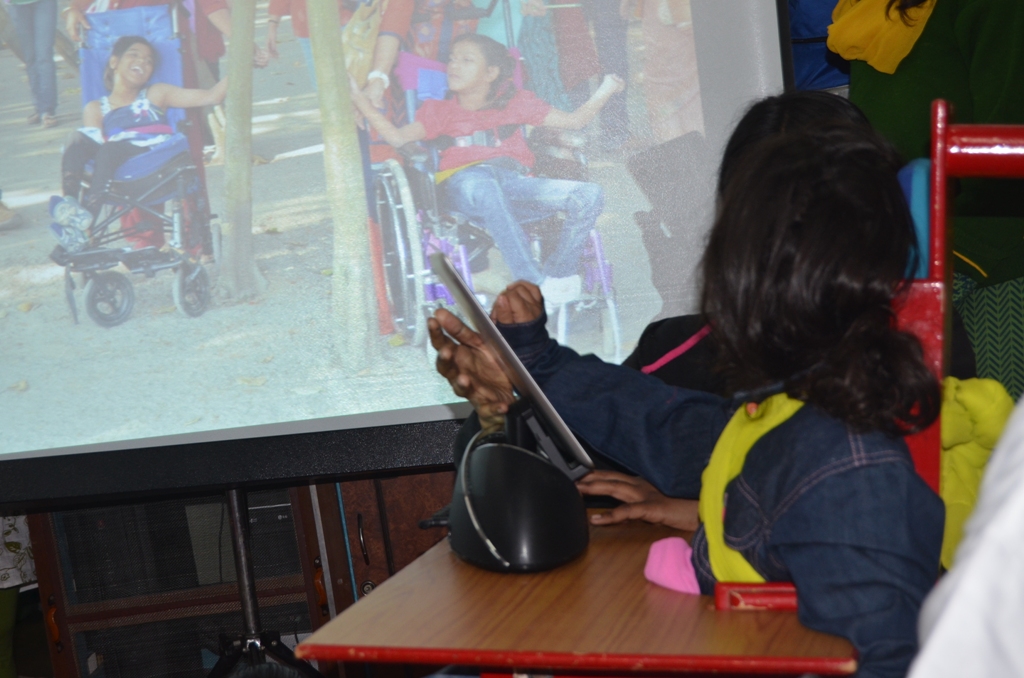
Ganga Presenting

Ganga Presenting

Ganga and Bornali both presented by use of the iPad and the recorded script.

This is inclusion.  Everyone is able to learn something and to contribute.  Some of the coursework has to separated by level of understanding and skills in reading and comprehension, but the ideas and subjects and methods of presentation can be done by all.  And our children with the most severe disabilities, even if they can’t join in, they still make wonderful and appreciative listeners.  Everyone has a role.

Our eventual plan is for the girls who are able, to enroll in the National Institute of  Open Schooling which will allow them to sit for Class 10 and 12 examinations. We will send to college those who are able.  We will look at job training for others.  Some of our older girls may need to stay with us.  I’ve promised marriage to those who want.  We talk about dowry because it’s integral to the world they live in.

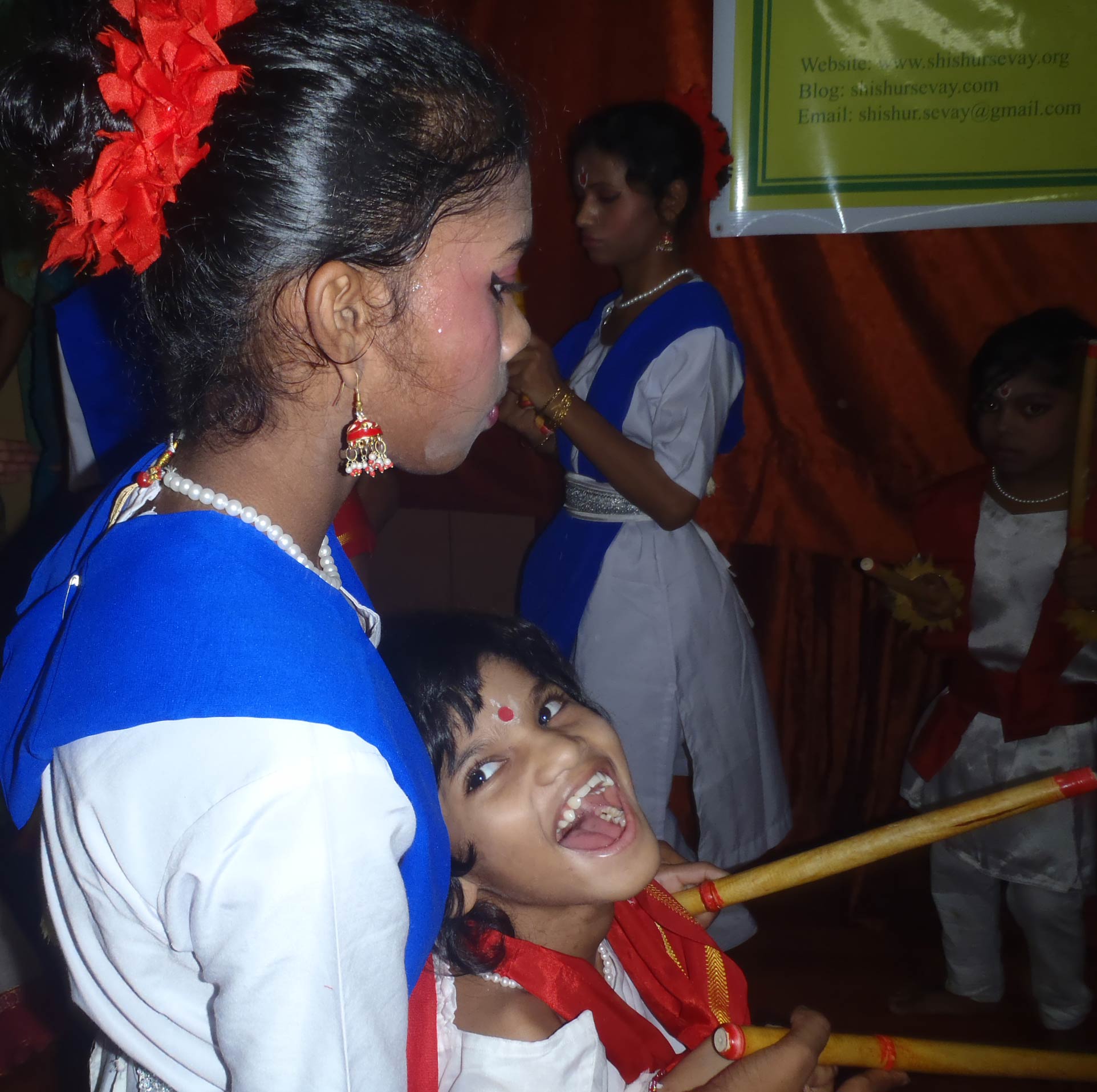
This year though, I find myself thinking a lot about our girls with the most profound disabilities and looking at the therapies and methods that have and have not “worked.”  The children thrive on attention, especially one on one!  If I were in the US, I’d be thinking about finding teenagers to just play with them, floor play, songs, things I’m familiar with.  I haven’t found that here.  My experience (and I add the caveat that I can only speak for my involvement with families since 2000) is that teenagers do not “babysit” or work outside their families.   Play happens sometimes as “therapy” by professional therapists, but that means it’s a very limited and expensive resource. As for cognitive tasks, my little ones would rather be dancing.

She'd Rather be Dancing

She’d Rather be Dancing

One day I will tell the story of what it took to get here, but Shishur Sevay is a wonderful place now and that’s how the journey must be seen.

HEARTS

Tuni will need to have her heart repaired.  She has a congenital heart condition, a variation of a Tetrology of Fallot.  Every medical student learns about it, almost like a rite of passage.  In those days there was only palliative care, surgical procedures to extend life.  Now there is surgery to FIX it!  In time Tuni will have this surgery.  The doctors here prefer to wait until the children are a year old when the survival rate is higher.  If she develops symptoms, like cyanosis, or her development doesn’t progress, then we will have to do it sooner.  For now we just feed her up, keep her happy, and watch.

We have been scouring the few papers that came with her.  I was trying to find out why she was originally admitted to the hospital last April.  I would like to know her weight at the time, and what symptoms presented.  But in looking into the papers, the story we had been told didn’t seem to make sense.  If she was brought in by her family then why was she “unknown baby” from the beginning?  She would have been admitted under a name.  Then we found in the police papers that THEY had been the ones to try to contact the family, including by email.  Or, maybe those are just the standard words used for a baby found somewhere.  I saw this in adoption papers all the time, words about an unmarried young woman abandoning her child… The words were exactly the same in each file.  But for the adoptee the words were specific and personal. Those words became part of their narratives.

If you read my last post, and comments on fb, we tend to create narratives, weaving together a few facts with many speculations.  Was the family poor?  Did they know she had Down’s?  Were they all agreed or was the mother mourning? In fact, we have no idea whatsoever. Maybe we will find out one day.

Earlier this evening I was talking to Tuni, tickling her, making funny faces… She is so responsive, so happy for smiles.  Anyway, I told her I thought she must have a really interesting book to write — about her life… about being here and there, about hospitals, and police, and she just giggled and giggled as if she understood every word.

My heart runneth over.

Image

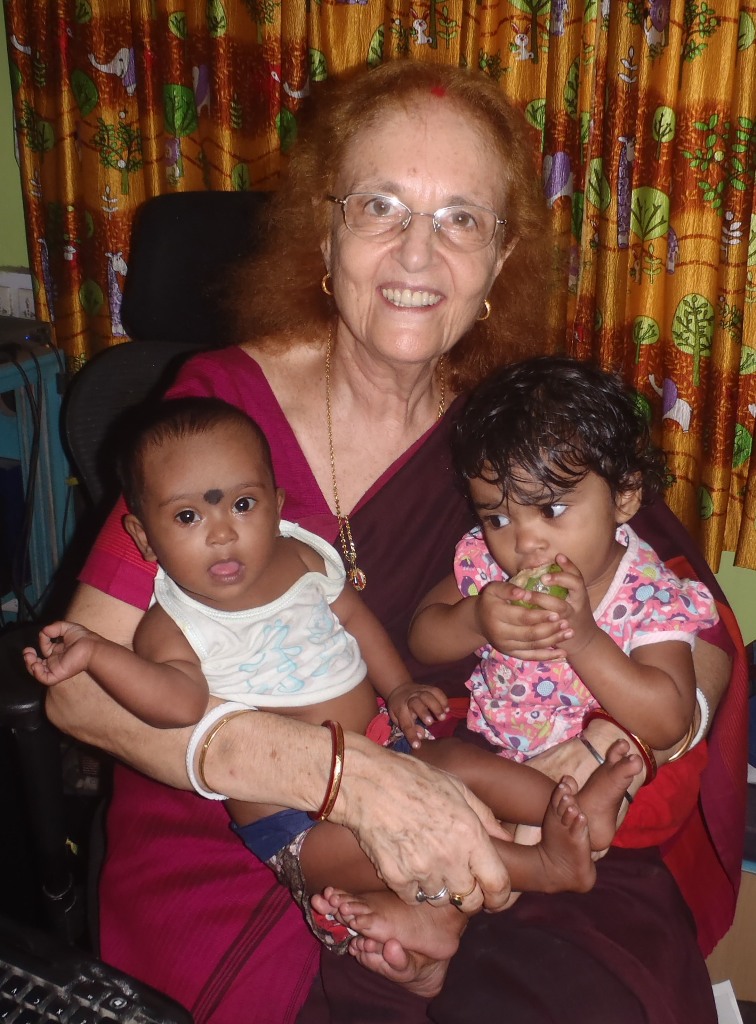
Tuni, Archi, and Me

One Baby’s Heart and So Many Questions!

Talking it over with Seema Aunty

Talking it over with Seema Aunty

Tuni is her name, but I added “Harrison” as I do for the kids with disabilities who have no surnames.  Having a chart read, “Baby Tuni” is not as good as “Tuni Harrison.”

Tuni is about seven months and has Down Syndrome.  At about three months of age she was hospitalized in a government hospital about four hours from Kolkata.  I don’t have records of why she was hospitalized, but we were told her family never came back for her and never responded to calls from the hospital.  That district has no facilities for children with disabilities, and was one of the children the Child Welfare Committee pleaded with me to take.  We picked her up last week, on Friday, the 19th of July.  I knew in taking a child with Down there was a possibility she would have other medical problems including heart disease.

Today I took her to Medica Superspecialty Center to see the pediatrician for a check-up and to start whatever investigations were in order.  Tuni was a charmer.  Yes, she has heart disease.  She was seen by the pediatric cardiologist, the same one who saw Ganga in the past.  He did a brief echocardiogram, enough to see that she has a “complicated heart situation.”  Tomorrow I take Tuni back for  a more thorough testing under sedation.  And then we will talk… as the doctor put it.

So much goes through my mind. Is it fixable?  What will it cost?  How will we manage it all?   I dare to even think, should we do it?  And then I get mad at myself for even asking.  I think about her family.  Maybe this is why they abandoned her.  Maybe they couldn’t afford treatment.  Maybe a mother is mourning. Or, maybe it was just the Down Syndrome… but they did put her in the hospital.  I hold no judgments any more.  This is a harsh place with harsh realities.  You don’t take a child to a government hospital unless you have no other alternatives.

This work has changed me too.  I now more easily see the person separate from the illness.  When I hold her and talk to her, I ask her, “What happened to you, Little One?”

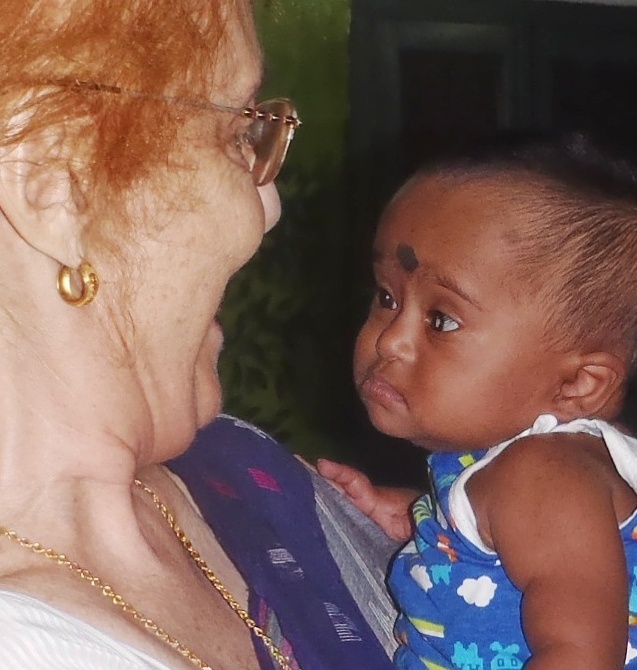
Looking worried... with reason.

Looking worried… with reason.

Good night from Kolkata at 12:50 am.  I need to get some sleep before the day begins.  Lots on my mind….

Previous Older Entries Next Newer Entries

August 2026
S M T W T F S
 1
2345678
9101112131415
16171819202122
23242526272829
3031