Shishur Sevay Welcoming Scrutiny

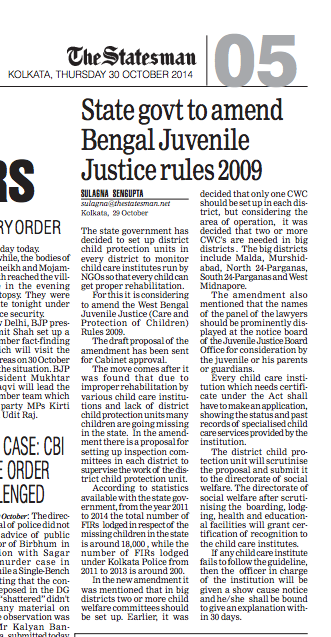
Screen Shot 2014-10-30 at 10.45.08 am

I read this story this morning.  It’s good that the government wants to improve services and accountability of NGO services to children.  So I welcome this, and I also dread this.  What will be the reality of how this will happen?  Ultimately, will we be certified as “good enough?”  What will be the criteria.  We are a model and we intend to influence government care of orphans and other children in need, including the disabled.  We want to document and report, and be transparent in how this process occurs, if it actually does proceed.   This is the first I have heard about it.  I will report when we hear anything along the way.  I will be open about the questions that are asked of us, and our replies.

Even at present, our records are open.  Is our documentation perfect?  Of course not.  We will improve what we can.  But our children are receiving good health care; good nutrition; education; rehabilitation; respect; discipline.  Our official website http://www.shishursevay.org continues to update all of these and our important documents are being loaded into the site.  Here are the worries I have as we enter into a revised process of licensing:

  • We are under constant pressure to take more children.  I have refused on the basis that we cannot take more without lowering the level of care we give.  We cannot become a warehouse.  We won’t.
  • We do not receive funds from the government.  Such a contract would require us to take more children.  For those NGOs that receive funds, they often arrive 1-2 YEARS late, and cover only a bare fraction of the real costs.  Proper care for children with disabilities is expensive because it is labor intensive.   Otherwise they don’t survive.
  • Inclusion may be a problem in the new licensing.  We have been told more than once that we cannot have “normals’ with “handicapped.”  The rationale from the government was that the “handicapped” are dangerous to the “normals.”  This was told to us at the same time I had established a ZERO TOLERANCE of violence because children with disabilities can easily be silently abused and we had dealt with such a situation here.  So maybe this will be an opportunity for educating and influencing the government about disability and inclusion.

Well, it’s a new adventure, which may or may not happen.  It’s a great idea, more scrutiny, and I really do welcome it.  When people walk through the entrance here, I see their faces change.  It’s not what they expected.  The kids are all around.  Kids and teachers and office staff… all “underfoot.”  My office is always a bit of a mess because if anyone doesn’t know where to put something, it ends up in my office.  It’s also the reception area.  It is shared space.  All doors in the house have windows. Privacy can be dangerous to children and to the helpless and voiceless.

I like “common space”  When I was a kid I used to spend hours drawing house plans.  I studied magazines that in those days had construction plans for homes.  My designs were always the same….. a common space in the middle.  So I guess that makes Shishur Sevay the house of my dreams.  I was a strange kid.  I’m still a bit on the strange side.

Seven Years Together at Shishur Sevay

A few nights ago I dreamed I was trying to put our records together and that required that I establish records on the moon first, which I did, and then replicated here at Shishur Sevay. I kept asking, “How can I explain to people that I had to get this done on the moon first?” I’m working on a blog post about the past seven years here. Maybe that’s the answer as to why the dream.  I’m feeling a lot of pressure, trying to write about what it’s been like, and probably holding back a lot on what it’s really been like. I’ve been to the moon and back…. that’s what was required.  It was cold and lonely and void of vegetation.

Shishur Sevay today is thriving.  It’s glowing.  It’s what I’d dreamed it would be. So here is the blog I was working on before I went to sleep, before I understood I’d been to the moon and back.  The process of building Shishur Sevay has been brutal, but the product is beautiful.

Seven Years Together

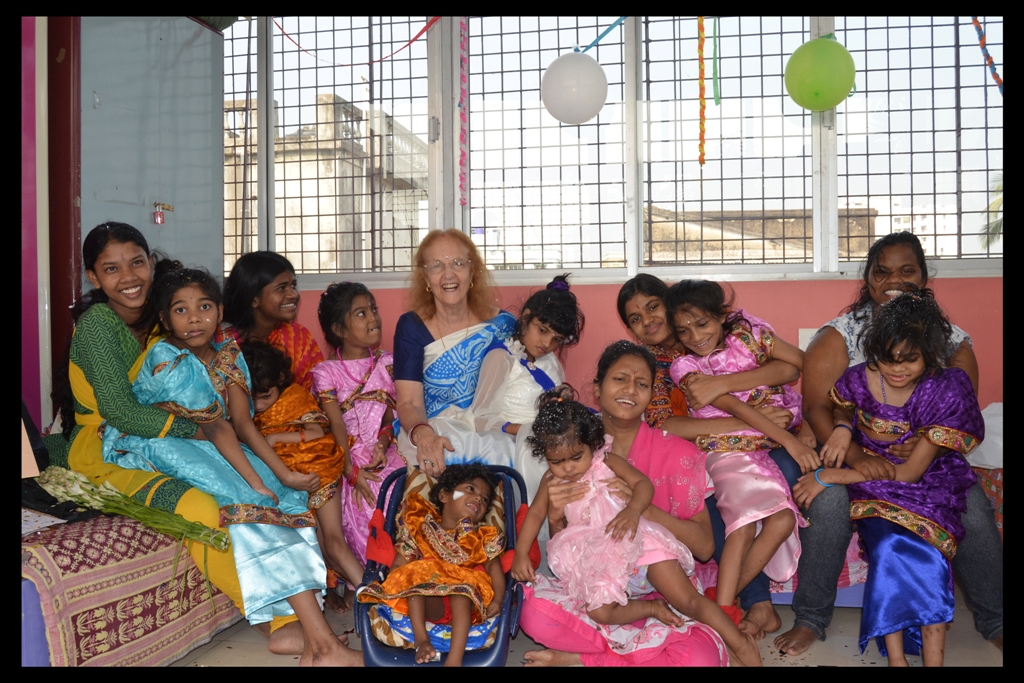
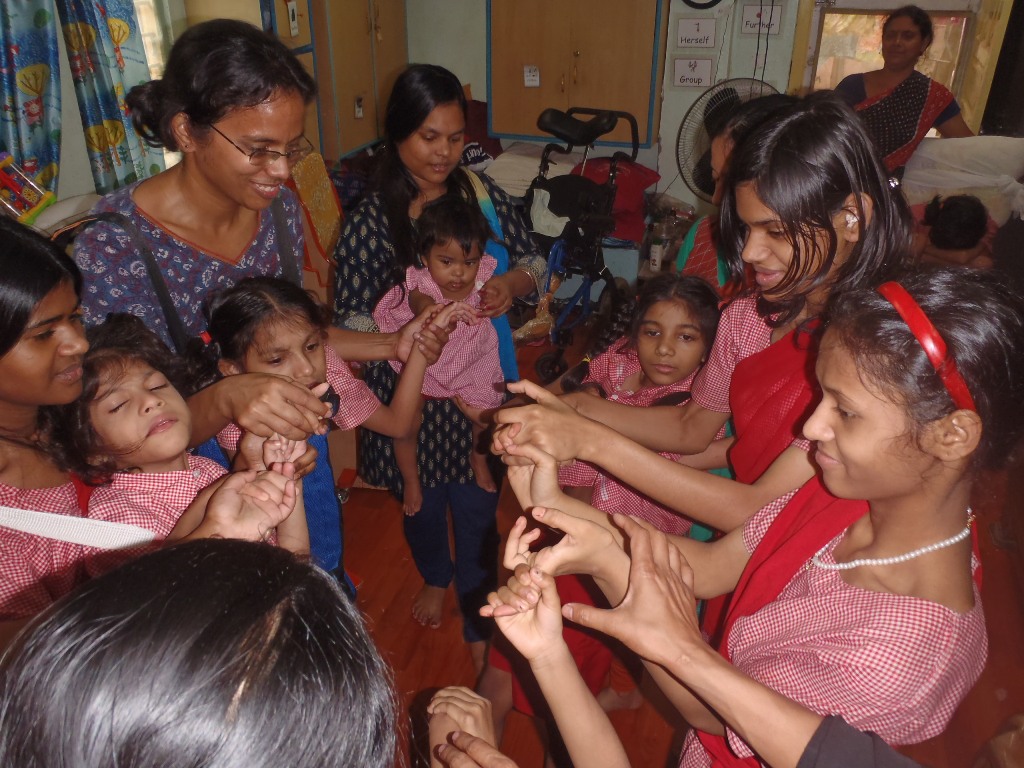
A picture of all the girls of Shishur Sevay and Dr. Harrison on her birthday

My Girls of Shishur Sevay and Me

The first twelve girls came to Shishur Sevay in February 2007, so for me this time of year is always one of reflection.  They came with an array of abilities, disabilities, and medical conditions.  All came with scars, emotional and physical.   They all were socially and educationally deprived, and had led lives filled with violence and deprivation.  Then at some point, each had lost everyone and everything: parents, siblings, extended family, and community, and eventually were placed in a government institution.  These are the children I’d sought, the ones considered not adoptable in India or abroad. They had been rejected by adoption representatives before they were sent to me for “rehabilitation” by Order of the Child Welfare Committee.   With adolescence, three of the girls became too unmanageable, with behaviors that put us all at risk. My decision to return them to government care was very difficult, and taken after many attempts over the years at various treatments and therapies, but necessary if Shishur Sevay was to be the safe place it is.  I had not expected ever to have to do that.

This year we started an inclusive school, Ichche Dana Learning Center because educating the girls in outside schools “did not work.”  The girls are beginning to put their efforts back into learning.  There were several factors interfering.  One was their early deprivation that left them far behind their classmates, while they were also older than their classmates.   Science is now giving us information on the effects of this early deprivation.

http://ecceportal.in/index.php/news2/136-more-talking-longer-sentences-help-babies-brains

At school the girls were seen as “different” because of their origins, and they felt different. Teachers lowered expectations; some gave them false high grades because they “felt sorry” for them.  Others ignored them, or queried them about their origins and caste. The Indian system of rote memory left them too frightened to learn anything but the paragraphs they had to memorize and give back, an impossible task when you don’t have the foundations of language, any language.   Ideas of self-discipline, hard mental work, and delayed gratification were as foreign to them as I was..  If work was hard it scared them.   They lived in fear.  It was time to bring them back and start anew, which is what we are doing and so far it is working very well.

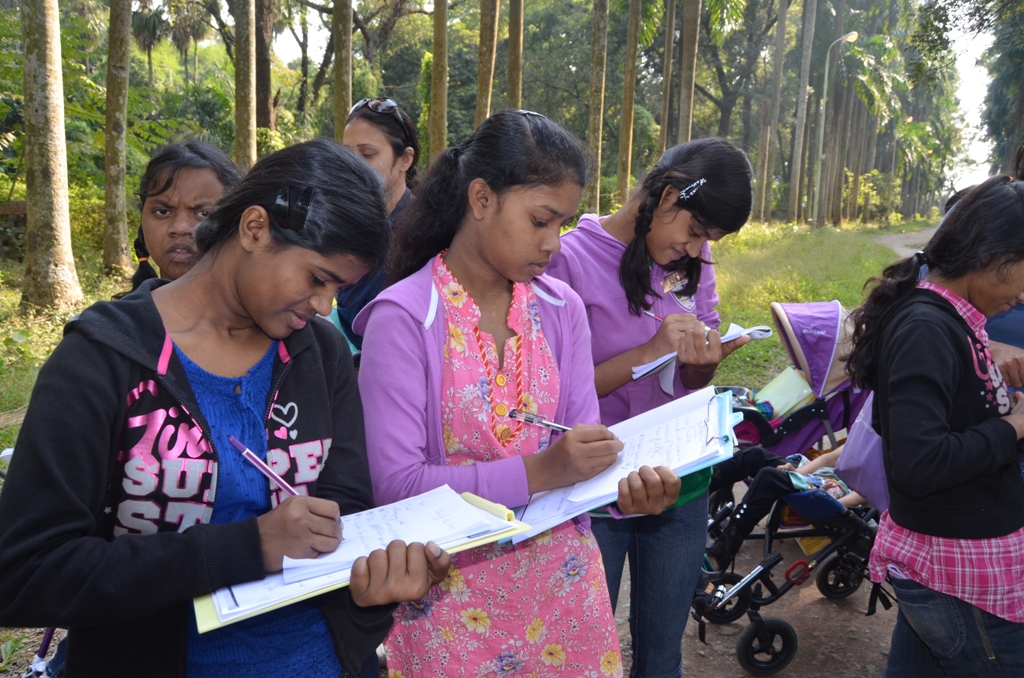
Girls taking notes at the botanical gardens.

Taking notes at the Botanical Gardens

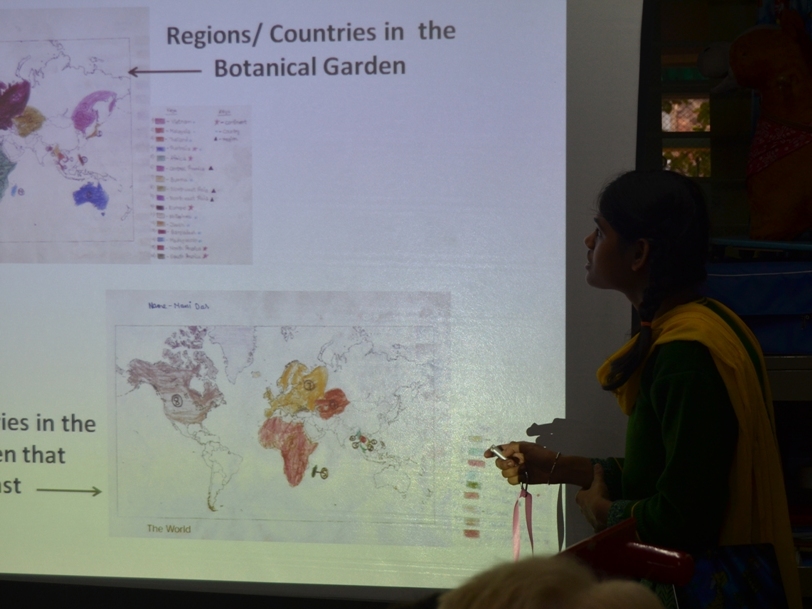
doing a presentation of trees of botanical gardens

Presentation about the trees of Botanical Gardens

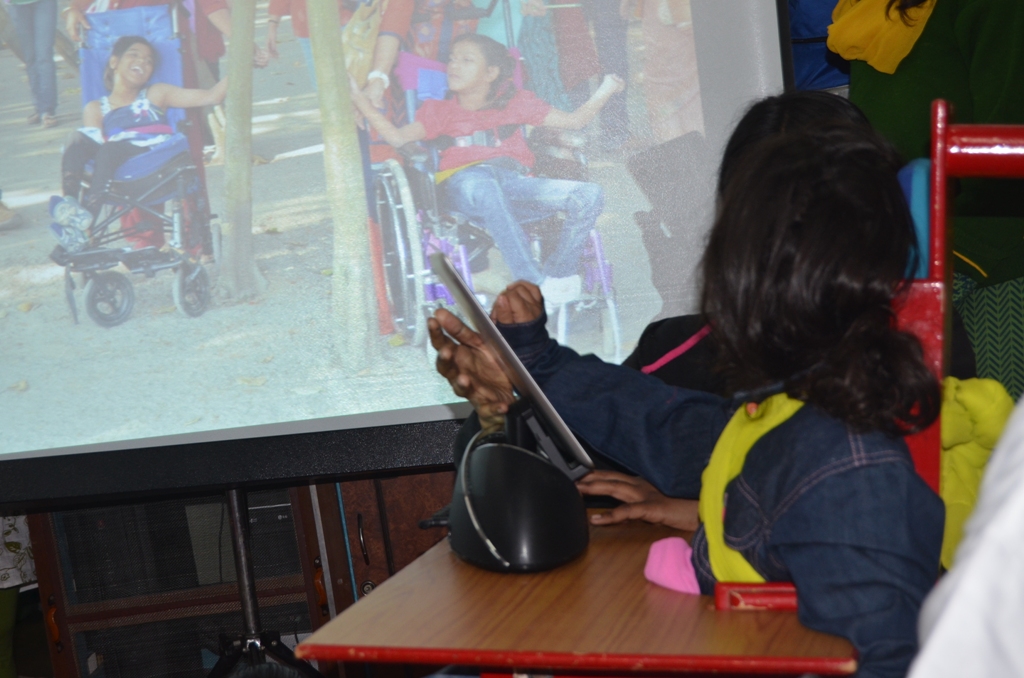
The girls did a presentation of their work to volunteers from Equal Health,a team of Australian educators who were with us  in January.

Ganga Presenting

Ganga Presenting

Ganga and Bornali both presented by use of the iPad and the recorded script.

This is inclusion.  Everyone is able to learn something and to contribute.  Some of the coursework has to separated by level of understanding and skills in reading and comprehension, but the ideas and subjects and methods of presentation can be done by all.  And our children with the most severe disabilities, even if they can’t join in, they still make wonderful and appreciative listeners.  Everyone has a role.

Our eventual plan is for the girls who are able, to enroll in the National Institute of  Open Schooling which will allow them to sit for Class 10 and 12 examinations. We will send to college those who are able.  We will look at job training for others.  Some of our older girls may need to stay with us.  I’ve promised marriage to those who want.  We talk about dowry because it’s integral to the world they live in.

This year though, I find myself thinking a lot about our girls with the most profound disabilities and looking at the therapies and methods that have and have not “worked.”  The children thrive on attention, especially one on one!  If I were in the US, I’d be thinking about finding teenagers to just play with them, floor play, songs, things I’m familiar with.  I haven’t found that here.  My experience (and I add the caveat that I can only speak for my involvement with families since 2000) is that teenagers do not “babysit” or work outside their families.   Play happens sometimes as “therapy” by professional therapists, but that means it’s a very limited and expensive resource. As for cognitive tasks, my little ones would rather be dancing.

She'd Rather be Dancing

She’d Rather be Dancing

One day I will tell the story of what it took to get here, but Shishur Sevay is a wonderful place now and that’s how the journey must be seen.

Theater: Laughter at the Expense of Those With Disabilities

We attended a drama, Anubhav, by Ramaprasad Banik, being put on by the Theater Group of Nehru Children’s Museum at the Academy of Fine Arts.  It was presented as a play about the emotional sensitivity of children, and it took place in a school for boys.    I took the five big girls, Kalpana,and Ganga (in her chair).  Seema Gupta, on our Board met us there.  She had friends whose children were in the play, an she had gotten the tickets for us.  She had also clarified in advance that we had one child in a wheelchair, and it was agreed the chair would be next to us in the aisle.

We were on the early side and went right in.  We found our seats in the second row, up to the aisle, but the aisle was so narrow, the chair totally blocked the aisle.  So I moved forward temporarily to the front row and put the chair in front of me, leaving a very wide area for people to pass.

“Madam, you must move.  This (the child in the chair) is blocking the way.”

Me: “Well there is still a lot of room for people to pass, but there is no room in the aisle for anyone to get past.  I have a seat just behind me, with the others.”  He looked back and figured out  we were a group.  I added, ‘We arranged all this in advance.”

“Madam, you can move her to the back of the auditorium so she does not block the aisle.”

“You mean where she can’t see as much?  That wouldn’t be nice to treat her that way just because she is in a wheelchair!”    Iwas being as sweet, dumb sounding, and immovable as I could.

“Oh yes, well then move her over to the end of the row, by the exit.”

“Oh my, but then she can’t see the full stage.”

All this happened over about ten minutes, with different men coming to replace the ones who had been unsuccessful in moving us.  Seema Gupta was wonderful in trying to help negotiate, knowing I wasn’t moving, and as upset as I was. I talked to Ganga as this was going on.  I asked if she was OK, and I said we were doing this so people would have better places for people who needed wheelchairs.  She smiled, grinned, and seemed to get it.  I asked again if she was OK, and she grinned.

A compromise was reached, wherein Ganga would be in the front with me before the play and when it started I would move back into the second row seat on the aisle and she would be in the aisle next to me.  All I could think of was the fire hazard of this arrangement now that we WERE blocking the aisle.

The play was in Bengali but I’d heard that it was about emotional sensitivity, and there was an orphan in it… and I could follow some of what was going on.  There was slapstick… I kept noticing that.  Early there was slapstick about a boy who couldn’t speak.  He would open his mouth and words wouldn’t come out.  The others would yell at him to talk.  His mother hit him over the head.  The whole place burst into laughter, including Ganga.  But then Ganga couldn’t stop laughing, couldn’t get herself under control.  Because it was fastest way, I picked her up out of the chair and left through the exit.  I sat with her in the lobby, just soothing her.  She calmed down.  She was upset.  We just sat, her head against my chest.

The theater group director happened to come by and said hello.  He had no idea what had gone on.  He was proud of the production, and said it was good our children were here “because it’s about these things.”  He talked with pride about his school, and the boys… (he then quickly added girls) who were in it.  But the play was a boy’s play.  There were NO good parts for girls.  They either were girls who giggled, or mothers of the boys.

I tried once to carry her back in but she started uncontrolled spasms of laughter as I opened the door.  But during intermission we did go back in.  I carried her in and sat with her on my lap, which is where she wanted to be.  Usually she would rather be with the big girls.  She didn’t laugh.  She was somber.   In the final scene the boy who can’t talk was being goaded by another boy.  Just another happy ending.

I just kept thinking how glad I was that Sudip wasn’t there, my Secretary with CP, who lives it all.

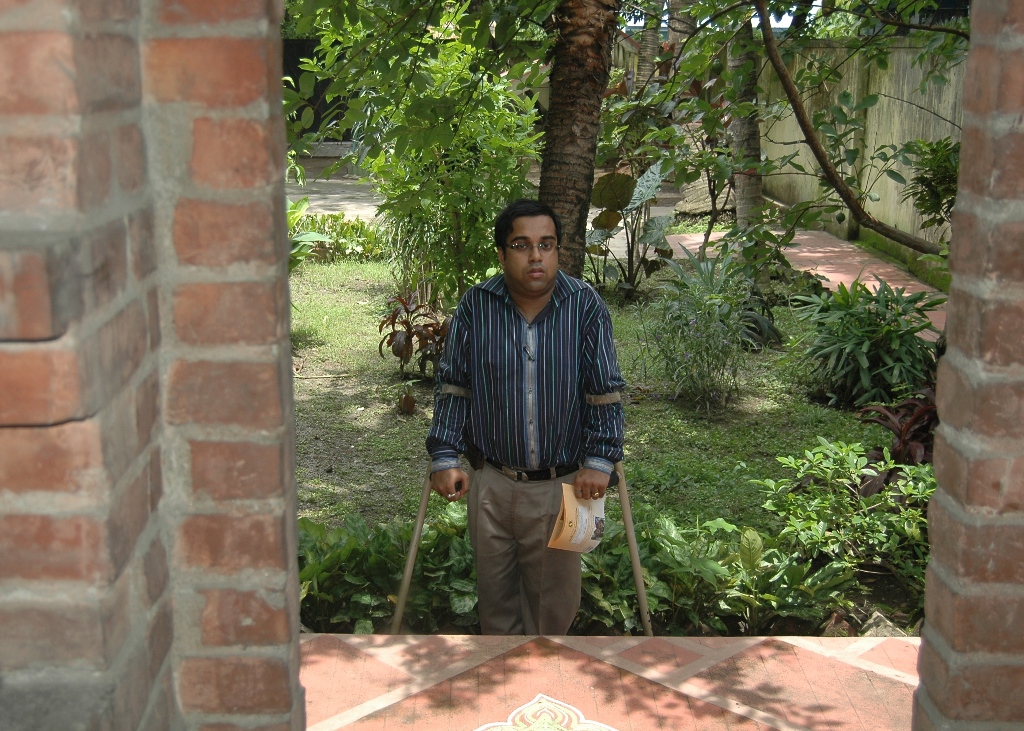
A few days ago we visited an NGO, which is part of an international group that serves the poor and those with disabilities.  Sudip had visited them seven years before as part of his activism with Ankur in Disability Awareness and they remembered him fondly.  We visited all their buildings and grounds and then they took us to the meditation room, a beautiful architecturally designed brick structure, but inaccessible to those with disabilities.  This had not changed in the seven years since Sudip had been there before.  I asked what they did with people in wheelchairs, whether they just carried them in.  “No, they sit outside the building.”

From inside this beautiful meditation room, I took a picture of Sudipendu Dutta standing outside.

Sudipendu Dutta on crutches standing outside inaccessible meditation building

Sudipendu Dutta Outside the Ashram’s Inaccessible Meditation Room

I’m White

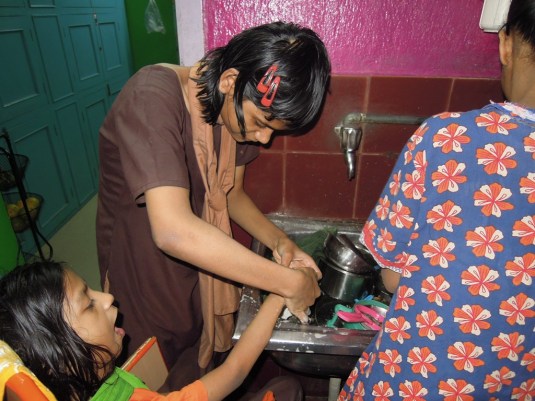
Child Labor Law Violation 1

Child Labor Law Violation

I had a bad time at CWC today.  I didn’t go alone, but it didn’t matter.  No one was listening to anything I said, and they were rude and angry if I did try to defend myself.   One of the consequences of my tough decisions in the last couple of months is that not everyone was happy, of course.  For matters of privacy I will be brief, but will say that adolescents, and I believe particularly adolescent girls can be very destructive, and very charmingly convincing that they have been wronged.  In fact this girl has been so wronged CWC now wants to see if the other girls are likewise being exploited in violation of Child Labor laws.

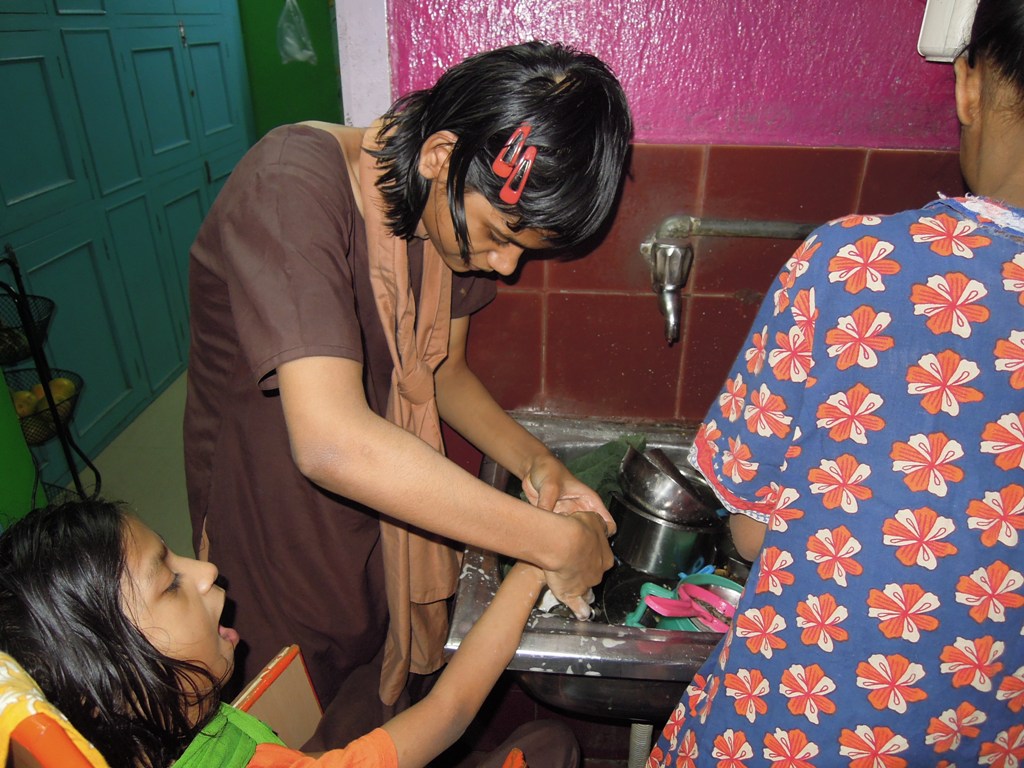
It sounds silly but I remember as a kid cleaning the house with my mother, playing music, talking…. taking care of our home.  I was told today though that in India this is not done, that girls/women don’t clean their own homes.  But what about my girls?  Should I assume they will all be affluent enough to hire servants to cook and clean?  You think those are the families they will marry into?  I think I somehow really challenged a cultural norm.  I think these people at CWC are enraged that the girls clean.  Maybe it’s my being a white American and some image of my exploiting them?  I tried to tell the CWC that I clean the bathroom, which is true, but they weren’t listening to anything I had to say.  I clean the bathroom for several reasons.  First, no one else wants to do it.  Second, in my mind, cleaning is honorable work.  Third, the girls have come to really appreciate a clean bathroom.  They take care of the other bathrooms. That’s not a bad thing.  And of course the hippocracy of all this is that in India it’s the middle class who most uses child servants in their homes.

They seemed enraged that a girl was expected to change the diaper of a child with disabilities.  I’m thinking this is all an April Fools joke and they are dead serious.  So the issue of diapers let to a sudden reaction that I had “normal and handicapped” in the same home and that had to end!  I said that CWC had given me these girls, but that wasn’t relevant either.  It was really ugly, and I expressed my feelings about it, which is to say I was not submissive.  I finally got one person who was lecturing me that this was a court, to understand this court had jurisdiction over the child but not over me.  They simply do not have the authority to force me to take a violent girl back into the home, however much she sheds tears.  Their plan was for me to take her back but not give her work to do.  Yeah, right!

I am not dealing with a rational system here.  I heard it described as judicial anarchy, and I think this is true.  There are no real rules.   Our home has been inspected seven times, with the same kids, same mix of “normals and handicapped” as they continued to describe them.  There has never been a problem.

Would this all be playing out differently if I were Indian?  I’m thinking yes.    It’s been the divide until recently even within the home.     Are they seeing me as the White lady using Indian girls to clean her house?    If this is the stereotype can they  even see beyond who I represent?  This is personal.  I have visited NGO’s where they show off the weaving being done by five year olds (vocational training), and no one says anything.  I reported a home almost ten years ago where girls were being used as servants instead of being sent to school.  I had proof, documents, school records, attendance records, but I could not get anything changed.

This is the CWC where I brought the eight starving children from Aunty’s, where three children there have died since then, but no one will do anything.  The last time I was there, I was standing outside and Aunty told me to move because the feces was coming down over the balcony and she didn’t want me to get dirty.  Government inspectors came but they ignored everything.  I was there.  They ignored me.

Now it’s 2:30 am and I can’t sleep.  I tried.  I’m also in the middle of major dental work, as things seemed a bit quiet and I took the time.  Well, I guess from the tension this evening, the temporary bridges and crowns cracked and my mouth hurts.  I’m afraid to leave Shishur Sevay until this “surprise” CWC inspection happens this week so I’m not sure what to do, except drink a lot of liquids only, and keep my mouth closed… not so easy…

We told the girls what was going on because they will be interviewed, and because we will be sprucing up our paperwork, which needed doing anyway.  So a friend told me to have them prepped and all I could think of were the custody cases in the US where the first question is always, “Did your mother/father tell you to say this?”  Nope, they will say what they want and I will deal with it, whatever it is.

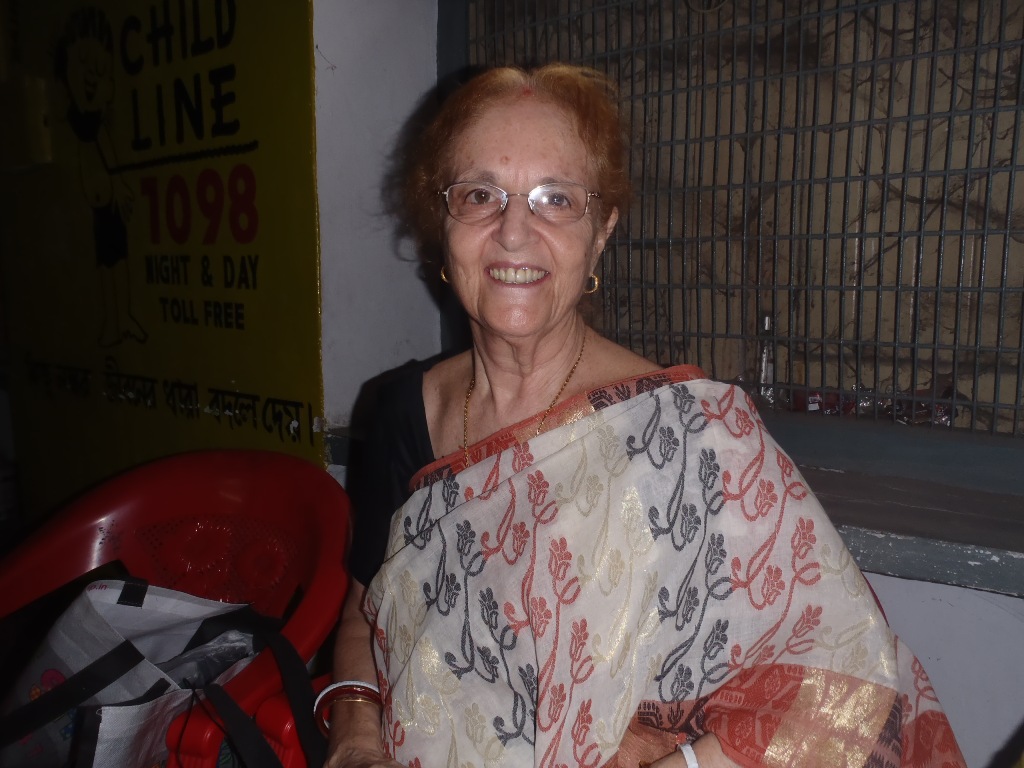
I know we will survive this — but I’m scared.  I’m also pissed.  I’m a seventy year old doctor, psychiatrist, and obstetrician and gynecologist.  I have 45 years of clinical experience working with woman and children.  Actually I wrote that in my report today but they ignored it.  Even when Seema Gupta translated it into Bengali they ignored it.  They are out for blood, my blood, this White woman’s blood.
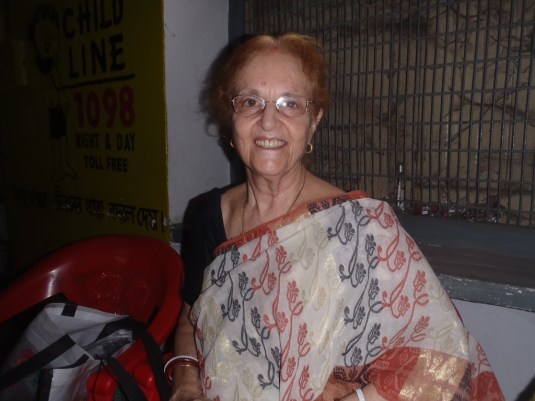
The Seventy Year Old Doctor

The Seventy Year Old Doctor

Here is my testimony:
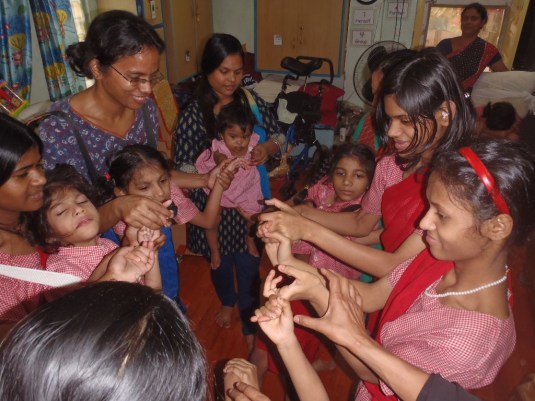
Dance and Movement, Inclusive as it should be

Dance and Movement, Inclusive as it should be

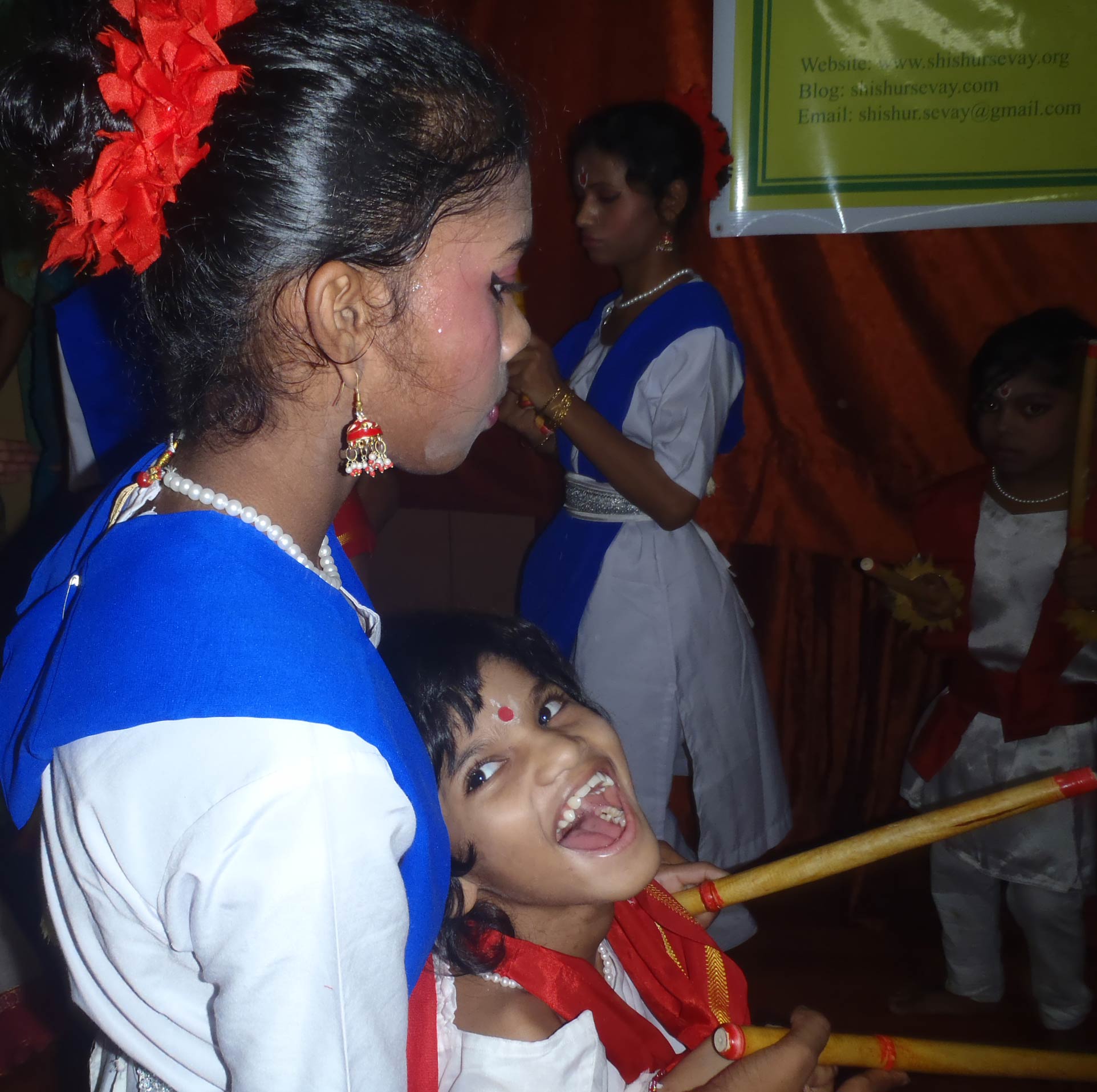
This is a picture from our new Dance and Movement classes three times a week.  On the days between classes the girls like to put on the music and practice.  Six years ago I promised Ganga she would dance one day, and now she does.

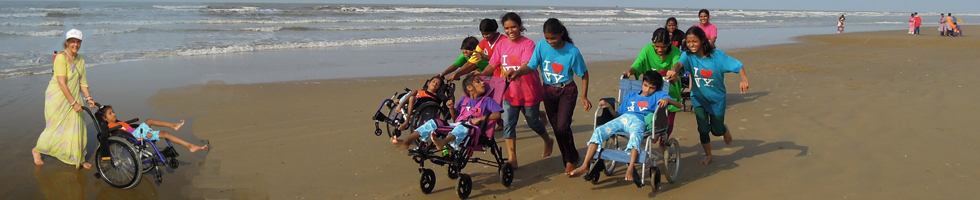
We live as a family.  We eat together, sleep together, watch tv together, pray together.  We don’t separate by abilities because we all have so much to give each other.

OOPS!  Another picture of all of us together.  no separate  beaches.

OOPS! Another picture of all of us together. no separate beaches.

The group who came with me today was

1.Seema Gupta, Board Member, Joint Secretary, and Deputy Registrar of Calcutta High Court.

2. Purba Rudra, Ph.D, our Academic Director

3. Sudipendu Dutta, my secretary.  (I hired him as assistant, but in India, Secretary is higher, so now he is my Secretary).  Sudip is an incredibly hard worker, sincere, responsible, and cares so much about what we are doing.  He also has Cerebral Palsy and walks with sticks.  He manages.  I kept wondering what it was like for him, listening to all this about not having “handicapped and normals” together.   What did this mean for his life, his family life, his work life…. Was it OK that we were all together or should there be separate accommodations for him?   He is also an activist working with others on creating a residence for people with disabilities…. and has been talking about the success of inclusion, Shishur Sevay as a model of how good it can be.  What was he thinking?  I’ll have to ask him in the morning.

Now it’s 3:30 am and I think I’m ready to post this and try to sleep for a couple of hours.

Previous Older Entries Next Newer Entries

August 2026
S M T W T F S
 1
2345678
9101112131415
16171819202122
23242526272829
3031