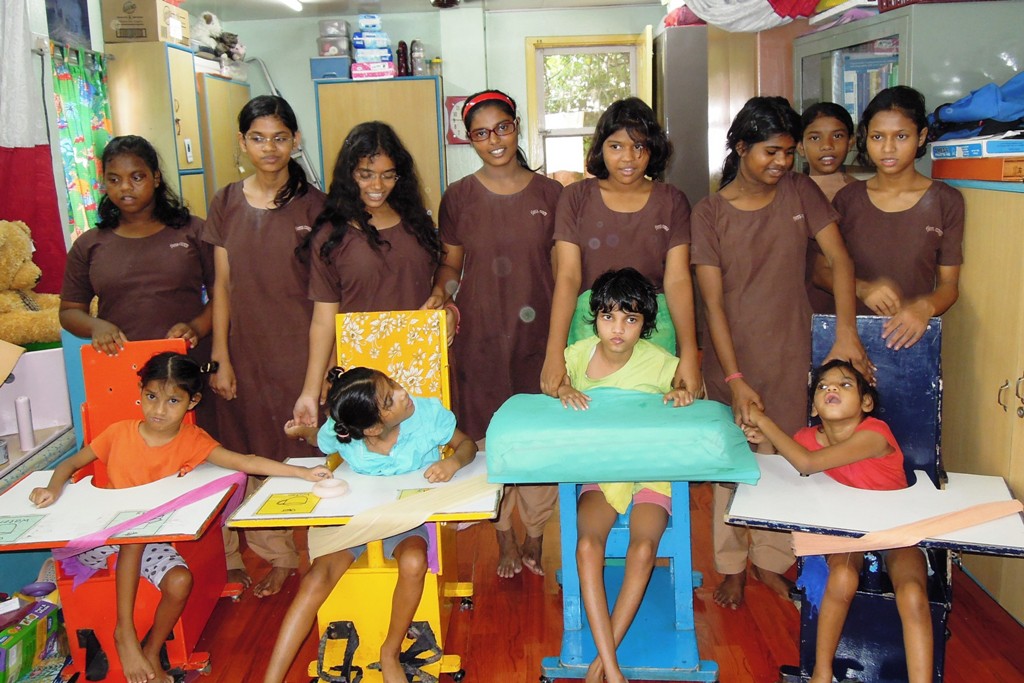
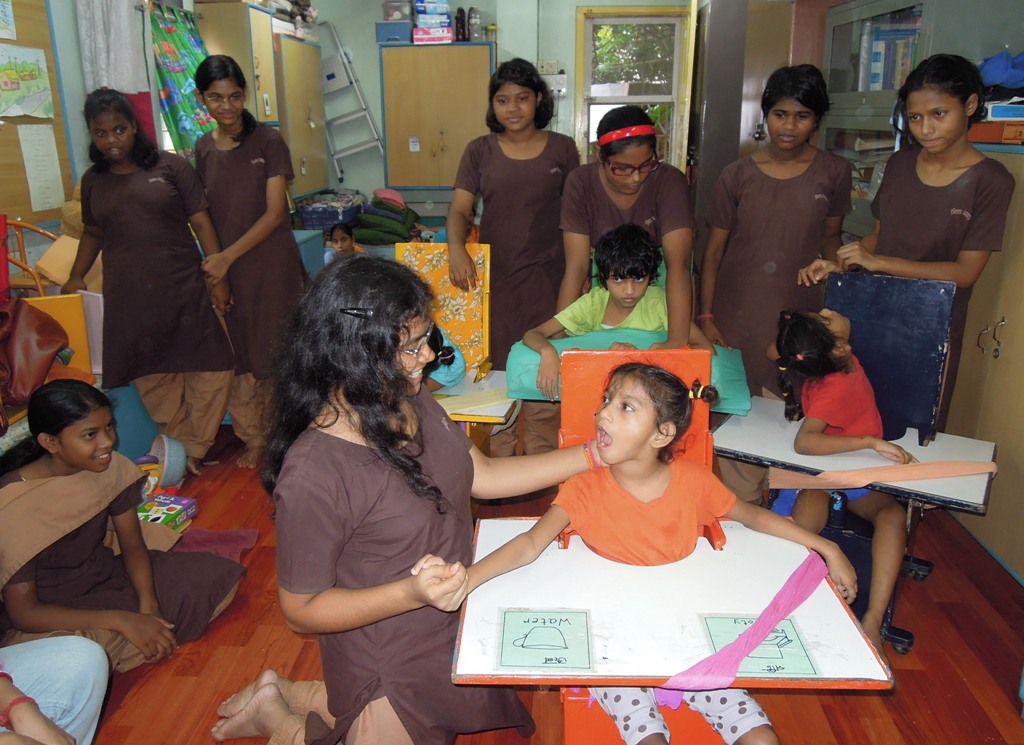
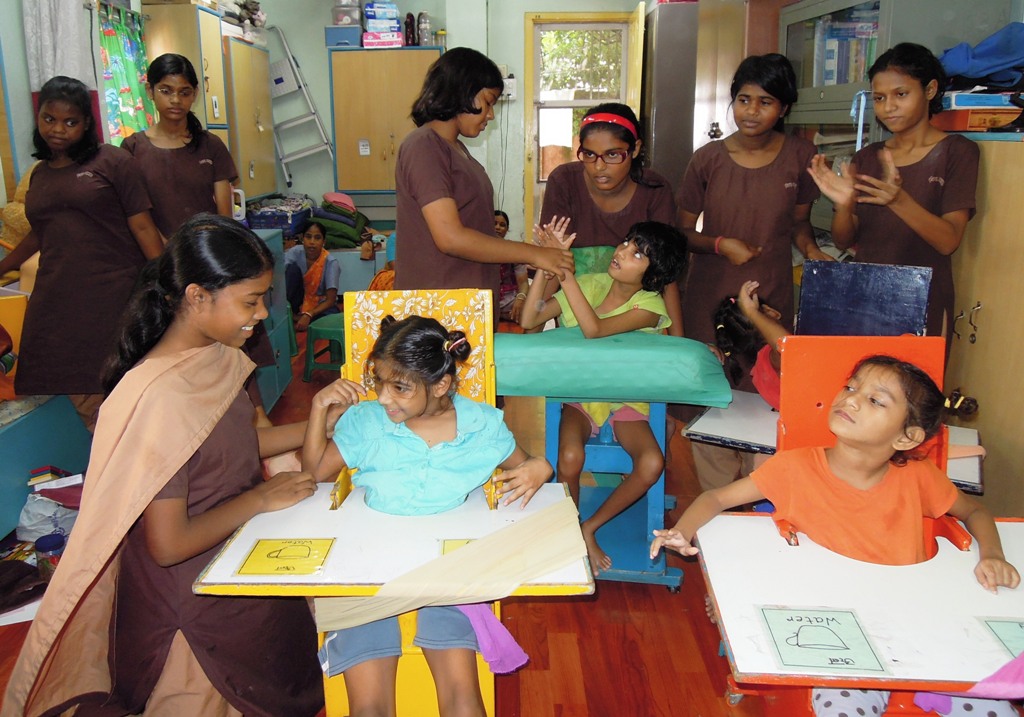
The day was a school holiday, a chance for us to do something special in teaching the girls. This would not necessarily excite everyone but the day’s activities were split into Recitation in the Morning, and Verbs in the Afternoon. I know I’m laughing as I write this. We are still playing catch up. The Class V girls had a Bengali poem that was fun and not too long, a poem about environmental pollution. So it was a chance for them to get past just reading as quickly as they could, while staring painfully at the ceiling. The girls were nervous so I suggested they do a show for the little ones, and for the teachers downstairs. I tell them nervous just signals you have to get used to doing something. Well, it was a lot of fun. Each did her recitation, and then I asked them to do it together and then I suggested the little ones try with them. Our little ones can’t speak, but they love being part of things.
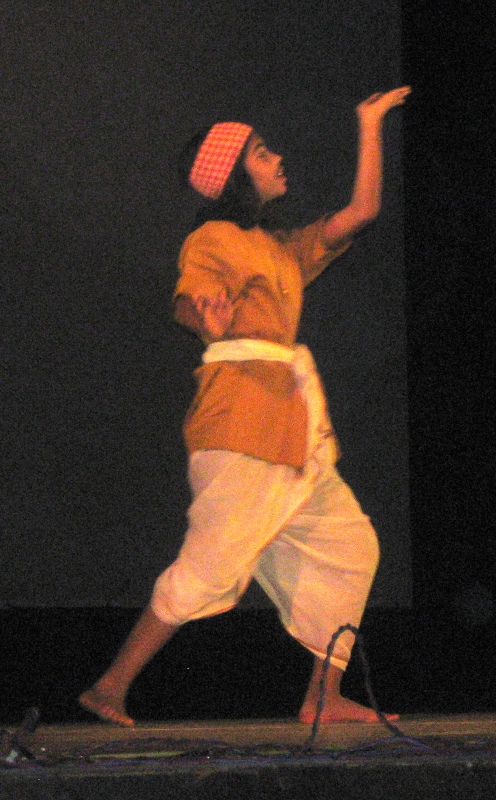
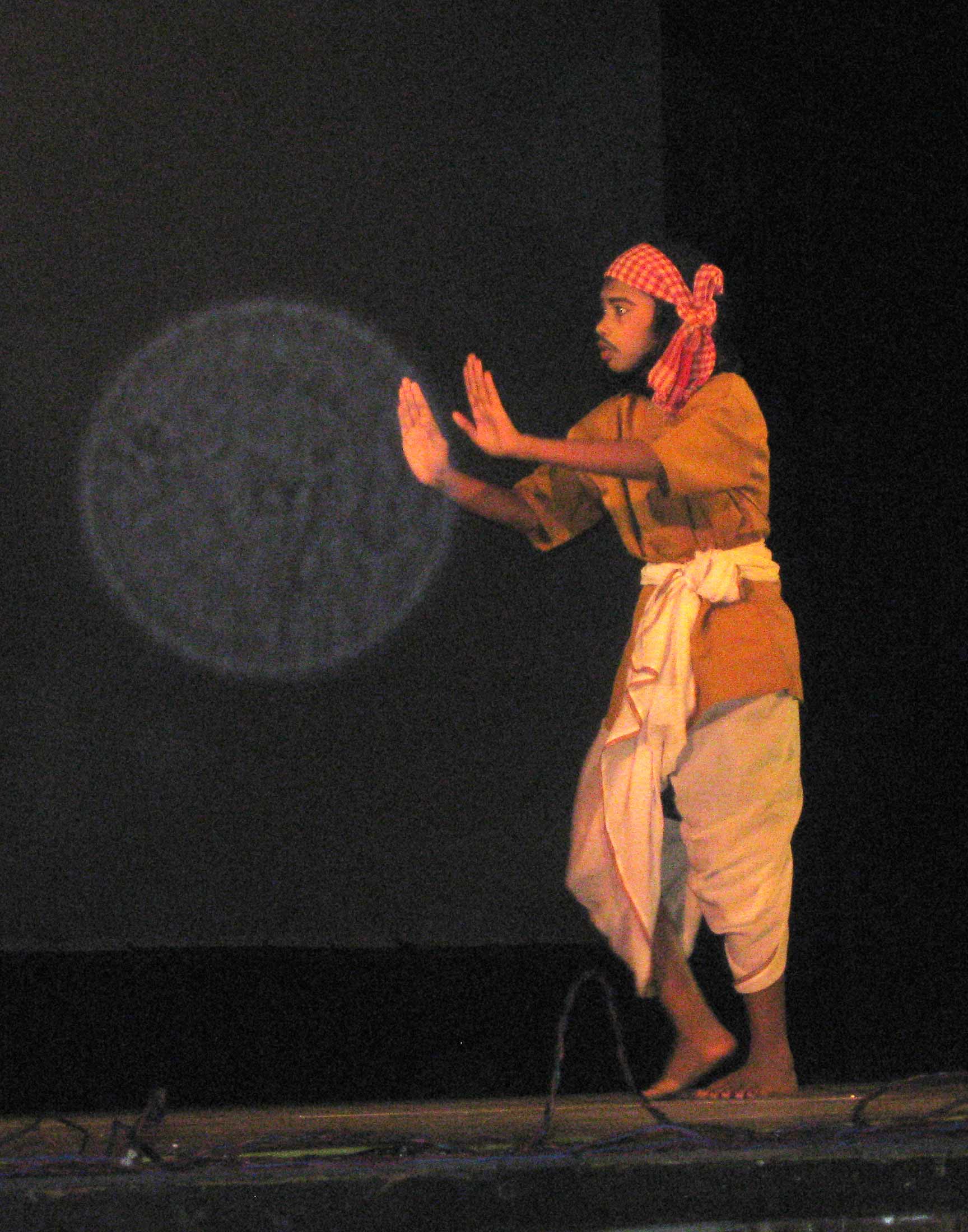
Shishur Sevay Recitation Team
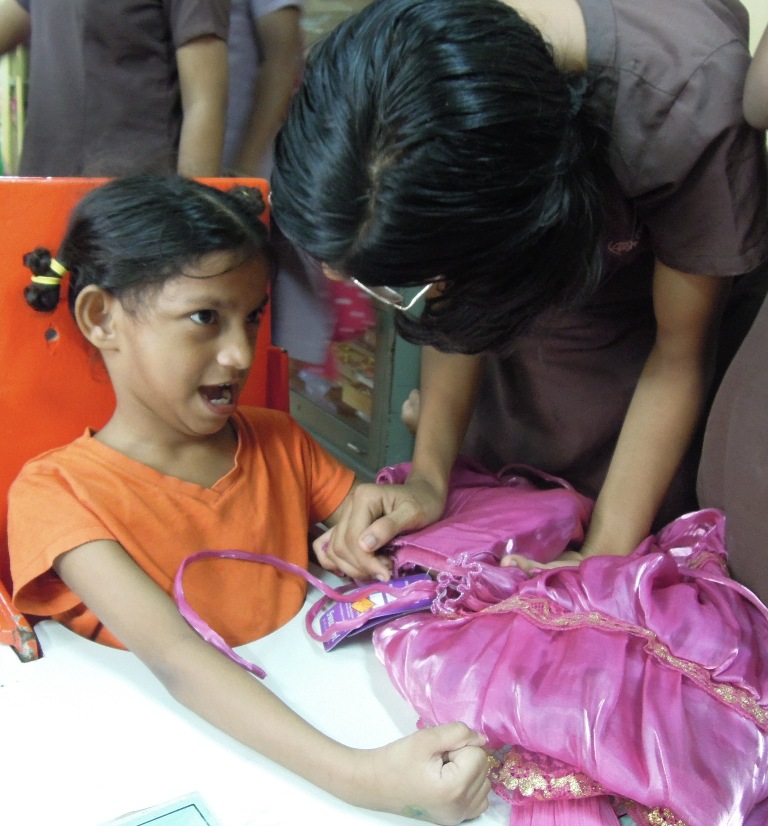
A couple of years ago Ganga joined in recitation, and did her recitation in her sounds, with a rhythm, and then stopped, pleased with herself. I asked her if she wanted to try. She did. But sounds did not come out.
Ganga trying, and big sister trying to help
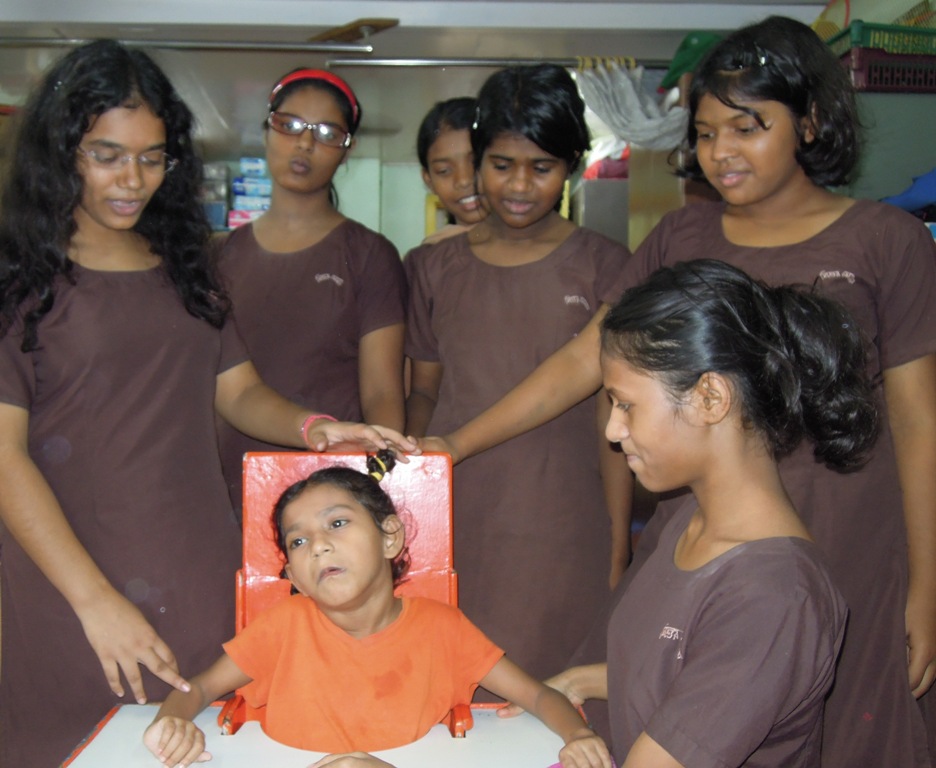
Ganga shows her feelings.
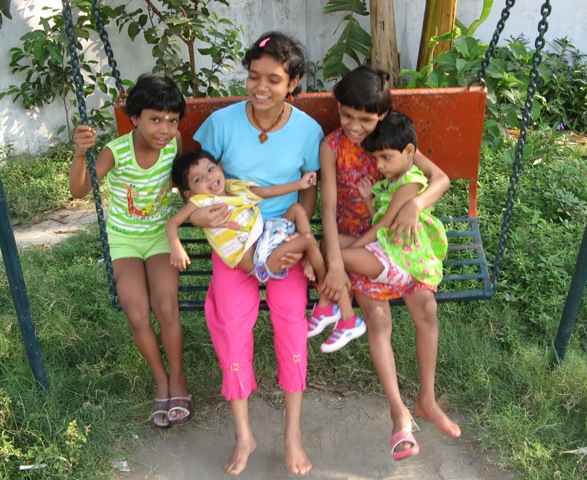
Bornali (front left) and Rani (back) are having a good time. Ganga knows the word "jealous" as we tease her with that often.Bornali tries too....
Ganga doesn’t really belong developmentally or cognitively in this group. She does if measured strictly by her disability in that she cannot care for herself at all. She cannot walk or talk or feed herself. She can tell us when she needs to go to the bathroom, but she cannot take care of those needs on her own. But cognitively she is among the smartest at Shishur Sevay. She is also among the hardest working.
Well, Ganga is funny too, very funny. I’ve started taking her along with the big girls when we go places. I ask myself, “If Ganga were not in a wheelchair would I be taking her?” We went shopping for Puja outfits and took her along, just the day before the recitations. The girls took turns carrying her as there was no way to use a wheelchair, and she has outgrown it too. She sat patiently while eight girls tried on outfits. She looked out the window at another stall where dresses were hanging. I thought we should get her an outfit too, as she clearly wanted to join in, and so I was set to get new clothes for the other little ones. We left the store and went to another downstairs store, walking past the dresses hanging from the ceiling. In the other store, Ganga kept saying no to whatever the man brought, and kept arching her back and looking with her eyes at the stairway going up. Finally I got smart and asked if she wanted to go upstairs to where she had seen a dress. That got a big grunt, her current form of yes. We took her up and she showed the dress she wanted. She would have no other! Then we picked out, or rather she helped pick out dresses for the others.
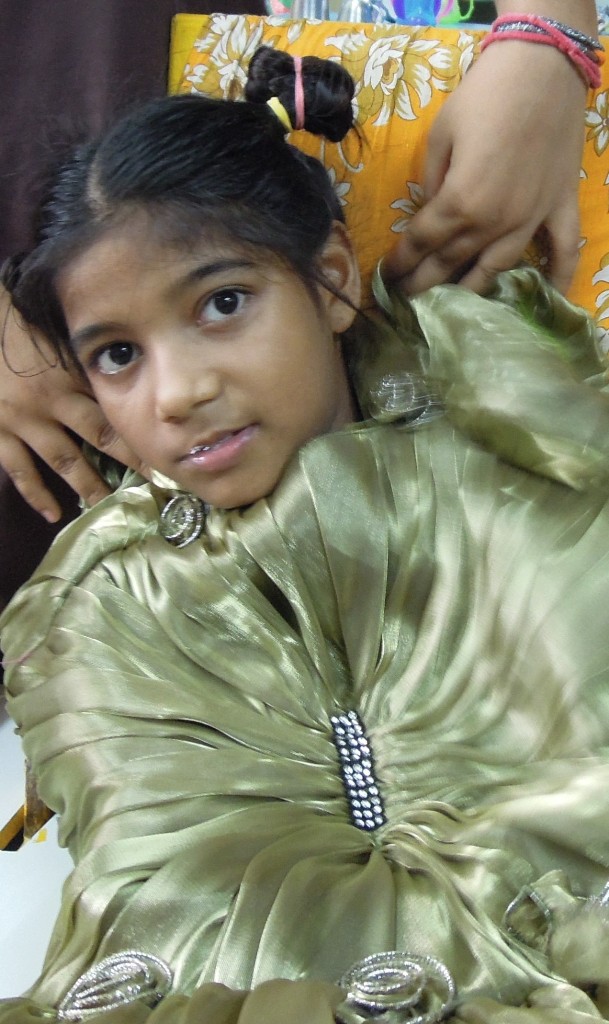
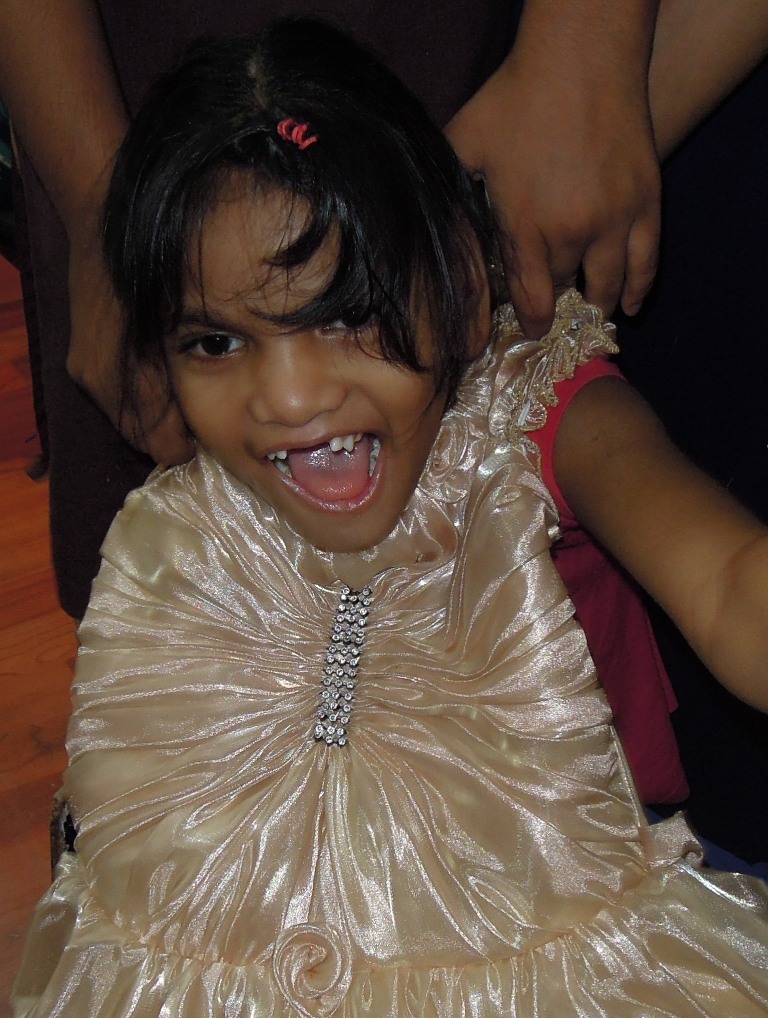
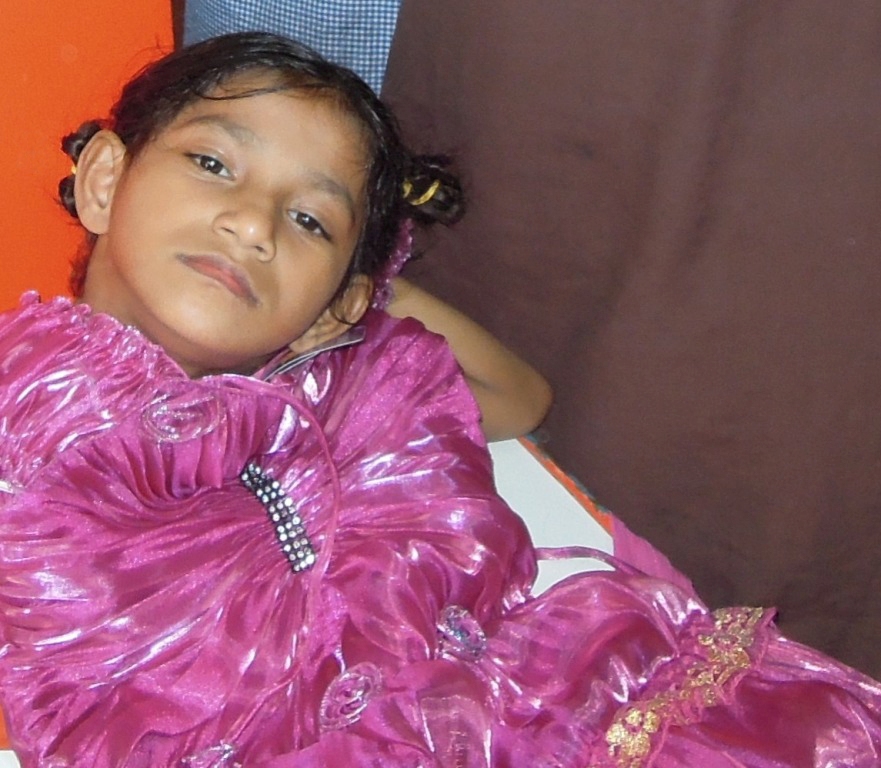
So on this day, following the Recitation, we decided to bring out the new dresses.
Ganga is pleased
Ganga chose this one for Bornali
Bornali is very happy with her dress
Sonali, the most spoiled, the most adored
The dresses cheered everyone, except Rani, who had fallen asleep in her chair.
Ganga requested one more photo.
I write about Ganga because she is on my mind a lot. With all the others, abled and not, I think we are providing all the resources we can to meet their needs, given where we are. With Ganga, I feel limited by where we are, by lack of expertise, lack of vision. I have technology but I’m still the IT person here. When I had the children with disabilities in special schools, they basically got the “orphan treatment.” And of course, since Ganga cannot speak, there are those who think I’ve lost my mind and just imagine her interest and intelligence.
If Ganga were in the US or UK or Australia or New Zealand where her role model Mackenzie Kench
is, she would be in school, probably at grade level for her age. This is her favorite video. I should show it to her again regarding recitation. In the video Mackenzie is failed on recitation because the voice is not her own.
I’m constantly interrupted as I write. I just learned that our children with disabilities are being harassed at the local park, or rather the childcare workers are being told they cannot sit on the swings with them. These swings are used by adult men and woman all the time. The first person who objected, a few days ago is the mother-in-law of the local councillor. She said the swings are only for her. The next was a very large henchman of the local councillor who said the swing was his. Today the harassment came from a neighbor two houses away, a nasty man who came to “mediate” the night of the riots and grabbed my arm to move me inside the house. I yelled at him to take his hands off me and leave. No, he was not being kind. He was trying to be the big male who would control me by sending me away. His involvement in this now makes me think it’s personal.
So I guess tomorrow I will go with the kids and I will sit on the swings with them, and tell any complainers to just call the police. The irony of it all is that when we first started, and long before we had kids here, I gave the councillor money to fix up the park, and the swings. I just wanted to fix it for the local kids.
We used to use the park a lot but as the girls got older, they were harassed by boys, which happens here in all parks eventually. The parks are mostly for big boys, men, and little kids.
Another irony, I was appointed as Honorary President of the Puja Committee for that park three years ago… it’s really hard to follow the politics here.
Recently someone offered to intervene on our behalf with the new administration, at a very high level. The local councillor was told to protect us. But instead he made it public in the neighborhood that he would not, which leaves us more vulnerable than before. People often ask me why I don’t go high up to ask for help. Well, I don’t really have those contacts, and if I try and fail I’m worse off than before. It has happened more than once. It was a lesson in not asking for help.
Well, tomorrow I’ll do my civil disobedience. It used to be so great in the park.
Last week four girls were told they could not take “tuition” at their school. It was ugly and painful. Today another girl was set to have tuition locally with her friends, and then the coaching teacher called and said she wouldn’t take her — no explanation. This is our girl who DOESN’T have head lice. This was to be our first venture into the community in terms of letting our children study with local children at their study centers. For twelve girls we have twelve different plans of how to meet their needs. The after-school classes were to be 5:30-7:30. She went off to school excited about being able to be with her friends after school. When she came home at 4 o’clock, I had to tell her that the teacher had said no, with no explanation. It’s been a week of epidemic rejection.
I am not aware of any services just for orphans. For the most part they are institutionalized in prison-like places, without education, and with only minimal health care. At 18 they are sent out. Or, orphans are sent to “orphanages” that are really serving as boarding schools for the poor. They serve a wonderful function in the society, but a child who has a parent, or an aunt, or grandmother still has some grounding, some roots, a place or places of origin on a map. Those relatives, even with minimal visiting, exert some pressure on the homes in terms of their children. These relatives serve as advocates. In most orphanages there is some part of the year when children briefly return to their families. Orphans simply have no place to go.
Gibi and I battled with the government to take orphans. They are usually reluctant to allow orphans out. They came to inspect our home and said it should not be empty, suggested I take other children until we could get orphans. We refused. At one point they wanted us to take children of sex-workers. We met with the NGO people. They advocated and advocated. There is a lot of money available for NGOs taking children of sex workers. We refused, saying, but where would we put our orphans? Eventually we were given our twelve orphan girls. Then two months later they wanted us to take four more girls, non-orphans. I was at the end of my resources, emotionally, managing this home, dealing with all the other obstacles. And, I did not want children who had mothers, working mothers, and who were already in schools. I imagined what it would be like, my girls suddenly at the bottom of the status and skills ladder. I imagined having to deal with mothers who wanted the best for their children. I didn’t blame them, but that’s not why I came to India.
I refused and in one meeting with the government a mother was there, mother of one of the girls they had wanted me to take. The gov officer asked me what was the difference between her child and my children. I turned to the mother and told her that she was a wonderful mother, that her child was really fortunate to have her trying so hard, but my children did not have that. The gov official was furious and said she would order an inquiry against me for discriminating against children with parents.
I was told that I had insulted the government by not taking the additional children. I was told that our license would not be renewed and they would take the children we had. I was terrified. But there was nothing I could do. Taking four girls with parents would have destroyed what I was trying to do. Children with parents have advocates. And that’s what I am for my children here. I am the wall that protects them and the voice that makes them visible during this vulnerable time in their lives. For many months after that battle I slept by the door at night; I didn’t leave Shishur Sevay except for brief errands. I told them they would take the children over my dead body.
It’s been a long day. The girls are tough. We get through these things. It’s just hard and painful at times.
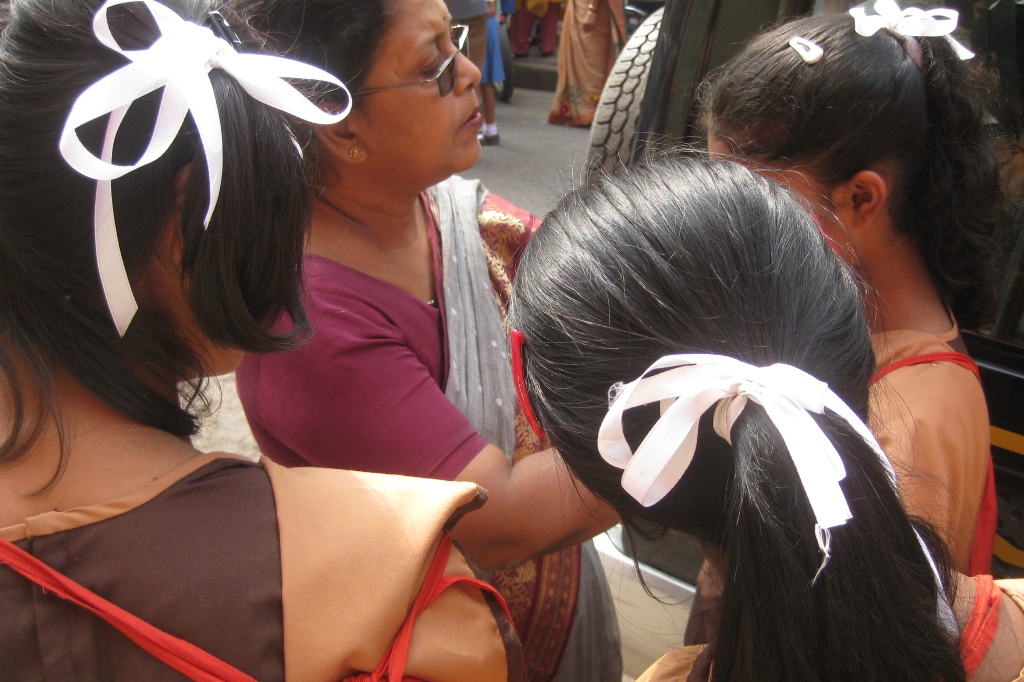
Epilogue to “A South American Fable” I read the story, South American Fable to the girls this morning. They “got it” and laughed and laughed. It gave them strength. But I also learned that another girl who is attending the government school is being harassed by teachers. We have let the girls grow their hair long. They wear braids usually, with garters or ribbons. To me it’s a sign of a child taken care of. Our girls with disabilities also have long hair. Two of their teachers only have sons at home and so they love doing the girls’ hair when they come. Only Rani has short hair as she tends to pull it.
To eradicate lice we ALL are treated once a week with medical lotion. We haven’t had lice here in at least two years. We do our heads Saturday nights and then wash all linens on Sunday. My office may be a disgraceful mess but WE DO NOT HAVE LICE! But our girl, who started late this year due to medical problems, was told immediately by a teacher, in front of all the others, that she had head lice. The teacher never even looked at her scalp. Now I hear the teacher is making fun of her because she has strabismus. The teacher is using a Bengali term used as an insult. (Two years ago another teacher called the girls, “children of pigs” but she insulted enough people that even the government school was able to remove her.) Now it is personal though. This is the secondary school and they have been clear in not wanting our children. A series of unfortunate circumstances resulted in our girl being there. I’ve spoken with SeemaDi and she will go there with me tomorrow. This meeting will require more than a North American Lady so I’ll bring along a “South American Lady.”
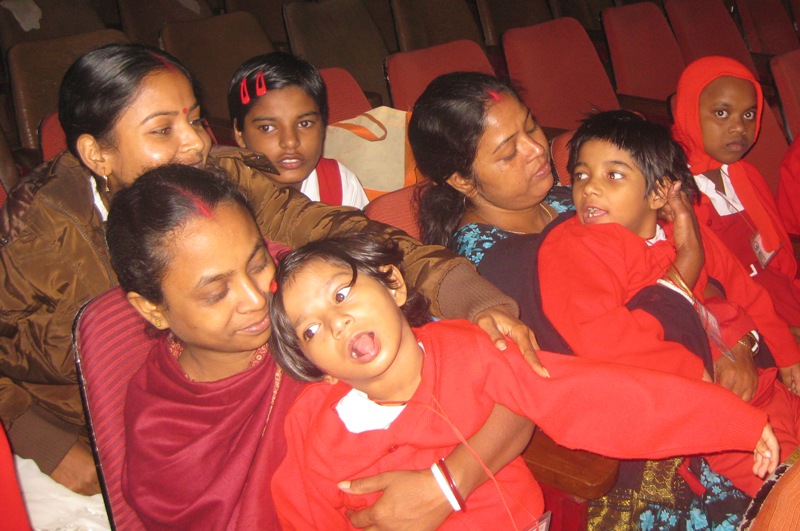
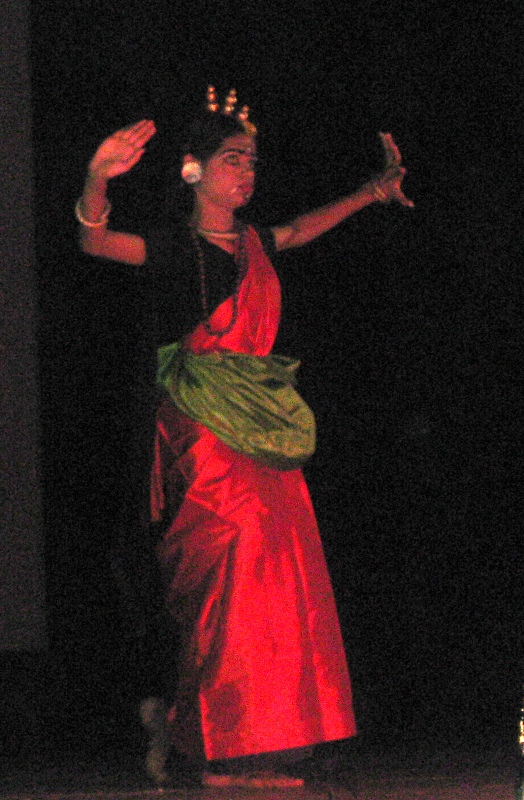
We have had brushes with these teachers before. Last year the school celebrated its 60th year with a major event at a public hall. Our girls took part in the performances as part of the lower school. We all went to watch, including our children with disabilities. But these teachers from the secondary school would not let me come in to sit down with the children with disabilities. We didn’t have wheelchairs. The massis were holding the girls. There was no place to sit. Eventually I found a back way into the auditorium.
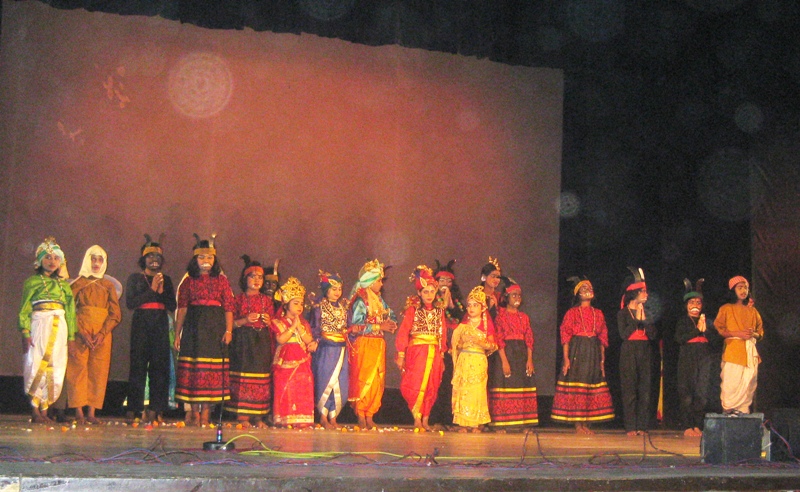
Our girls performed:
Our Girls Among The Others -- The Goal of Social Integration
Well, today, Saturday 27th August, Seema and I went to meet with the Principal of the Secondary School. Surprise, she was really receptive in listening to what had been said to our girl. She took the names of the teachers, and said that behavior was not right. She was friendly. It was an encounter that put a smile on my face for the day.
In the past few days I’ve been talking about our lack of head lice, and the explanation of their abandonment of our home and heads. I think I don’t want to keep talking about it. I’ve written it in our child’s school diary; I’ve written it in a few emails, and now on the blog. But there is one more thing I just have to say and then I will be quiet,
I posted the following on FB today. Mostly I think of FB where I try out some ideas and don’t work hard to formulate full and reasoned thoughts. But lots of people liked my spontaneous writing, and I used to do it more on the blog, so i thought I’d talk about today, what’s on my mind. here is what I posted on FB:
special moments… the girls come home from school and Jelly, our dog sneaks in with them as they come in the doorway. They laugh, scold her, and try to carry her out as she wiggles. ordinary life, what they need the most, and what I enjoy the most.
So that made me think about what a really “normal” family we are, just that there are lots of us, and I am a single mom, as I was before. But I have lots of help. That’s a major difference. And when the girls come in, and the dog slips in with them, it feels as normal as my life ever did. It’s late now, and the girls are giggling at the supper table. We are eating in shifts some days now because the girls are in three different schools with different hours, and now since the trouble at school, four also go out in the evening for “tuition.” The ones who go to school all day have rice for breakfast to fill them. But by the time they eat, two others have already left for school at 6:15. Harmonium and singing practice start at 6:15 am, and then studies with Seema Di from 6:45-8. And the day goes on this way, with kids coming and going (always accompanied when they are out) and teachers coming for individual girls who are here at different hours. Gibi comes and monitors some of the classroom work, and goes for the afternoon pick-up. She usually leaves after prathana at 6pm. Three special educators teach the girls with disabilities from 9 am to 1. Another comes at five to work with Ganga on computer. Today I told the teachers that I want more content in the teaching for Ganga and Bornali. I”ve started a new academic effort for Ganga. She is probably more motivated to learn than ANY of the 12 girls but her inability to speak makes people think she is a little child. I think I’ve written this before. It’s on my mind a lot.
OK, there IS something on my mind that is not safe for me to write about. It is every parent’s fear that a negative encounter with a school will result in punishment or expulsion of their children. Therefore I cannot talk about what is on my mind. But suddenly today, I found in my head a make-believe-story, that like TV shows, carries a disclaimer that it bears NO RESEMBLANCE to any situation or people it might resemble. Got it? This is NOT a true story! This story has absolutely nothing to do with any events here. It is only coincidental that I thought of it today.
Once upon a time in a big city in a South American country (unnamed) there were five orphan girls who had learned a lot and came to be admitted to a fine school! This was a school very proud of its values of generosity and the King of the school was very happy to have five orphan girls there. Everyone was happy until one day the North American Lady who was a mother to the children had a dream that there was no water in the school for when the children went to the bathroom. The NA Lady thought her dream was true! So she went to the school to see if her dream was real! But even after the King explained that they used invisible water and showed her the invisible water, she continued to believe no water was there! A crowd of teachers came and stood around her. Everyone showed her how they washed in the invisible water.
They said, “We cannot see God, but we know He is there. We cannot feel the water…,” but before they could finish the NA Lady called out, “..BECAUSE IT IS NOT THERE!!!!” She could not feel the water and could not lie. She even could feel God, but she still could not feel the water at the school!!!!! The King was shocked speechless!
The King could not forgive her, and carried a vendetta deep in his heart. So sometimes he did mean things to the orphan children. He tried to shame them. But the children would not be shamed because they knew in their hearts that when water cannot be felt or seen, it is not there. And they were proud too, because their mother’s dreams were true, and the children had come to love hearing about her dreams, even if they caused trouble at school.
And they all lived happily ever after.
You see, they were just a typical normal family with a stay-at- home mother who sometimes made trouble at the school.




Recent Comments