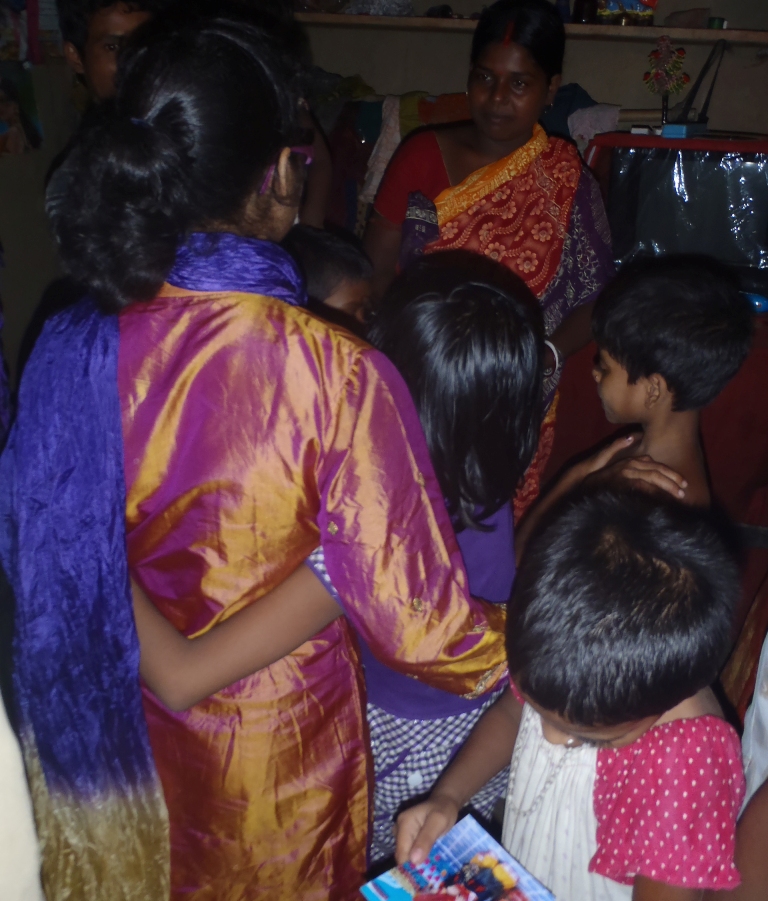
She’s Going Home To Her Family

I’ve just gotten off the phone with the eldest sister of our oldest girl.  My office door has been closed, Seema Gupta, our girl, and I on the phone.  I  walk out to talk with the staff while our girl goes to talk to the other girls.  This is not really a surprise to them, but it is to the staff.

I tell them, “She is going home to her village.”

“She is doing WHAT?”

“She is going to live with her Didi (elder sister),” I explain to some of the staff.  They know her mother had died when she was born and that painful traumatic events had taken her to the government institution and then to us.  In the past year we have learned her name, her real age, and we have visited her relatives in the village.

Teachers, massis, all are incredulous. “But what about her studies?”

“Her sister will put her in the local Girl’s High School, and after school she will help with their sewing work that brings income.”  Her sister had been looking into this since our visit as she couldn’t get her youngest sibling out of her mind.  It was as if she was waiting for our call.  I think their first choice would have been for her to stay here where she has a “better” life — the rational view.  But it seems that now, after many years, emotionally they want her to come home, and they needed for her to want to come home.

My staff protest.  “She won’t be able to live there.  She won’t have such good food, or clothes!  She won’t be able to live that way!”

“No,” I explain.  “She doesn’t care about that.  It means nothing compared to being with her family.”  It’s what I’ve been saying about all of them.  They don’t care about “stuff” or even food.  They would give it all up in a second to be with family.

I know this is true.  I know it in my being.  I know it because the girls and I have talked about it many times.  When I put myself in their places, imagine myself there, I’m not sure what I would do, but my decisions wouldn’t be based on comfort or things.  Abuse would keep me from family.   Things, and food, would never count in the equation.  And maybe this is the crux of what is wrong in the usual adoption model, that the child is “better off” in the home with more comforts.  Kids who have lost their families often don’t care as much.  Maybe some of them sense of the transience of “stuff.”

Staff  ask me, even suggest, that I must be upset — after all I’ve done.  They don’t get it though.  My mission is to care for orphans, and to figure out what they need.  I started this home with the question “what do they need?”   Then we build on ways to meet those defined needs.  My job is to lead them to where they need to be.

Like her Didi, our girl has been unsettled since the visit, her mind constantly going back to her family.  Last week we called her Didi and it happened to be when the sister’s daughter was in labor with her second child.  So our girls got on the phone with her, talked and distracted her from the pains.  In the morning we learned that a boy had been born.  In the Indian system of naming relationships, our girl is now a grandmother.  She wants to be there to take care of the baby.

This reunion could not have happened previously, as there were some very serious family problems that had to be resolved first.  She could not have gone back then.  She knew it and said it then, but things and people and circumstances sometimes change.    And we really don’t know how it will work out.  She is almost 18, almost out of government care.  We will petition the government to allow her to go to her family and we expect them to agree.   We will ask the government to note her real name and age in their records.  So this will be the next chapter in her life, and in a way another chapter  in the life of Shishur Sevay.  On paper and in her heart, she will be theirs, but she will also be ours, if she wants.  But she won’t be an “orphan” any more and that may be the most important part of this for her.    Remember, it was when Donkey Sir, the teacher was insulting her, that she thought to herself, “I’m not an orphan.  I have a family.  I don’t have to put up with this.”

To be an orphan in this culture is to live in shame.

I don’t expect it all to go smoothly.  I’ve dealt with village expectations.  But I know our girl is strong.  I believe she may be a leader.  I know that she cares about the poor, writeS about the poor, and wants to help the poor when she grows up.  I suggested she keep a journal.  She gave the “the look.”  Oh well, I tried.  Maybe one day she will want to.

I have walked this path before.

The other girls, how are they?  It’s mixed.  Some are upset.   They think about their families, want to find them if they can.  One girl was remembering her house by the water and a factory along the water, and we knew the town from which the police report came so we went on Google Earth looking for a factory and water.  One day we will go there and start with the police station, the police report.  Does she want to go back?  I don’t think so.  But she wants to know if her grandmother is alive.  They are losing their Didi, who I often thought of as Wendy and the lost boys of Peter Pan.  Wendy has a home to go back to.

There is yet another pull among the girls.  They are survivors of family betrayal.  They protect themselves and at some level trust no one.  So they worry, and ask me, “Who will take care of us if you die?”  They panic if I have a headache.  They know I had cancer.  So, each girl here is also trying to figure out her Plan B, “What if Mummy dies and no one will take care of us?”  So I go through the list of people who care about them, the plans we have in place, but they still worry.   I worry too  It’s what mothers do.
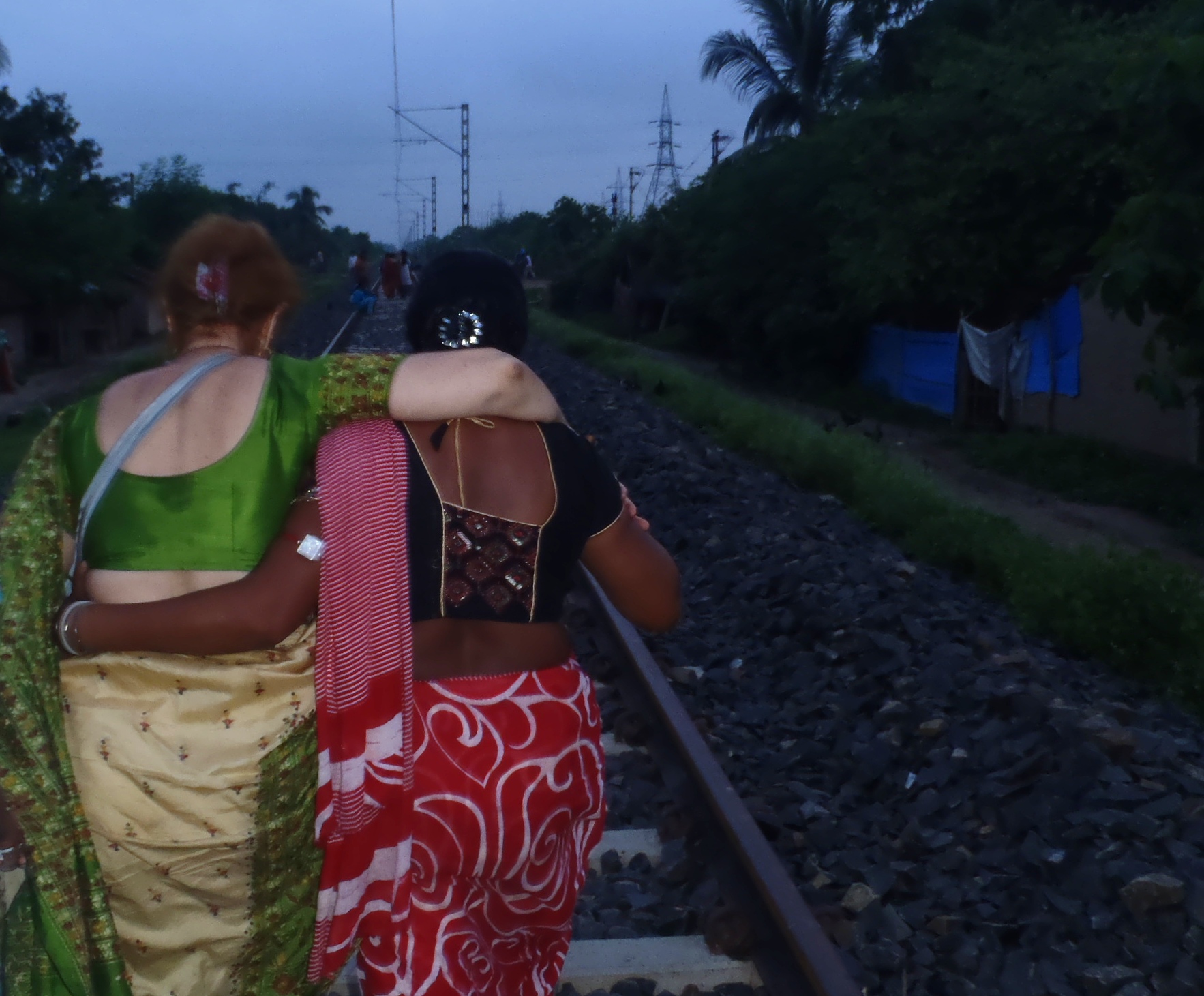
I’m walking along the railway tracks with her Didi at the end of our visit.
Keeping Girls Safe in Kolkata

Last night the girls and I sat and talked…. I felt a familiar intimacy,  as mother and her daughters.   Each evening, one of our staff takes Rani for a walk, with one of our older girls, as Rani really needs someone on each side.  On this evening, two local men followed them from our gate, met up with more young men and made the staff person very uncomfortable, and afraid one of them would grab our girl.  Meanwhile, our girl, characteristic of the cognitively impaired, lacking judgement, smiled at them broadly.    Our little group left the park and came right home with the young men following them to our gate.   “Nothing happened,” except fear, and fear is a happening.    Our talk last night was because these walks will end now.

“Mummy, I’m not worried because if someone tries to grab me, other people around will help.”  I wish I believed this.  “No, it’s not true.  Maybe they would and maybe not.”  So then I told them about Guwahati, where a woman was gangraped recently while reporters filmed and crowds watched as she cried for help.  I also told them more about our community.  When I go out on the road, I’m often referred to as, “The Mother Teresa of Our Area.”  But when we have been under attack from the goondas, when they told the girls to get me inside of they would kill me (I didn’t go) those people who likened me to Mother Teresa did not come to help.   Instead they formed a large crowd out on the road where they got reports, updates, and finally the police came…. but none of those people came to help.  They would not challenge the criminals at our gate.

The girls listened, and then one of them said poignantly, “When we were little you didn’t tell us these things, but now we are big and so you have to tell us.”  She got it right.  I talked about “bad things on the street” and each one nodded that she knew about bad things   They each had lived bad things on the street.  They did not argue.

Purba, Maggie and I had been talking recently about the lack of free movement in the girls’ lives.  They don’t go to the park because it is not safe.  They will be stared at and heckled.  It’s not just them.  Girls are not outside in the park, or rather only little girls are outside.  When I bought the house I imagined the girls playing outside our gate, running in the lane in front of us, still a few bends from the road.  But men carrying small black pouches come and go, doing the business of the area.  And the goondas of last evening stand around and stare.

As I write I hear the criticisms from many that I am too overprotective.  But I don’t know what “over” means.  I protect them because they are in danger.  They are prey.  As girls they are prey and as orphans they are prey.  I was a teenager when I was raped in New York City.  So it’s true that I will do everything in my power to protect these girls, as I did with my first two daughters in the US.  My daughters here do not yearn for freedom.  They had a lot of it and they are still recovering, still happy in the safety of Shishur Sevay.  What I would find stifling, they find comforting.

I yearn for open spaces where they can run and play.  We once went on a picnic where by afternoon we found ourselves in the middle of a riot.  We only got out alive because of the Rapid Action Force (RAF) who came to rescue us with rifles and shields and led us to safety.  I’m not ready to write more, but this is a dangerous place for girls, a very dangerous place.  It’s why I’m here,  a one person RAF trying to protect 14 orphan girls.

Square Centimeters or Centimeters Squared

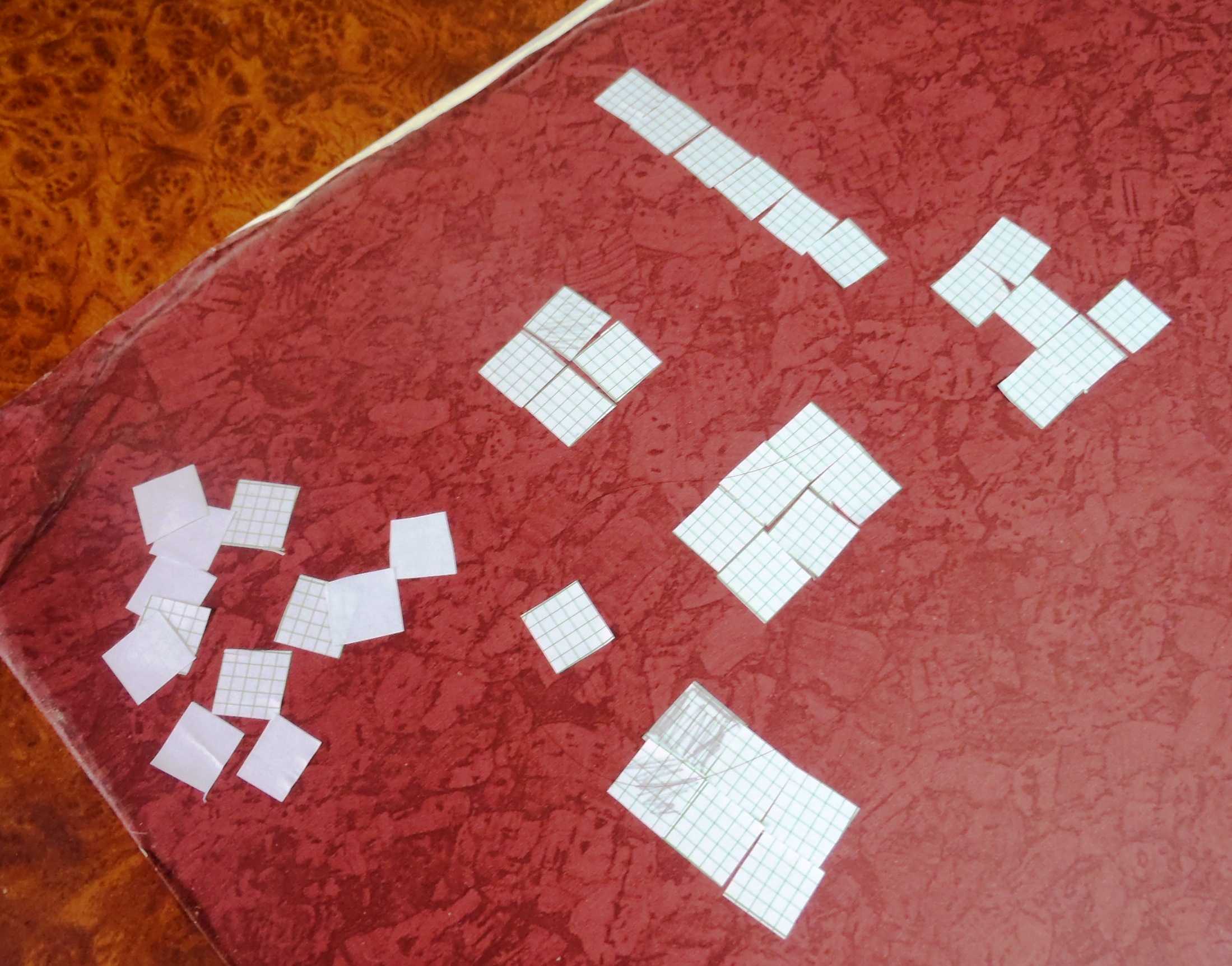
The same subjects keep coming up!  The girls are totally confused about the concepts of square centimeters and centimeters squared, and still mildly confused about length and area.  We cut 1 cm squares and made shapes.  This came up because I asked them to do a drawing 2 square centimeters.  Failing that we went back to 1 square centimeter.  You see, when I asked for 2 square cm, I got a square 2×2, which was really 4 sq. cm.  They were working on a principal or pattern of a square of 2 cm sides so you square  the 2, namely 2 squared, but that’s 4 square cm, and not two.  We made progress, I hope.  I like the creative design which was right as another way to get six square centimeters.  We also talked about tiles on the floor, how wide the table was, and then if we wanted to put all the books in a box we had to give it height, add another dimension.

the girls cut up pieces of graph paper in 1 cm squares and used them to create areas of different sizes and shapes/

Putting together square centimeters

We talked (I talk and hopefully they nod and when I asked what they thought they answered in centimeters).  I don’t know what stops them.  They are smart kids and I said I wouldn’t be spending these hours with them if I didn’t think they were able to get it.  They freeze, the deer in the headlights I wrote about last week.  Today the image was of children crouched in a burning house, afraid to come through the open door.  They are so afraid of getting it wrong they can’t think straight.  It’s not about language because they had the same problems when they were learning in Bengali.  But then last year when they were still learning in Bengali their math teacher was confused about length and area.

WAIT!!!!  I just Googled the title of this post, and guess what, it’s not just my girls who are confused!!!!   This is from a 2001 question in a math forum. http://mathforum.org/library/drmath/view/57209.html

My wife is a teacher and we have had a disagreement over the 
definition of meters squared. She says that a rectangle 3 meters by 4 
meters equals 12 meters squared. I say it is 12 "square meters," and 
that 12 meters squared would be a square measuring 12 meters on each 
side (or a total of 144 square meters). Who is right? This is 
important because she doesn't want to incorrectly advise her students.

 The answers are confusing and there seem to have been some changes in the 50 years since I studied math.  There is some difference between the symbols used for squaring and the words.  HMMMMM as Ganga would say.  I'm really glad I decided to write about how confused the girls are, since I'm now confused.   But, the concept, the squares, the area, how you build area and then cubic space -- those are the fundamentals we need to keep working, and meanwhile I'll have to find some help on the symbols.  As I pointed out to the girls, if we are going to get tiles for the dining room floor it really matters whether we have  64 sq feet in our 8x8 room or 64x64 sq feet, which is 4096  sq. ft, and a bit out of our budget.  

Maggie Redden, Shishur Sevay Intern — Music and Dance, Heart and Soul

Maggie Redden is a gifted writer, athlete, courageous explorer of life and herself.  She joined us in January for a year, partly wanting to connect with her Indian heritage.  She chose Shishur Sevay over the Peace Corps!   It is hard to imagine life here without her, as she will be going back in December.   She will be going home for two weeks at the end of August and I know it is hard for her to contemplate coming back even for a few months.  But she will come back, in part because of her commitment, and even more because she can’t get the pictures of our girls, now her little sisters, out of her mind.

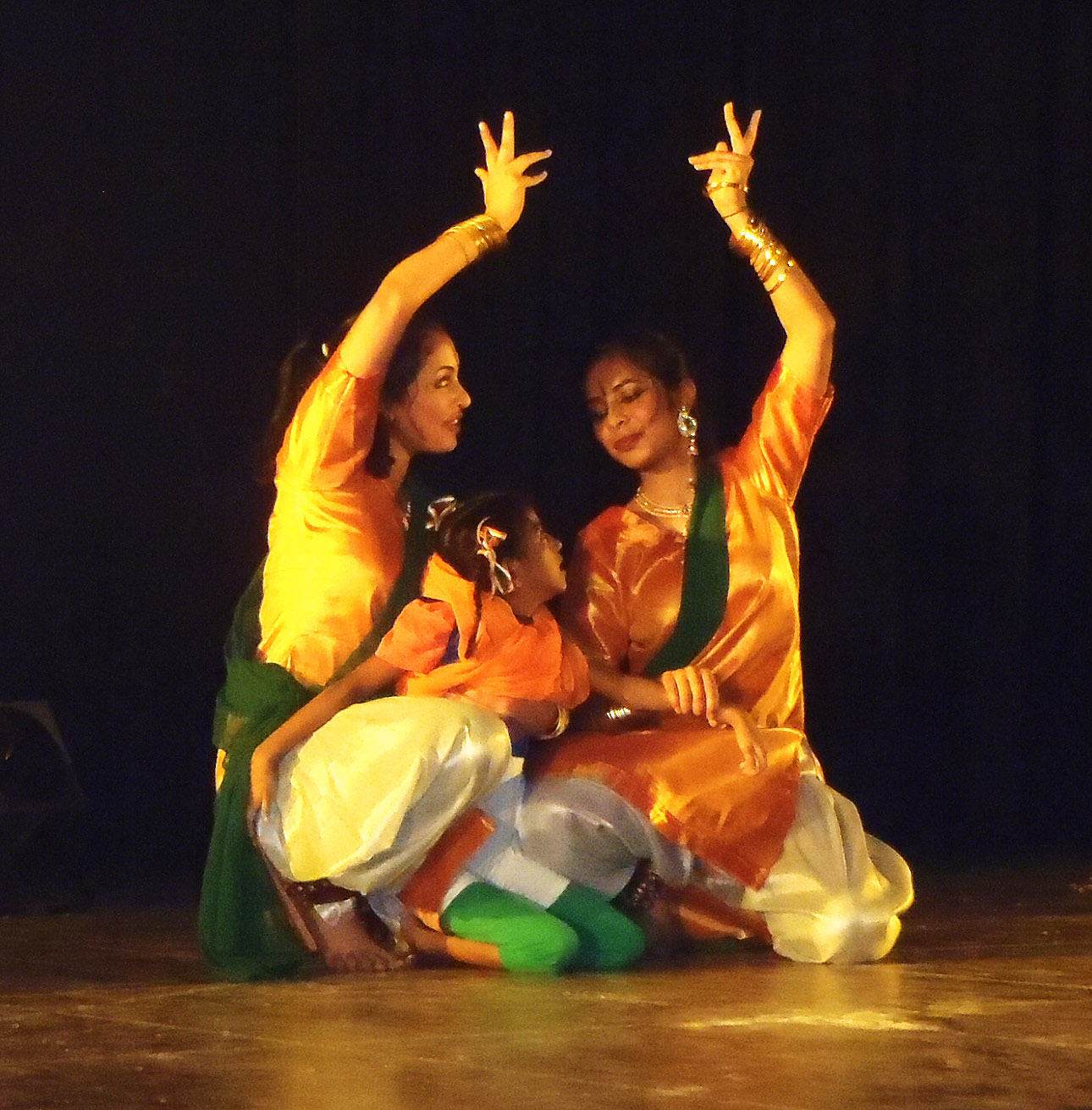
Ganga in Dance for Life with Sreya and Priya Mukherjee

Maggie writes a blog that is always enlightening, but here is a special post I wanted to share.  I’d planned on writing something about the Dance For Life program, but Maggie has said it more beautifully than I could.  As for Maggie’s general experience of Kolkata, I know.  I know.  I know.  I’m here because if I were not here, our girls would have to face this place alone.   Many “reasons” brought me to Kolkata, one of which was to prove to my Indian born daughter that Kolkata was not as bad as she thought, or rather as she had experienced.  One day I told her she was right.  I know.  I know. I know.

Read Maggie’s post:

http://maggieredden.tumblr.com/post/29023873610/music-and-dance-heart-and-soul

Previous Older Entries Next Newer Entries

August 2026
S M T W T F S
 1
2345678
9101112131415
16171819202122
23242526272829
3031