Another Word for Orphan is _____BLANK_______.

Words, names, labels… I'm working on a brochure for Shishur Sevay, with a deadline of one week.  I need to get it done and out.  I'm slow because I keep getting lost in pictures, and memories.  "My kids are sooooo cute; I must use this picture too."  I'm slowed down by the work of honing our message, like sculpture.  I start with the big blob of clay and carve and carve, put back some pieces, carve more.  It's taking me a long time as I work on the words related to disabilities.  I found a wonderful helpful site: www.disabilityisnatural.com. Kathie Snow writes of People First Language, namely seeing the person before the disability.  The terminology changes over time, because it is an attempt to change attitudes, and sometimes the new terms become infected with the negative attitudes and so we work again to find words to correct the problem.  It's a critical process, even in its evolution.

I have not had to spend any time assessing the right terms for orphan, because there is only one that I know of, namely orphan.  It's a negative term; it evokes pity; it implies suffering, poverty, illiteracy.  My girls HATE the word.  One day they came home and asked, "Why do they call us orphans?  We have a mother; we live in a house! We are not poor."  They are trying to say that orphan doesn't define them, that it is not a single identity.  But there is no vast literature about other words. 

The definition of orphan often depends on the purpose of assigning the label.  UNICEF has divided orphans into groups depending on whether children lost one parent or two.  Thus there are single orphans and double orphans.  A single orphan can be an maternal or paternal orphan. This work came out of the HIV/AIDS epidemic and an attempt to categorize children for assigning services. 

Orphan in the NGO world is often used very broadly.  I spent a number of years visiting orphanages in West Bengal.  I worked closely with one for several years.  One year I brought my younger daughter to see what I was doing.  She had heard so much about this place.  When we arrived there were only about 15 girls instead of the 150+ girls usually there.  It seemed deserted.  The director told us, "The government hasn't given us food money so I sent them all home."  I asked, "HOME????"  She told me that only a few were kept back because their families were too far away.  Cici turned to me, "Fake?"  Yes, it is fake as an orphanage.  What it is, and what most such places are, is a hostel for poor children.  The children are housed there and sent out to school.  It's an important service, but it is NOT an orphanage.

I seem to have lots of stories about orphans.  I visited a new orphanage, one just starting.  I asked about orphans.  He said, "I only take orphans if their parents are willing to sign them over to me until 18."  To him there was no contradiction.  Orphan, poor, single parent… all the same.  In each of these places, an organization asking about numbers of orphans would get inflated numbers.  I'm not sure it would occur to anyone to look more deeply.  Or, the census of the home would be taken and since the place is listed as an orphanage, all the children would be assumed to be orphans.

I have another orphan story.  Adoptees often visit us at Shishur Sevay, especially if they are from Kolkata.  An adoptee came who wanted to visit one of Mother Teresa's Homes.  We wanted to go because the mother of two children I sponsor was working there.  Gibi knew some people there too.  This home had a section for disturbed women, and a separate area for orphan children.  We visited both.

The orphan ward was a large area up on the second floor, with cribs almost wall to wall.  Forty children about 2-4 years were in separate cribs.  It was afternoon, rest time, and most were quiet.    I asked about these particular children, why they are there.  "They are sick, so we take care of them."  I was surprised because they didn't look sick.  I've been on plenty of pediatric hospital wards.  Then I asked, "Do they get any education?"   I was thinking about the pre-school type of teaching.  I was told, "No, they aren't here long enough."  I learned that the children stay 3-4 months and that they come to be given nutritious food and then sent home to their families.  I thought about what a four month separation from family meant to a toddler.  I thought about all the volunteers who come and get attached to these "motherless children".  (I guess I just found one other term for orphan — motherless child).  Our visiting adoptee was present for all this discussion.  I was surprised then to read her report of her trip, that the high point was being with the orphans at Mother Teresa's.  It just doesn't click for people.  An orphan with parents is still an orphan, such is the power and imagery of the word orphan.

I have another orphan story.  Cici and I visited Dakinishwar, a Kali temple just North of Kolkata.  Roaming children approach visitors, hands outstretched, begging for money.  "We are orphans.  We have no mother or father."  This day I started to chat with one of the boys, maybe 8-10 years.  I can't remember exactly what I said.  I do remember that Cici was terribly embarrassed by what I was doing and stood at some distance.  I asked the boy, "you go to school?"  I knew he didn't.  I asked where he lived, just chatting… and then I asked, "What does your father do?"  "He has a rickshaw."  I went on, "And your mother. what does she do?"  "She begs, like this…"  Here we were, the orphan and the foreigner, and he was telling me about his family.  I don't think he realized the contradiction.  He just felt comfortable enough with me to chat, one on one…. Did I give him money before I went on?  Of course.  Is it illegal? I think so.  I know there is a campaign to stop people from giving.  Usually I don't give.  It's complex.  I gave the orphan his wage, a good performance.  But it also gives one pause to think because this was a child with two working parents.  He could have gone to school.  The issues are not simply ones of money.

Even as I write I struggle for alternative words, and I can't really find any.  I think that is because there is no "orphan voice", only others speaking on behalf of orphans, and there are economic implications in the use of the word. I have four children with severe disabilities.  None can talk.  Do they know whether they should be referred to as "disabled" or "with disabilities" or "differently abled" or "special needs?"  No, but they have people around them protecting their interests.  They advocacy groups of themselves, their families, teachers, institutions, all willing to engage in the exercise of finding constructive and non-demeaning terminology.  

Here are some thoughts from the girls, and from me:

I am who I am

Stand-alones

Free Agent Children

Overcomers

Children Against the Odds

Children unencumbered

The realities are harsh when I think about it.  My children here were abandoned, dumped, sold, forgotten, left to fend for themselves.  Two of our girls with severe disabilities have closed up earring holes.  Once they had families.  Someone pierced their ears, made them pretty, then dumped them.  The children cannot speak.  They cannot tell us.

One problem with the term orphan, is that it carries shame, as if the child has done something, become something bad — the child carries the crime of the adults. 

"Children of parents who dump them?"  No, not just parents.  To be an orphan in society, means that no one else stepped in.  No relative took responsibility for them.  In fact, their stories are of relatives who sold or dumped them after the death or disappearance of the parents.  I hear stories like, "My mother died and then my uncle took me and my sister to a pond and left us there."  Pretty much, orphans are kids who have nothing, no one.  That's how I define them, no family, no community… adrift until caught, somewhere by someone, for better or worse, more often for worse.

The Economics of "Orphan"

The term orphan is often used for raising funds.  Therefore the wider the definition, the higher the numbers and the greater the funds.  For instance, I always thought of children with one parent as "children of single parents" not maternal or paternal orphans.  A change in definition changes the size of the pool.

Orphan in the adoption world often represents the number of children who "should" be available for adoption.  Broadening the definition evokes more sense of need.  But if "orphanages" are mostly places for poor people to leave their children for education, and where parents may regularly visit, then the use of the term is deceptive.  The numbers are also deceptive. In West Bengal, most institutions will not take a child unless a parent or family member signs them in and agrees to take responsibility for them at 18 years when they are no longer eligible to stay.  In my early years in Kolkata I kept wondering, "where are the orphans?  I couldn't find them."  I was told at that time that they were all in government institutions and that you couldn't get to them.  Sukanya for blog-1368W
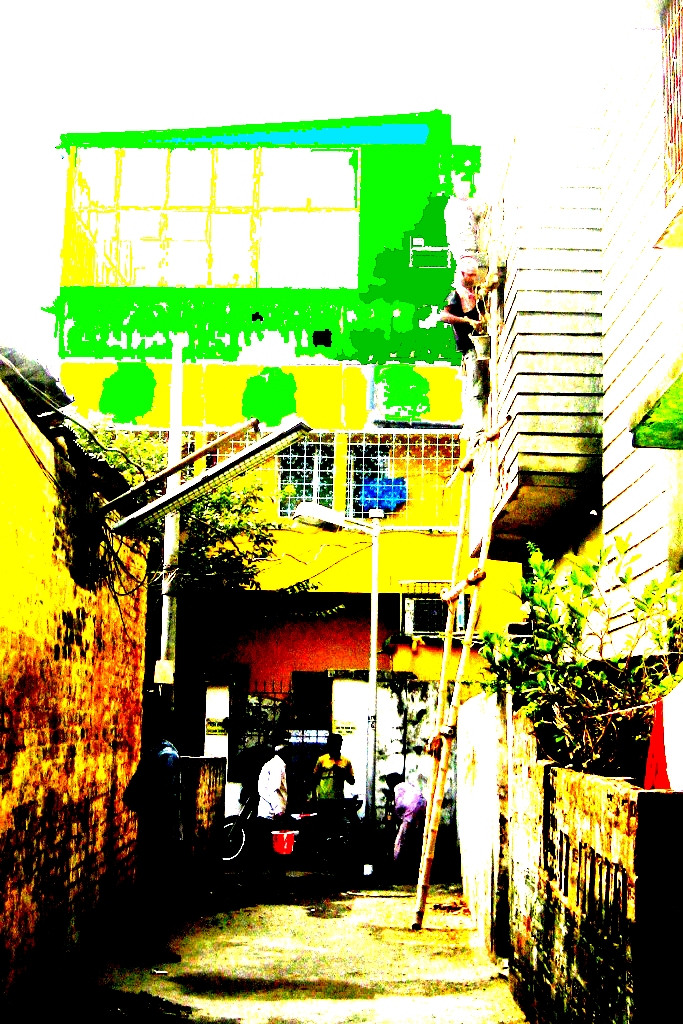
Well, we got 12 of them out (by court order, not the scaffolding you see in the picture).  The ones who understand and feel the power of language feel badly being referred to as orphans. They feel the term as, "I must have been so bad my family didn't keep me."  I tell them they are courageous survivors because it takes courage to fight internal and external demons in order to change our lives.  Help me out there!  Help us find words, help them find words….. 
 

Making Peace at the End of the Lane

We have brokered peace in the neighborhood.  We still want to move, but it will not happen quickly.  We simply don't have the money.  But we do have peace for now, and it's been a process involving the neighbors and us, talking, sometimes yelling, but in the end understanding each other better.

First of all, I learned a few weeks ago that the night of "Barbarians at the Gates" the neighbors thought I was calling them all "bastards,"  That's simply not a word I use, or think of as an insult, as some of my favorite people are members of a group of adoptees calling themselves "Bastard Nation."  I was shocked when this news was casually dropped by someone, who had assumed it was true.  I was told, "Well, it upset them when you called them all bastards."  I thought and thought and then realized that when I had yelled out, "Bhaccha" meaning children, trying to say children were sleeping, they heard something else.  That explains the level of rage which had not been present before.  When I learned this I immediately called one of the goondas and explained.  He understood.  I also said how hard it was for me when they threatened to kill me, and he said, "We were drunk!!!!!  We say bad things.  We don't mean it."  I hadn't expected the admission. 

There was another bad night when some young men tried to intervene on our behalf, but they also had their own motivations.  Caught in the middle between factions, we chose to stay with our known neighbors, and defended them against the new outsiders.  It sounds complicated, which I guess it was. 

Things have changed though.  The music doesn't blare any more.  That makes a huge difference.  Over and over we are told they do not want us to leave.  (They have seen our possible replacements, and they would rather have us.)

Last night was the cricket game between India and Pakistan.  I could hear each scoring (of India), cheers coming from the houses around us.  Firecrackers were set off from time to time.  Then India won, and I knew because of the sustained cheering outside.  I somehow felt I should go outside.  Our front gate was locked, and I went out the side door.  The lane was deserted, with people obviously in their houses.  So i stood and yelled out, "Bhallo India!" and a woman ran out and looked at me and I yelled Bhallo India again and she grinned and went running down the lane and next about 20 men came running and screaming to our gate and we were shaking hands and I was saying over and over again, Bhallo India.  Then everyone was out in the lane and celebrating, and I went inside.  I learned today that the girls had been awake and worried I was going out to fight with the neighbors.  I assumed the neighbors were afraid to really celebrate… just a feeling, and I wanted to establish I'm not a grump.  I get pushed sometimes, and I get scared, very scared, and very protective of my kids.

Just yesterday morning I had thanked the young man with the store for keeping the music low.  I think that had been a big factor… the constant music I couldn't shut out.

When I moved here the girls were little.  Now some are big.  Anyplace I move, people will be suspicious of us, what we are doing.  I learned that even in our area there are people who think we are raising the girls to sell the the U.S.  It's just the mentality.

Peace in the neighborhood… a process, an achievement whether it lasts or not.  I feel good about it though… working it out… trying to bridge misunderstandings, trying to keep us safe at the End of the Lane.

Crowsnest_8535CR-psdWWeb-01 


Holi Sadness

I found this post in “Drafts” as I’m going through the blog and saving files, making hard copies, and looking back over these years.  When you live along railway tracks, in stations, in fields, you may be in India but you may not be part of what the world thinks of as Indian culture or heritage.  You live as an outsider.  Our children were all outsiders.

I learned something today that made me really sad.  Saturday was Holi, the “Festival of Colors” and one of the most popular and non-religious holidays in India.  Our first Holi here we did not celebrate as the girls had just arrived the month before and I didn’t realize it was upon us.  In the chaos of those first days and months, it was just another day when few staff came and we managed to get through the day.  Few people travel; public transportation is halted; walking on the streets can result in being sprayed with colored powder or water.  It’s a time when people have permission to go wild.  Holi is also popular among the Indian population in the US.  In the adoption community, families with children from India often try to find Holi events, to help their children keep in touch with their culture and heritage.

We decided to give the girls a written assignment, as we are working on their thinking and writing abilities.  The assignment was to describe Holi before they came to Shishur Sevay.  Namely write about Holi as you remember it with your families.  I thought I’d be evoking happy memories of time with their families. As I finished describing this “wonderful” assignment, a mood of sadness came over them all.  Only two of eight girls had celebrated Holi.  One more had heard of it, but hadn’t ever celebrated it.  We changed to assignments depending on whether they’d known Holi before.  They could write about their first Holi here, or their first Saraswati here, or Kali Puja, as one girl wanted to.  I told them I was so sad for them, not having had Holi, but I was also so happy we had all these holidays here, that they could know them because of Shishur Sevay.

Just Another Day…

The girls are getting ready to go to sleep.  The TV is off, lights out, and they have closed the door to my office so I won't hear them whispering.  The classroom cleaning team is almost finished and soon they will go to bed.  The dinner team finished the dishes and the floor.  Music plays from outside but sometimes it is OK.  Tonight it's classical Bengali, soulful, and not the Bollywood music, an unwelcome intruder.  I'm at the computer, reflecting, which is much better than working on my "to do" list.

This morning I had to be at the school, the government school where two of the girls attend at 8:30.  That meant I couldn't walk the other girls to their school bus so I arranged for Bijoy and our house supervisor to go with them. 

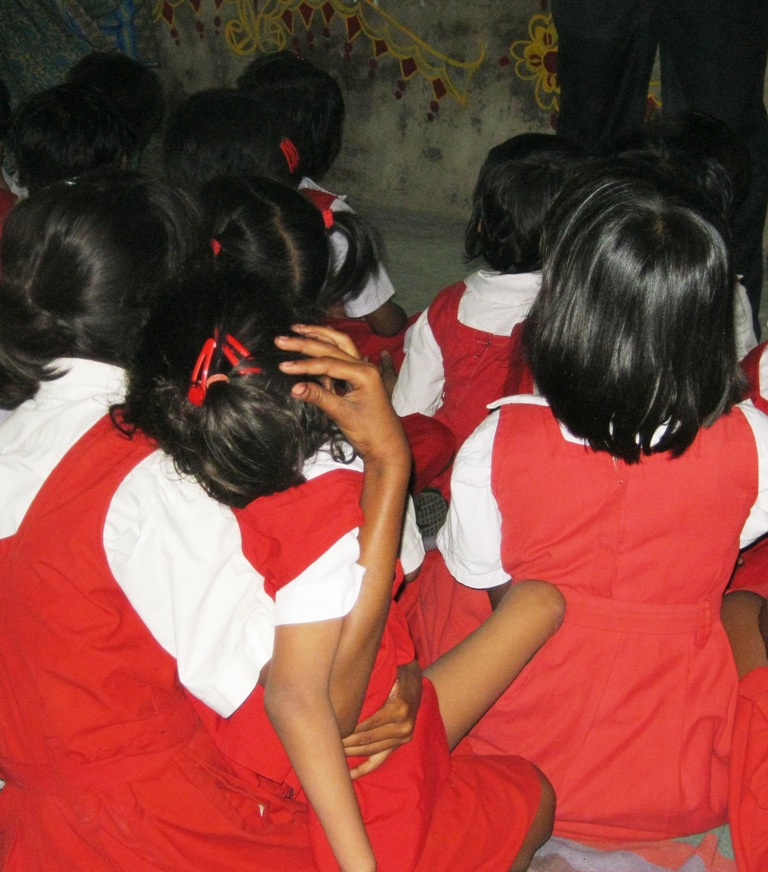
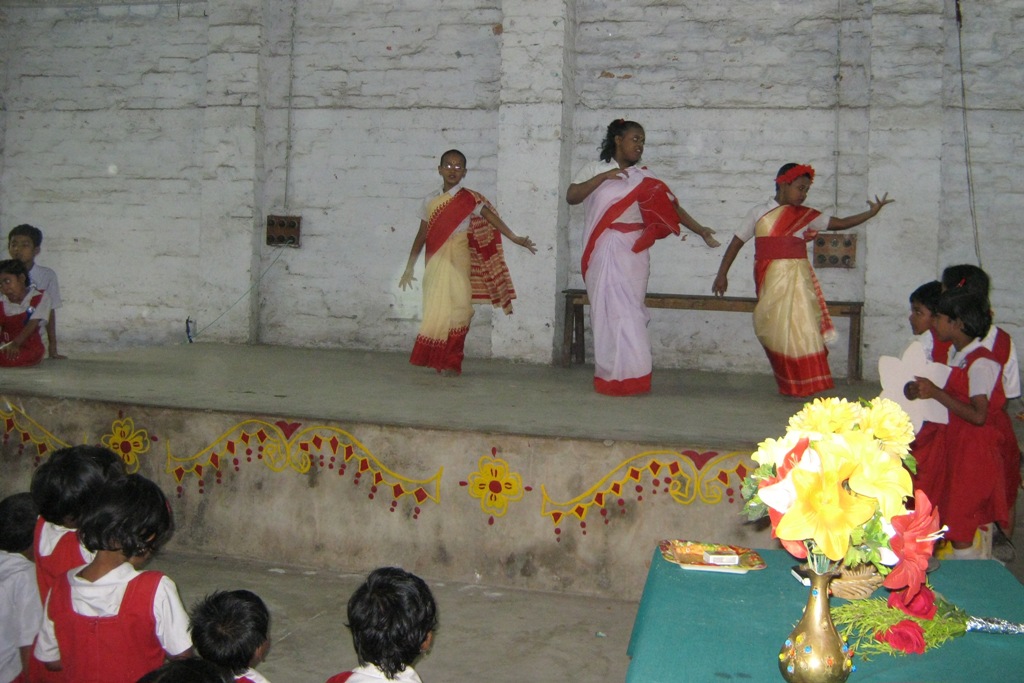
The government school was having their yearly ceremony to welcome new children.  One of our girls was dancing. I was invited to say a few words, and just to be present with them.  I arrived to find my help was needed in putting on saris, and I thought back to my decision in 2003 that the only way to learn how to put on a sari was to do it regularly.  In that setting I'm just one of the mothers down on my knees trying to get the pleats right.

I sat out in the hall, next to Ganga in her wheelchair, as the rest of the preparations continued.  Children were running wildly up and down the hall.  Ganga squirmed, and signalled she wanted something.  It's sounds, but not words.  I asked if she wanted to go home.  She really looked uncomfortable.  She indicated no.  I asked, "Ganga, are you alright?"  She looked me straight in the eyes and shook her head, No.  I asked if she wanted to get on my lap and she seemed to want to.  I took her out of her chair and put her on my lap.  She was still not happy.  Then she stretched out her body to touch the ground with her feet.  Ganga wanted to run with the other children.

Ganga cannot walk.  Her knees buckle, her hips are weak, and her toes twist to the side and point.  So I held her under her arms and I "walked her" and all the children looked and walked with her.  Ganga was with her friends.  At the end of the hall she was OK to go back in her wheelchair.  We went into the auditorium, where mats were on the floor for children to sit.  I wheeled her to the side of the mats.  When the children all came in and sat on the mats she was unhappy again.  She was clear she wanted to sit with the others on the mats.  So I took her out of the chair and sat on the mat with her, next to some girls.  Pretty soon they were holding her up and I went back to the chair.  At first she looked back, but that was mostly because she loves having her picture taken.

Sabitri_0134w 

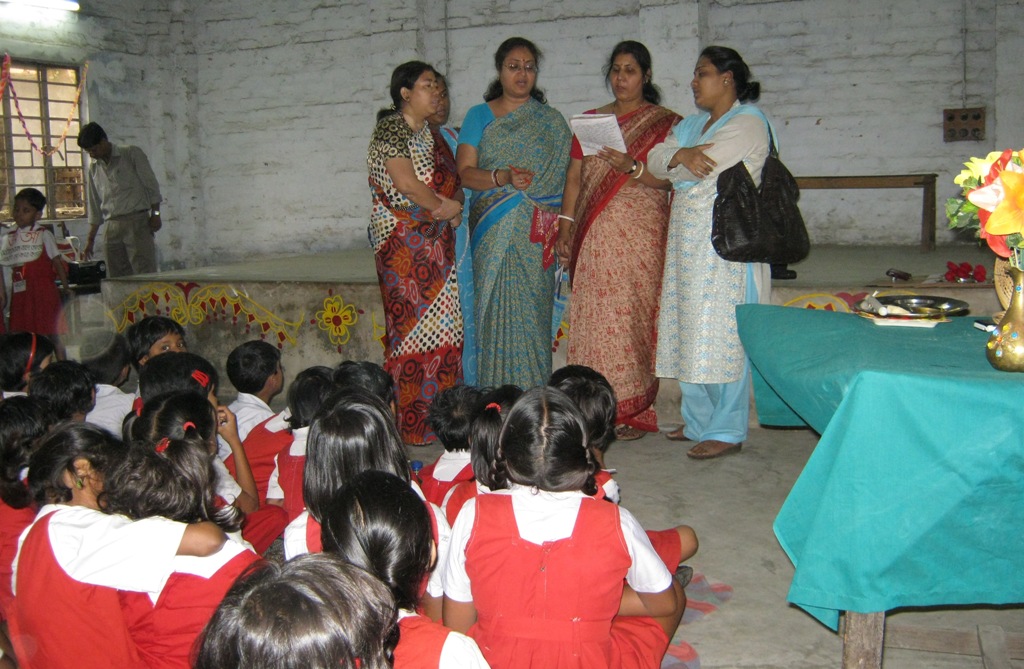
The program began with the teachers singing.

Sabitri_0136W 
 Ganga is in the lower left corner.  I was asked to speak a few words.  I used my little bit of Bengali to tell them how happy I was to be here, and noted all the years we had been part of the school.  Then I told them how wonderful it was that they had taken in children with disabilities.  They had done this out of love in their hearts.  This school had not be "designated" for children with disabilities but they opened their doors to disabled children in the community.    The school had greatly improved in the last four years.  The headmistress has fought for good teachers.  She withstood disapproval for taking these children.  I also know that this year the teachers put together a fund and admitted ten children who could not afford uniforms, books, the minimal admission fees.  So my words were what I was feeling, gratitude for the chances they took for our girls.  I've been the President of the Mother/Teacher's Committee for the past three years and it is an incredible honor.  I AM a part of this community.  Our children are a part of this community, which is why I do not want to move far.

But that brings me to a visit I had this evening by three young men I've talked to before.  They are part of the local community leadership.  They know what is going on.  They do not want us to leave.  They want to fix the problems.  They came this evening to say they want to get back for me the extortion money I paid four years ago.  They have already spoken to the person involved.  Now they want a meeting in which I will speak of it, in his presence. 

I was really confused at first, not at all sure what to say.  And then I thought, "Sure!"  They said it could be anywhere, and at first I didn't want it here but then I thought about the sheer presence of the group here, all coming to this house, past the house of the man who wants to be gatekeeper, and it seemed great.  In fact the "gatekeeper" has been ordered to be present.  I suggested they keep him busy early in the evening, take him for ice cream so he won't drink before the meeting.

Tomorrow evening we will meet here.  We will meet upstairs.  I have their phone numbers.  They are the ones who take care of us at the Sit and Draw contests, and they make sure our girls dance at community events.  But in the past they did not come to the end of the lane to help us.  Now they do.

I believe that ultimately we will move, but it is going to take time.  That I know.  We have seen possibilities that interest us. But in a way that is irrelevant at the moment.  What is relevant is that there ARE people here who want to protect us.  I'm very touched by that.  They are trying to make their community better, their India better.  I'm touched by that too. When they left I just kept grinning and grinning, and saying to Bijoy, "This is good.  This is very good!"  He was grinning too.  He is a young man who wants his India to be a better place than it is.

Well, in between the school program of the morning, and the visit from the young men in the evening, I did some shopping for things I've been putting off.  The girls needed fresh under garments.  The little ones needed some fresh "half pants" or shorts, and shirts.  The staff needed fresh saris and churidas.  We provide clothes for the massis and they wash the clothes daily.  It's part of keeping this place healthy and clean.   I had fun shopping.  Gibi and I have a good act for bargaining.  The price is always very high because of my white skin, higher than the usual high of bargaining.  So then I say no.  Gibi tells them they are charging because of my skin.  Then I say, "Gibi, let's go.  Stop talking to them," and I get about three or four feet away and they call me back.  Now we bargain for real.  Today Bijoy was watching from the car and laughing at our act.  

Late in the morning a new special educator came, and we reviewed reports she has written about the children with disabilities.  She will be coming three days a week starting in April, but has already started guiding the other teachers of the children with disabilities.  We are having a big teacher's meeting tomorrow, so I spent some time helping the new teachers prepare materials for that.  I fixed a couple of the laptops that were reluctant to go online — computers are moody I've decided.

In closing, here is a picture of one of our girls dancing for the function today.  I'm proud of her too.  I'm proud of all of them.  I have been entrusted with their safety and welfare.  I think about this a lot.  I hummed to the music as they danced.

 Sabitri_0140

Previous Older Entries Next Newer Entries

August 2026
S M T W T F S
 1
2345678
9101112131415
16171819202122
23242526272829
3031