One Thousand Rupees a Day!!!!!!!

Heather, my older daughter asked me, "How much are you spending a day on food?"  I had just told her how food costs were much too high and I was looking at cutting back.  I'm under constant pressure IN INDIA to cut back on food costs.  Before I left I complained to the staff, "We are spending ONE THOUSAND rupees per day on food!!!"  So, it was good to be out of India, talking to my daughter about the costs.  When I told her, she asked how much that was in US dollars and I said, "about $20."  Then I laughed, at myself.

For $20 a day I feed 12 children, six staff, myself, with several others present for lunch also.  This money includes cleaning supplies and toiletries.  It does not include milk, because I pay for that out of pocket because people would be more horrified if I included that.  Milk is about Rs. 4000 a month, or about $80 a month.  In the next budget year I will separate out food from cleaning supplies, because I want to document what it costs to keep a place clean. Shishur Sevay is very clean.  In Kolkata one is at constant war with dirt.  We live, 12 children, and me, in 1200 sq. ft.  The only marble is in the two bathrooms.  That was a political statement about how NGO's usually spend money and where they usually put the marble.


Well, back to the food!!!!  From the beginning I have been under fire for how much I feed the children. In the first year I felt like staff thought I was trying to "poison" the children with too much vegetables and protein.  I finally protested that I was tired of hearing that Indian children can't eat that much.  I reminded people that I was a doctor, had raised an "Indian" child and I had friends who raised Indian children.  I took out the USDA charts of nutrition and reminded people that this is why they all wanted their kids to go to the US.  But I think it also goes deeper, to the emotion and disapproval that ORPHANS are getting more food than others.

What do I actually feed the children on $20 a day including cleaning and laundry, etc?  Breakfast is usually a cereal and milk of some sort, some days egg, some days vegetable and chapatti.  It varies.  I've taught the girls to make French Toast, but they do it with chillies!   Lunch is the main meal of the day, with supper mostly being rice with leftovers.  But lunch is fish 2-3 days a week, chicken once, and alternating panir, channa, curried egg, neutrala (a soy product they don't really like but I do — a health food).  Each day they have two vegetables, rice, dal, and fresh salad of some sort, cucumber, tomato, carrot, according to season. Most days they have lassi or some other yogurt.  It's good for the stomach.  The girls average two fruits a day.  The LOVE fruit.  Usually it's banana and orange.  The four little ones get fresh squeezed orange juice every day.  Rani is fussy so she often gets pomegrante.

The principal of a school where I wanted to send the handicapped childen came to see our home.  She clearly was not happy with what she saw and could not wait to get out.  I'd say she was almost rude about it.  The feedback I received is that I was feeding the children too much.  She saw on one tray BOTH an egg and a piece of fish.  She also saw TWO vegetables!!!  It seems that Indian children only need one vegetable a day.  I received  a stern lecture as feedback.  The other criticism was that I was not authorative enough with my staff and they did not respect me.  (I can't ever seem to get it right.)  Needless to say, schooling there did not work out.  I took the children out when I found that the staff would not give them water in the four hours they were there.  These are my handicapped who cannot speak.  But when we would pick them up they would each stick out their tongues, which is how they ask for water.  The water bottles we brought were full.  The school principal would only agree to "look into the matter."  She wouldn't simply tell me, "I'll make sure they get water."  My children are treated as orphans, but in truth they are no longer orphans.  Whatever the paperwork, they have a mother who fights for them, for their education, for relief of their hunger and thirst.  I was accused by the school of trading in education for water.  But really it was about what kind of human being doesn't give water to a thirsty child?  Who were these people I was entrusting with my children.  And what sort of principal doesn't just say, "Don't worry, I'll make sure they get water?"

I include meals for the staff at Shishur Sevay because I want to.  I don't like, and the girls don't like, a separation of who eats what.  This is unusual here with employment, but the staff eats what we do.  It's also a way of keeping them healthy. I know from experience that if they brought lunch it would me simply rice and dal.  There would be no protein.  When we buy treats, the staff shares them too.  The girls automatically offer food and treats to staff.  I love that they do this.

I feed the children because I believe this is very important for their health.  They are incredibly healthy as a group.  We probably have a total of 10 sick days in the year (for all).  One girl reminds us she has NEVER had a fever.  Another won the attendance record in school last year.  Stomach troubles — maybe two girls a month but it's always gone by the next day. The handicapped children are all under sized; their lungs don't work as well. Their circulation isn't as good.  I worry about them more.  I love watching them eat protein and vegetables and fruits and yogurt.  It makes me happy.  Our water is filtered.  Our staff is trained in cleanliness, and there is soap everywhere.

I happen to love soap.  In the years with Johnson & Johnson I decided I could be happy promoting soap all over the world.  I love it because everywhere I've ever been people love to be clean.  I love driving down streets in Kolkata and seeing that at every spigot people are bathing.   If it were not so intrusive and subject to misinterpretation, I would do photographs of people bathing, mothers holding children covered with lather, pouring clean water over them to rinse them off. 

Back to the food though, I'll assume that 80% of the cost is actually food.  So that would be Rs. 800 a day for food.  Fruit and vegetables cost about Rs. 100 each.  Fish is Rs. 250.  That leaves only Rs. 350 for rice, dal, staples — all the other foods and cooking items.  Rice has almost doubled in cost in the four years since we started.  The same is true for the other staples. 

I sit here in NY where carry out lunch for Cici and me costs the same as a day's food for Shishur Sevay.

My mind goes to another question I have been asking lately, "Why SHOULD orphans be poor?"  What is the moral imperative that says they should not be "spoiled" with too much food, as though society sets a bar above which their needs should NOT be met.  "Thou shalt not have more than non-orphans!"  When the girls came I was warned by the head of the government institution that they should not get used to shampoo.  More than one official has said this.  I answer that I love the smell of clean hair so that's why I indulge them, not for them, but for me.  I got them used to using soap all the time by saying, "Mummy loves the smell of clean hands," and they happily lined up for me to smell their clean hands.  I truly understand they may not forever be able to afford shampoo and soap, depending on how their lives go, but this is not a reason to deny them.  In today's economic world no one can assure one's children that they will always have what they had as children.  As for learning to do without, the girls at Shishur Sevay know that already.

Why should orphans be poor?  I understand why they are poor.  They don't have family to take care of them!  But why should I, or any other orphanage director or board or donor KEEP them poor?  What if we were to change the paradigm?  I have a different view of orphans now.  I believe they are potentially a strong force for supporting their country, identification with country where family and community do not exist.  I find that their level of compassion for others often surpasses those around them.  The ones who have lived alone on the streets are true survivors.  They are strong.  They are a force that can be directed for good work and contribution to society.

Well, that's at their best, AFTER I fight with them to eat their vegetables.  I know it is not so simple.  I know they live with "shame" at being orphans, and I wonder why a child should feel shame at what has been done to her.  The victim carries the shame of the perpetrator.  These girls have been abused.  So they have shame.  But the shame should be on those who are content to see them hungry and alone.  I think about that too… all the people for whom they were invisible on the sidewalks, the train stations… all the people who stepped over them, around them, handed them or didn't hand them a rupee.


This morning's Telegraph has an opinion piece on government care of orphans. 

http://www.telegraphindia.com/1100316/jsp/opinion/story_12218178.jsp

 My mission when I began Shishur Sevay, was to get the girls out of such an institution.  I want to impact on how orphans are treated, what is considered adequate, what it takes to raise them, heal them, discipline them, feed them.  First it requires a paradigm shift and then the will to carry it out.

I have to remember, "one take-out" lunch in New York. I'm not over-spending at Shishur Sevay.  Maybe I need to stop discarding the monthly milk bills   Maybe the REAL cost of food is $25 a day, not the $20 I have been pretending it to be. 

OMG:  One Thousand Two Hundred Rupees a Day!!!!!!
Sit and Draw Kolkata 2010; Written from NY — the other side of the world

CAVEAT: I write this post from New York, thus with some distance from the issues I raise.  I probably sound harsh to those who try to help handicapped children, but I cannot find forums in which to discuss these thoughts.  All questions are interpreted as challenges, and as personal affronts.  I once disagreed with one of our teachers about whether a child was retarded (her word), which I didn't think she was.  The teacher said, "Then you are saying I have not been a teacher for 30 years!"  So in truth, this post is also meant to invite the thoughts of my readers, many of whom have had "too much" personal experience with disabilities.  Where I sound harsh, I am feeling frustration.  I'm using the Sit and Draw experience to illustrate a problem, but I have only gratitude to my staff and others who helped make this a wonderful day for the children.

IMG_3586 

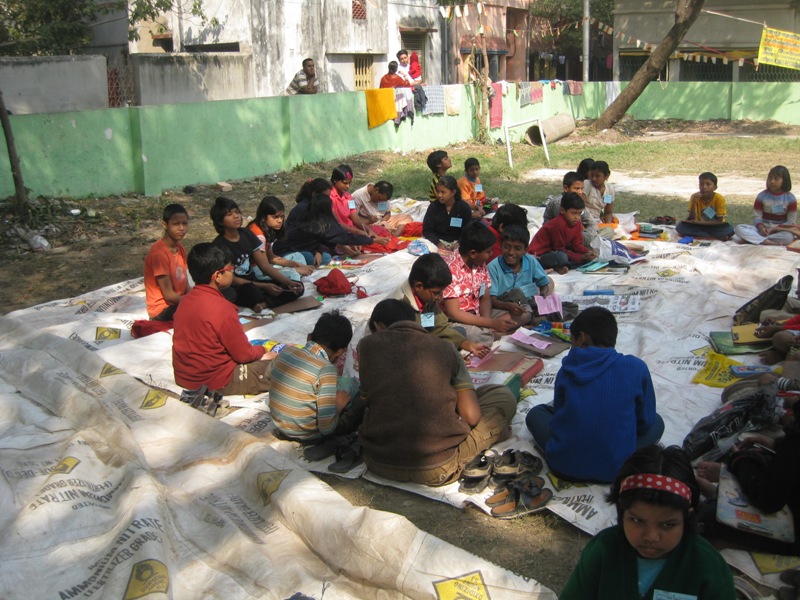
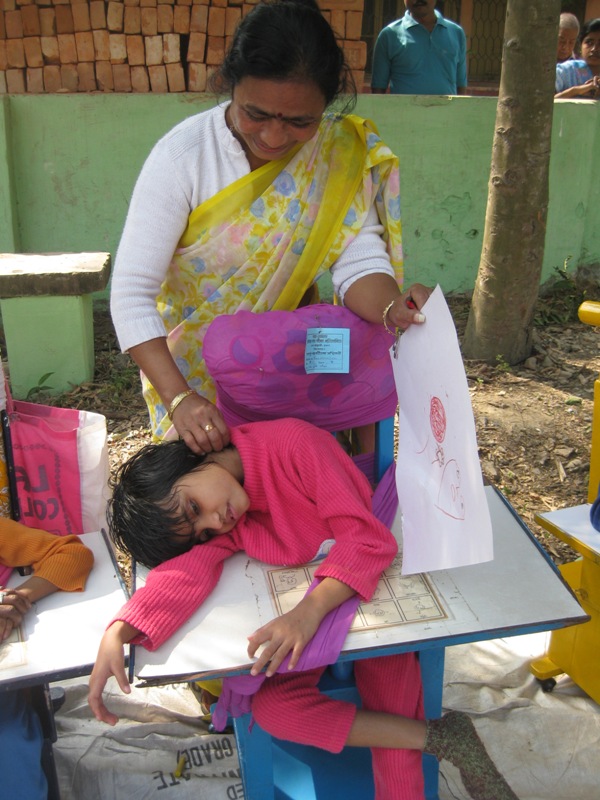
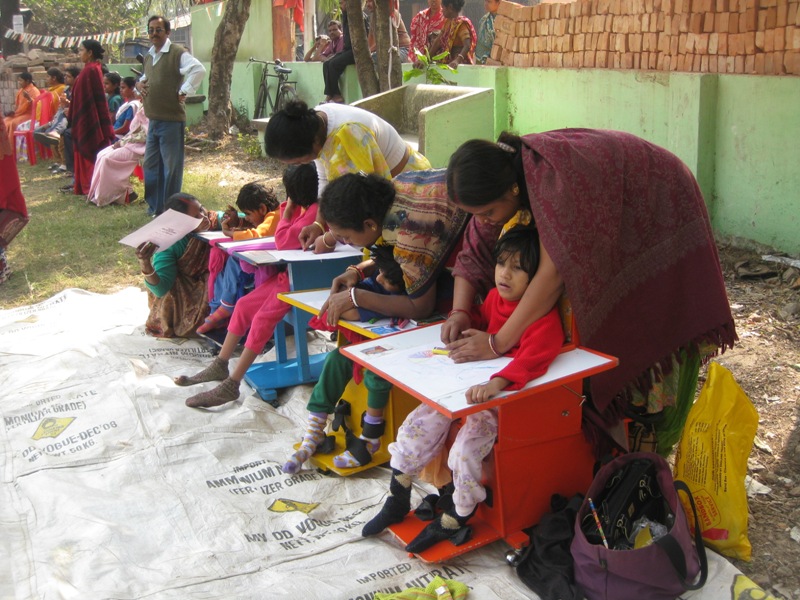
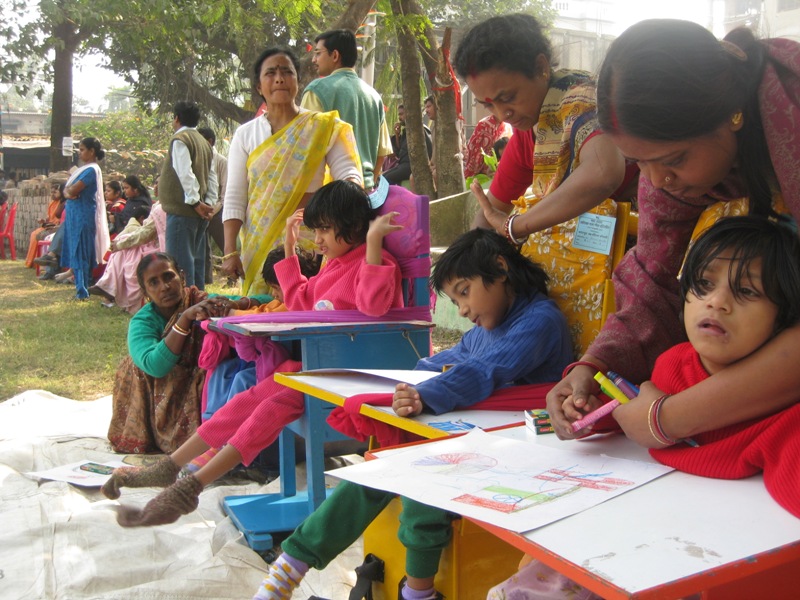
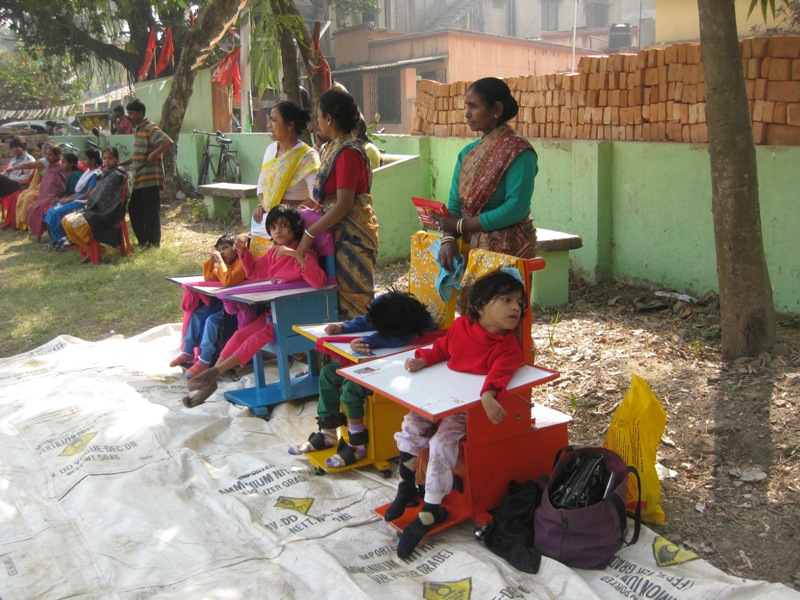
From Left: Sonali, Rani, Bornali, Ganga and three of our staff.  This is our local park.  Our big girls were off in their section for the Sit and Draw. 

IMG_3585 

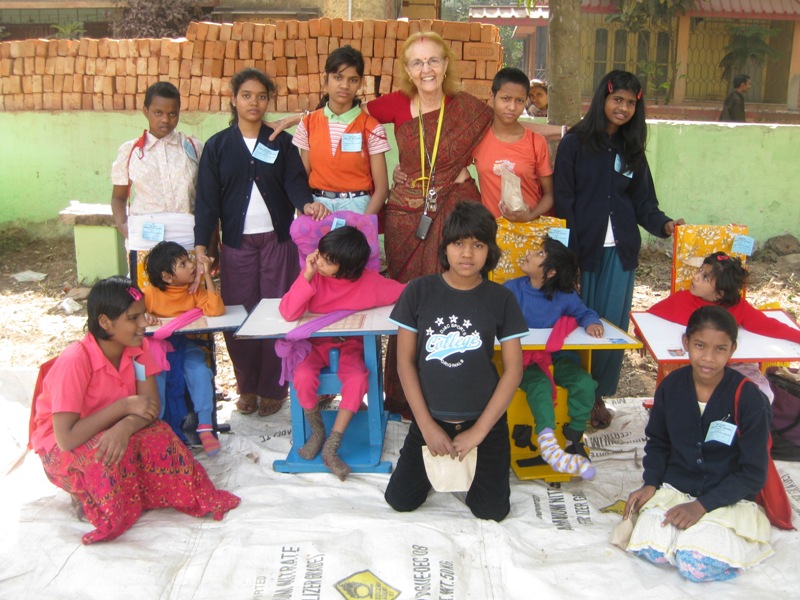
I love pictures like this because you can't tell which girls are from Shishur Sevay.  This is how it should be.   

***************************

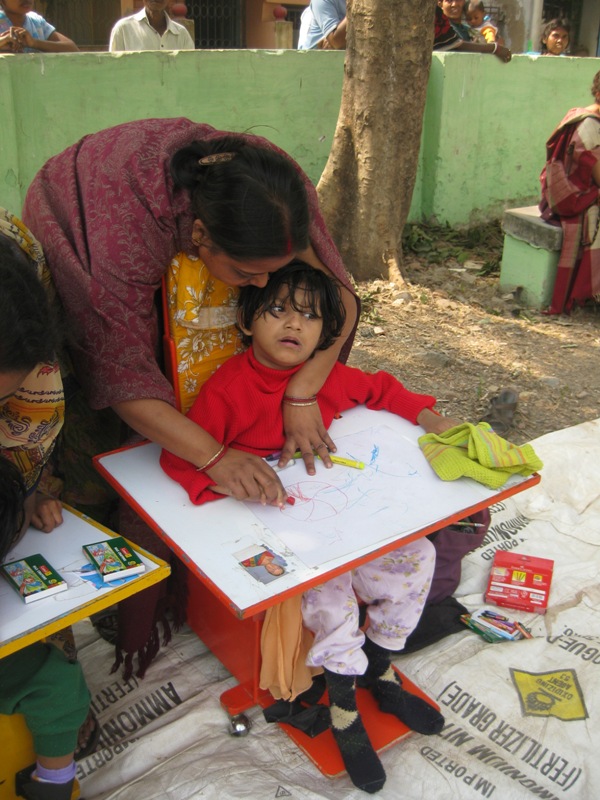
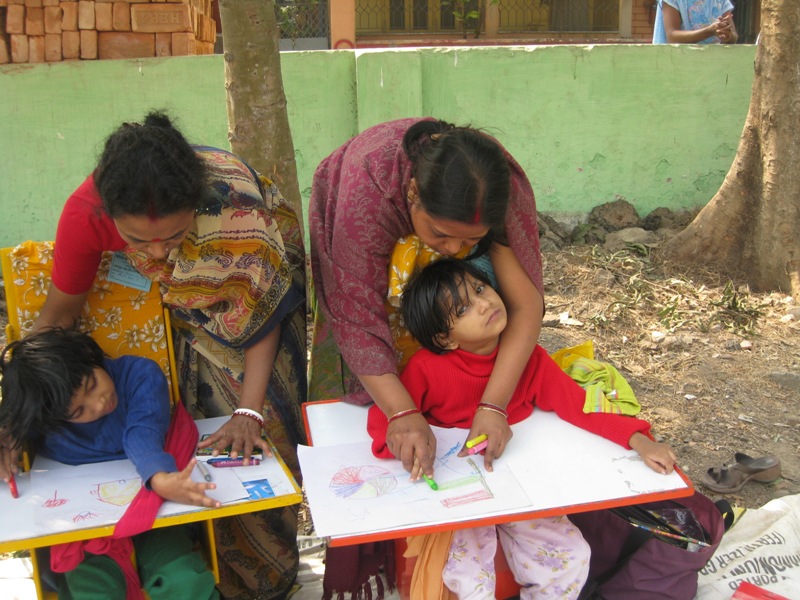
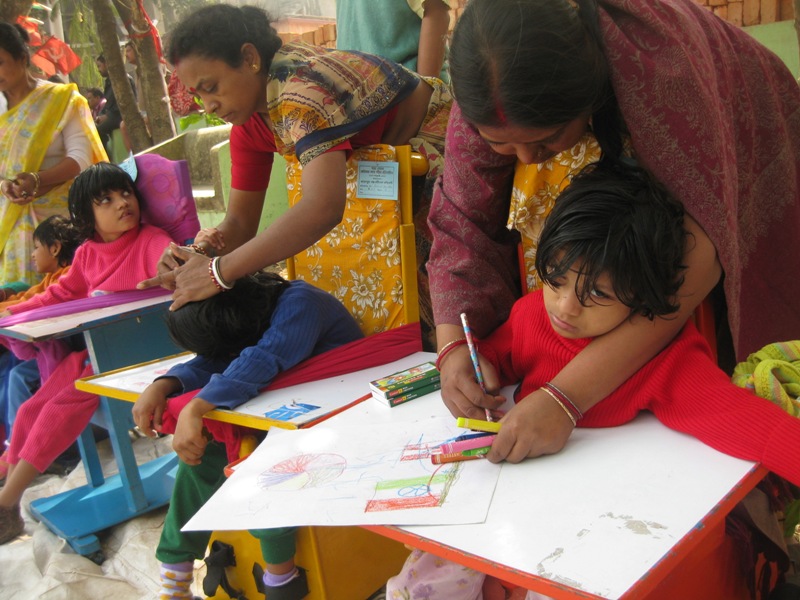
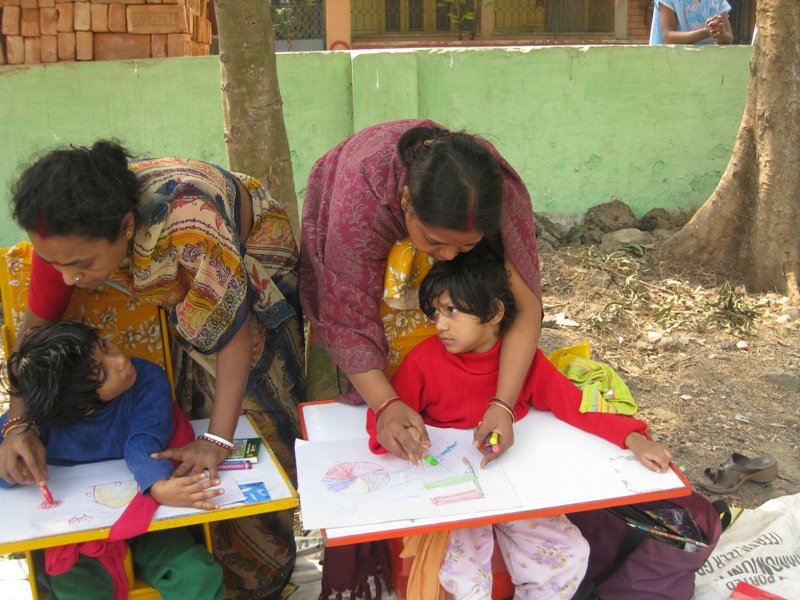
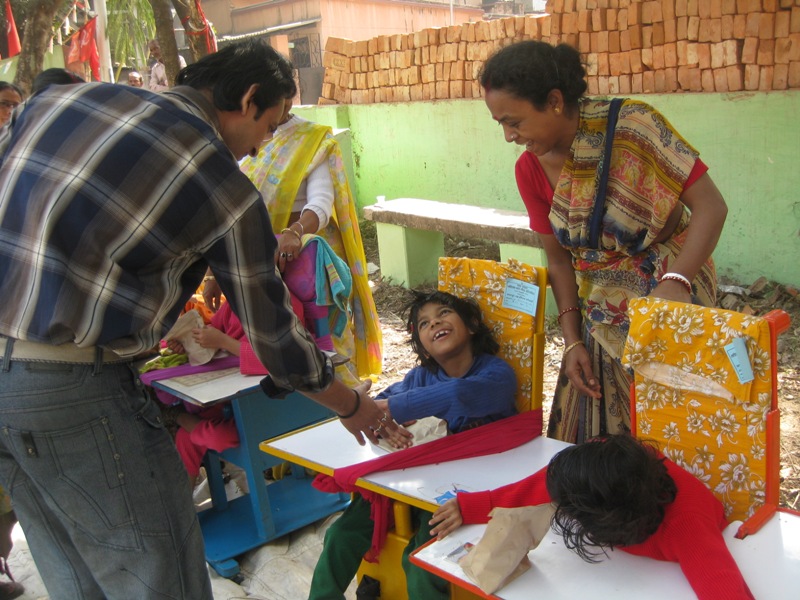
SIT and DRAW 2010… Our girls, all 12 of them participated.  The local community once again welcomed all of our girls, including our four with disabilities. This year we carried their chairs out to the park instead of trying to do this on laps.  It was a wonderful experience, topped by awards to our four handicapped children in the evening.   The work of the older girls reflected their abilities.  This was not true for the drawings of the children with disabilities.  

I never liked when my kids with disabilities, kids who couldn't hold a pencil, would come home from school with finely detailed drawings they could not possibly have done. I happen to treasure the scribbles of my children for whom just holding the crayon is a challenge, and then getting the marking onto the paper — their own genuine signature, the reflection not of their disabilities but of the effort and determination it takes for them to make their markings — in their own image, reflections of who they are and what they can do when they struggle.  In fact I want one day to produce greeting cards that are really done by them, cards and refrigerator art that is genuinely theirs. 

Does it matter?  I believe it does.  I think it has something to do with self, and identity, and what is real and what is fake.  I am committed to understanding how these children feel, how they experience the world around them, when they cannot speak in words.  What is life like for them?  I want to know and then I want them to know I know.  What is it like to be Sonali, Rani, Bornali, or Ganga? 

Sit and Draw is ingrained in the cultural life here.  Drawing is taken very seriously.  On this day we had Sit and Draw in the morning, then Quiz program in the afternoon and dance performances in the evening.  Shishur Sevay girls took part in all of these.


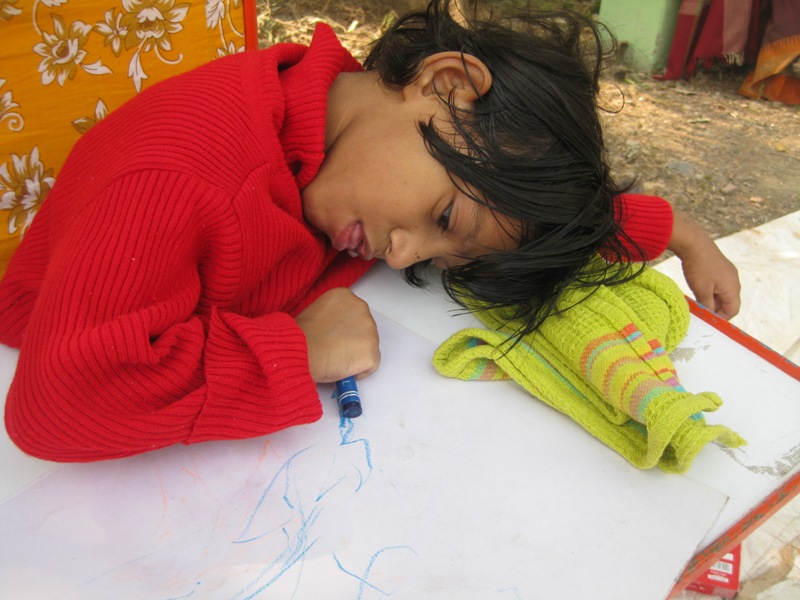
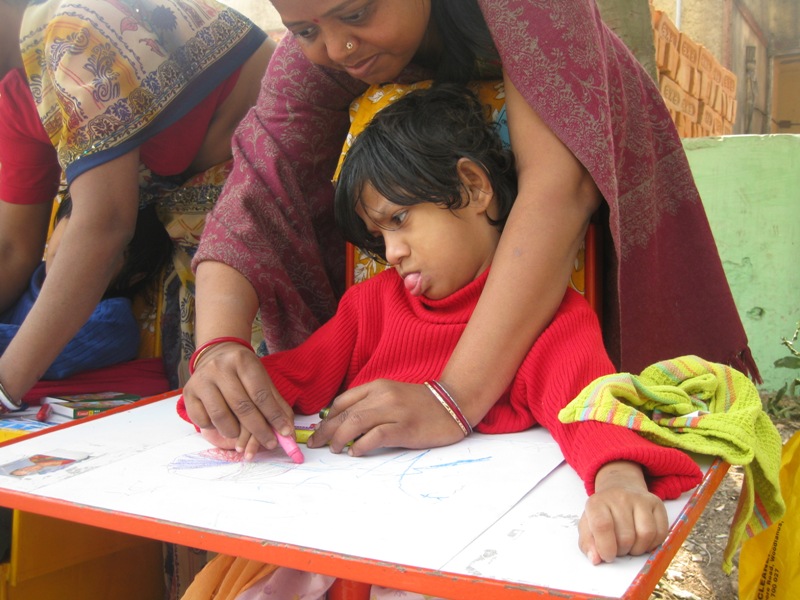
This is Ganga, our most expressive.  When she came three years ago she could not use any of her limbs or hold her head up.  She was totally limp.  Only her eyes spoke.  I used to hold her and just follow her eyes, carry her where she wanted to go, which was usually upstairs to the classroom with the big girls.  Sometimes at night she would wake up crying, and I would follow her eyes, taking me outside into the night… so I had to also teach her that just because I KNEW what she wanted didn't mean she was going to GET what she wanted.  Night was for sleeping.  

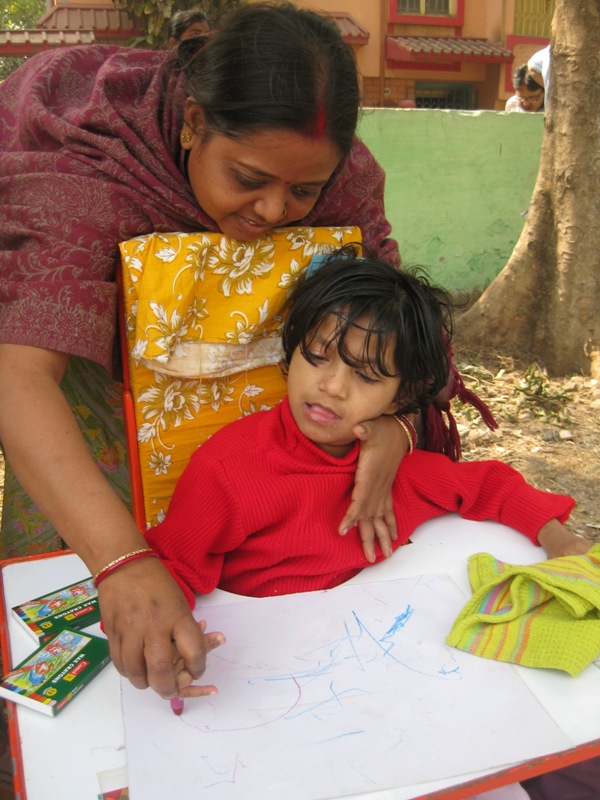
Ganga loves to draw.

IMG_3593
The orange is too faint to see in the picture, but this is her typical pose for drawing.  I was working with her so she got to do it herself.

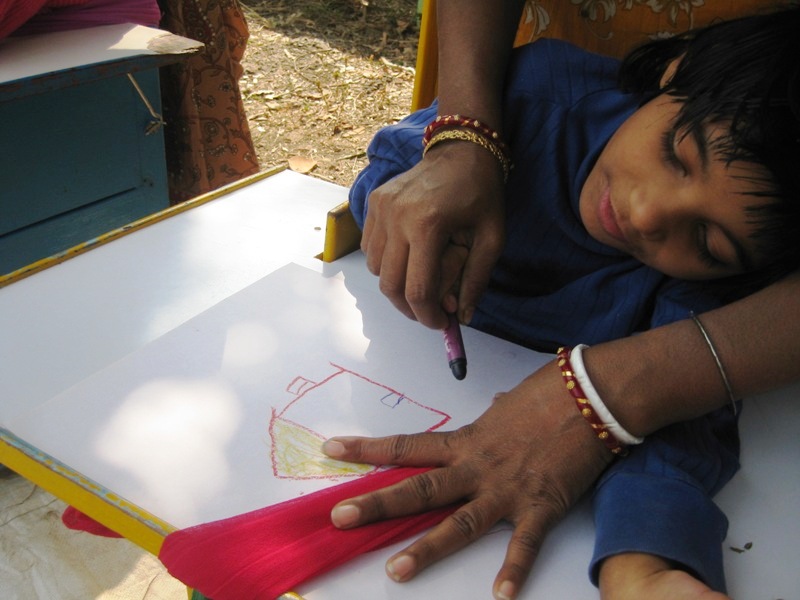
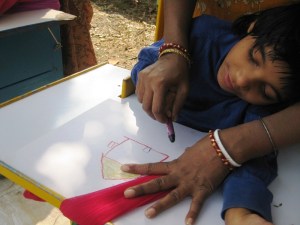
Here is Bornali.  She is getting help.   I think in her mind it's, "Someone is helping me, paying attention to me.  This is good."  She can't tell us enough yet.  Sometimes I look in her eyes and imagine one day her giving me feedback on everything I've said and done  — what has really been going on as she has been getting by by going along.

IMG_3594 

One day a teacher was working with her with a puzzle with pegs so she could lift the pieces.  The teacher wanted her to pick up the piece with her and.  But when the teacher glanced away, Bornali proudly grabbed it with her teeth and held it up!  She was so proud of herself.  I was too.  She analyzed the task as picking up the piece, not using her hand to do it. 

IMG_3597 
 It's a house.  Is it hers?  Does it matter?  I wonder.

But, back to Ganga.  She is working.

IMG_3600
I KNOW those markings…. that's Ganga's handwriting. 

IMG_3601
Ganga is going back over part of what she has done.

IMG_3603
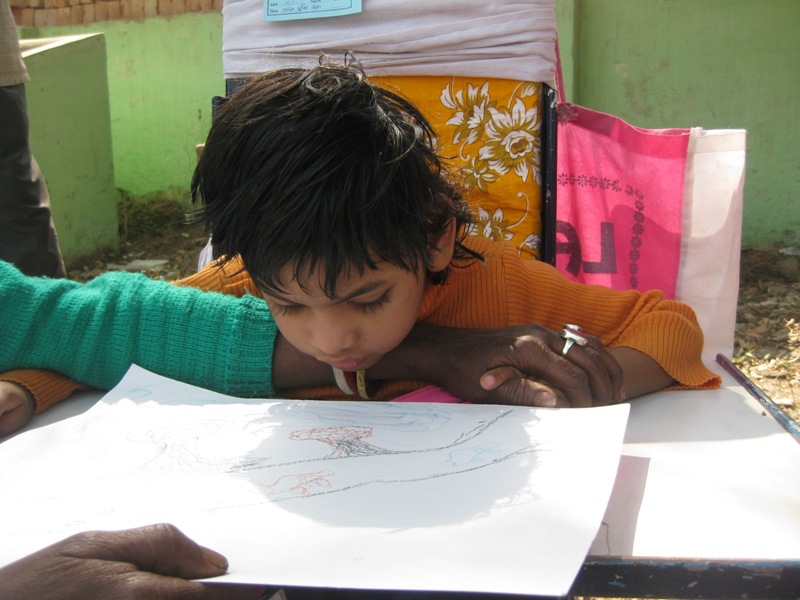
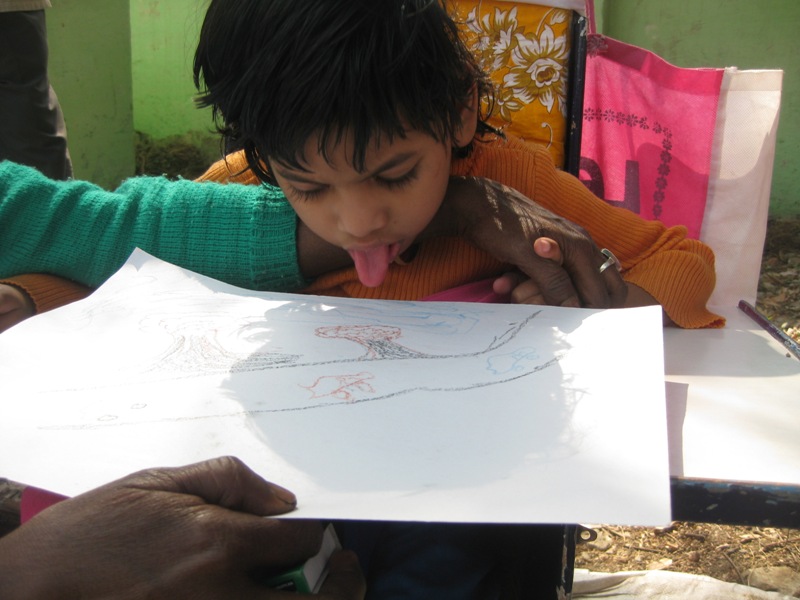
  Sonali is "drawing" a landscape.  Sonali is visually impaired.  She sees light, and forms if they are close.  She holds things up to the corner of her left eye and then tries to touch it with her tongue.  

"Visually impaired" is apparently a very political term here because I have been scolded more than once for using it.  The medical people — doctors — agree but the special educators tell me she does not have a problem.  We just haven't taught her how to see.  She has brain damage, and she finds her way around by touch and uses her hand to explore the face of anyone holding her.  This is irrelevant.  India has not been left out the almost universal answer to all childrens' problems — blame the mother.

IMG_3609 

IMG_3610 

I wonder what she thinks she is looking at.

IMG_3611 

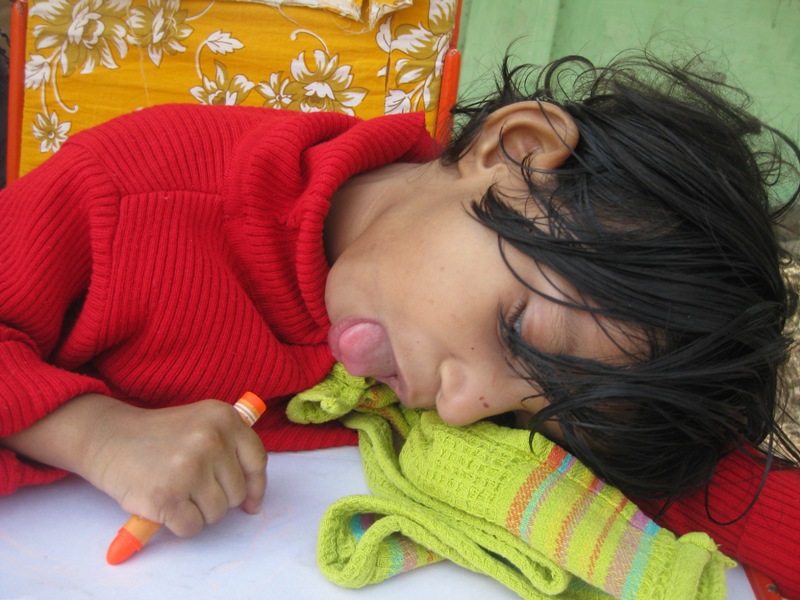
Rani is bored and is taking a nap.  She knows this is not her work because if it were, it would be crumbled, and have some spit and bite marks — her signature.


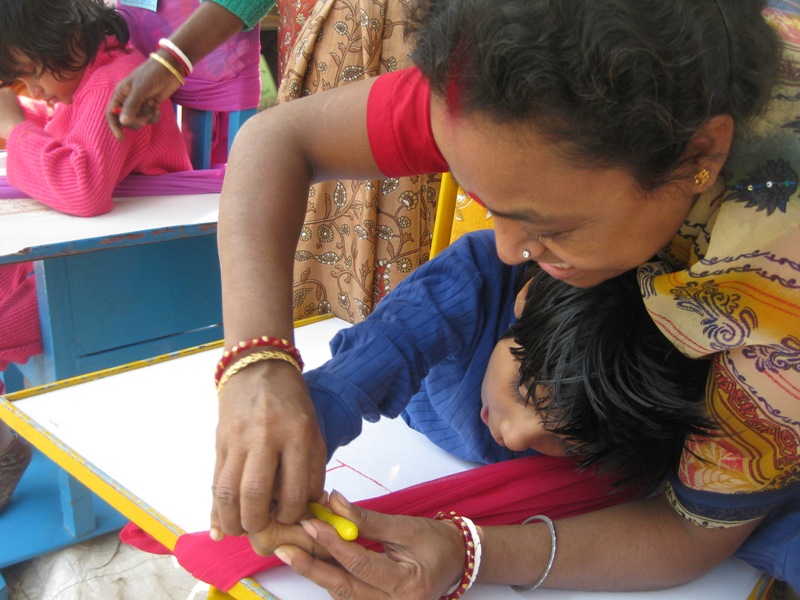
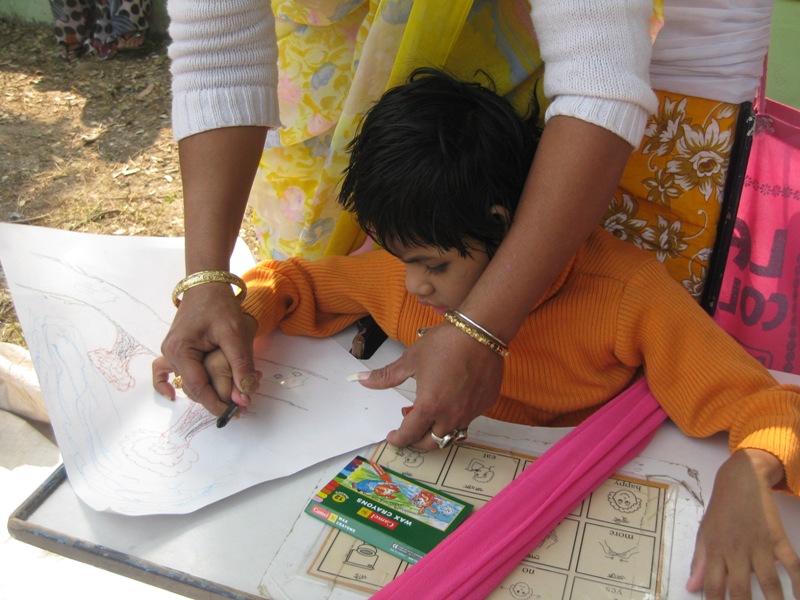
But now, something has happened with Ganga.  Ganga had "finished" her picture.  She put down her crayons and did not want any more crayons and did not want to do more.  I asked her if she wanted to do more and she shook her head no.  She can tell us yes and know.  That's a wonderful basis for language and communication.  Her "yes" is always clear.  But her "no" is sometimes a tease to us.  She jokes with us.  She is a thinker.

IMG_3605 

An onlooker came and decided to help her.  She did not understand that Ganga had finished HER drawing.  I'm showing these picture's because they best describe a struggle I've had all along to let the children help themselves, value what they really do, accept them as they are.  Ganga's eyes tell it all.

IMG_3607 

IMG_3612 

IMG_3615 
 

IMG_3617 
 

IMG_3619

 
 IMG_3628 


IMG_3620

IMG_3630 

This is just a fun morning in the park, but this is also what I found in the schools for handicapped.  I would get reports of what the children could do: "Can draw a circle" really meant could fill in space in a stencil of a circle if someone holds her hand and the pencil.  That may be an activity but it is not a skill. 

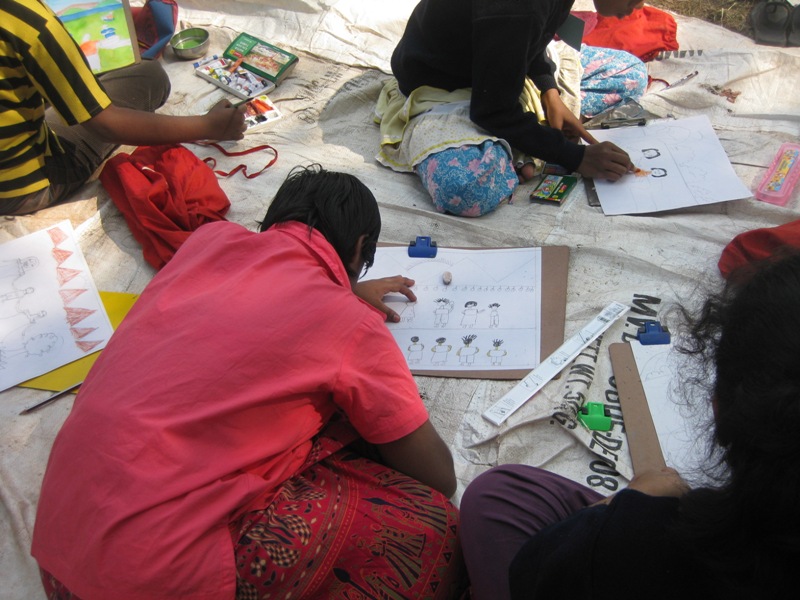
Meanwhile the big girls worked on their drawings, some of them probably wishing for some help.  They are self-conscious.  They have been accepted at times, insulted at other times.  Our participation in this whole day of festivities was last minute and the result of much miscommunication.  We had not been invited for the past two years.  Then the day before I received an invitation, but too late for us to participate in the sports event. 

The girls apparently knew of these events but assumed they were not invited because they are orphans.  As usual, I was clueless because no one even told me about the events.  One of our staff has a son who was participating but she also didn't tell me.  This is the culture about which I always complain.  No one tells me, and because I don't have the language, I don't know what is going on.  (For those who want to instruct me that I must learn Bengali I can only say, it's too late; I'm too old; if I could I would.)  I told the girls they were wrong and that it was because of me, because I has stopped paying protection money and we had not been invited since then.  I told them it was a problem of having a white mother.

The next day I brought along a translator and confronted the Club President.  After a fiery exchange, we agreed it was all a miscommunication because they thought I knew and they thought I was now with another Club so their feelings were hurt.  The result was really wonderful assistance because I was able to make clear that no one tells me what is going on, that yes, my staff and others should have told me, but they didn't, and don't, so the club people have to tell me.  When we showed up for the Sit and Draw, and I couldn't even figure out which table was registration, the young men really helped, sweetly and genuinely.  But yes, I was basically alone in terms of anyone who spoke English and could help.  The girls and I are often alone.  It also brings us closer to each other.

IMG_3654 

IMG_3656
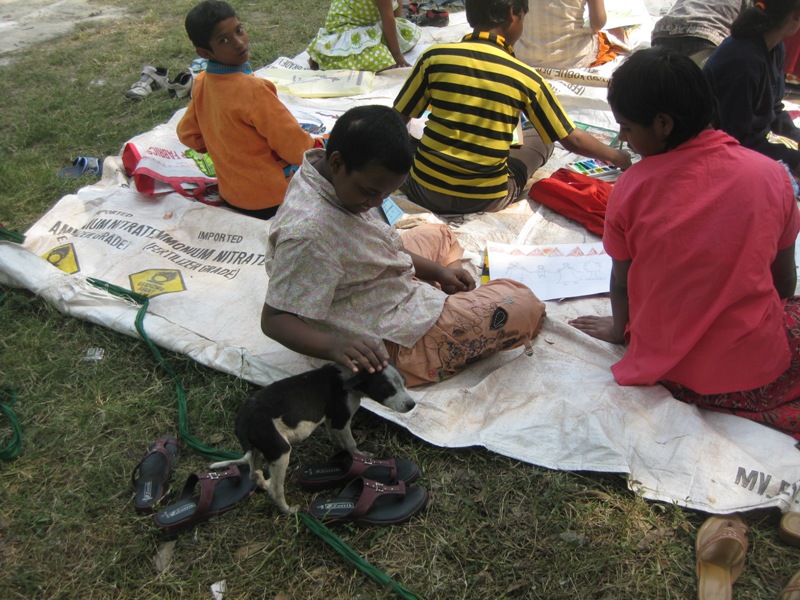
A puppy comes to visit.

Treats are given out after contestants hand in their drawings.  The bag has an assortment of sweets.  Bornali is especially happy to receive hers and she reaches out to shake hands.

IMG_3667 
  

When it is all over, the girls and I pose for a picture. 
 

 IMG_3682 

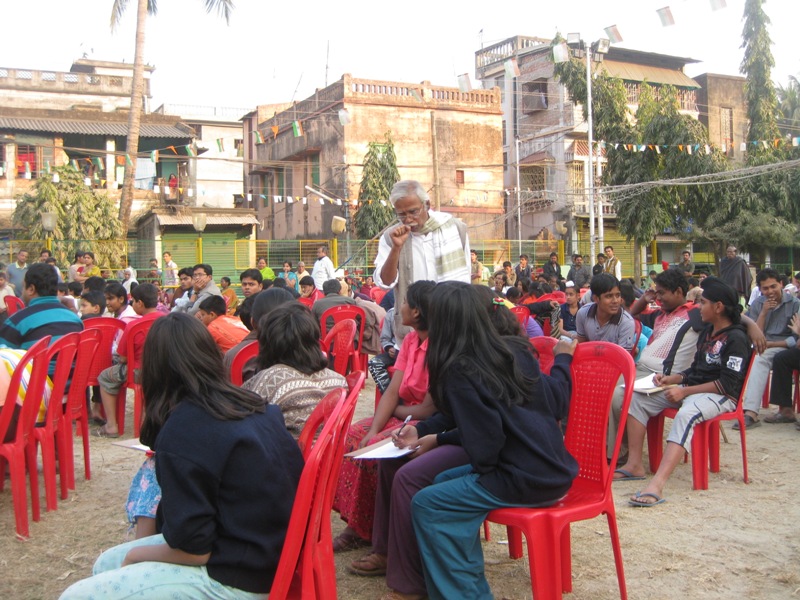
Later in the afternoon six of the girls came back to the park for the Quiz program.  This was ignorance on my part because the competition was high school students, college students, adults… but my girls braved it out.  Next year we will skip this part.

IMG_3702

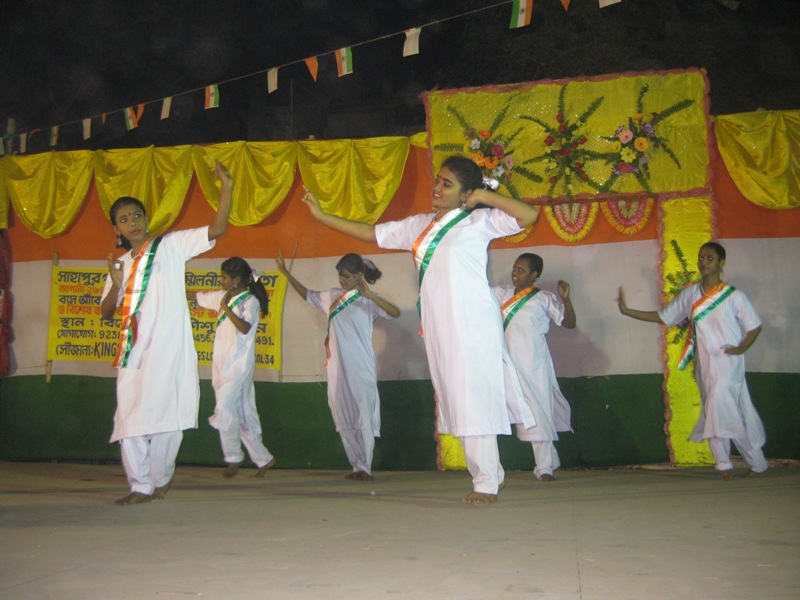
Evening… dance.. Thinking we would be pleased, the announcer over and over again referred to the Shishur Sevay Orphans!  The girls hated it, me too.  It comes with the territory.  I don't think it helped with the judges though. The girls danced very well but the prizes went to the students of the private dance schools.  We weren't out-danced, but we were out-costumed.

IMG_3715 

IMG_3717 

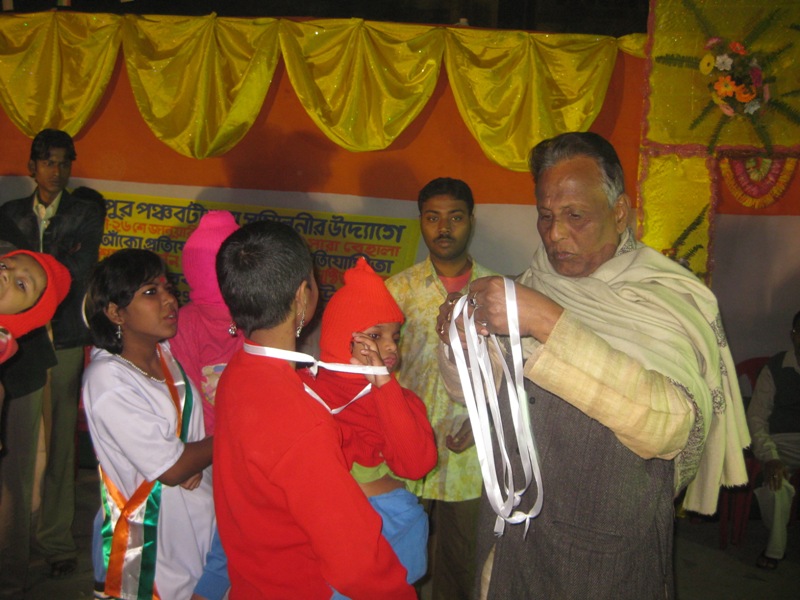
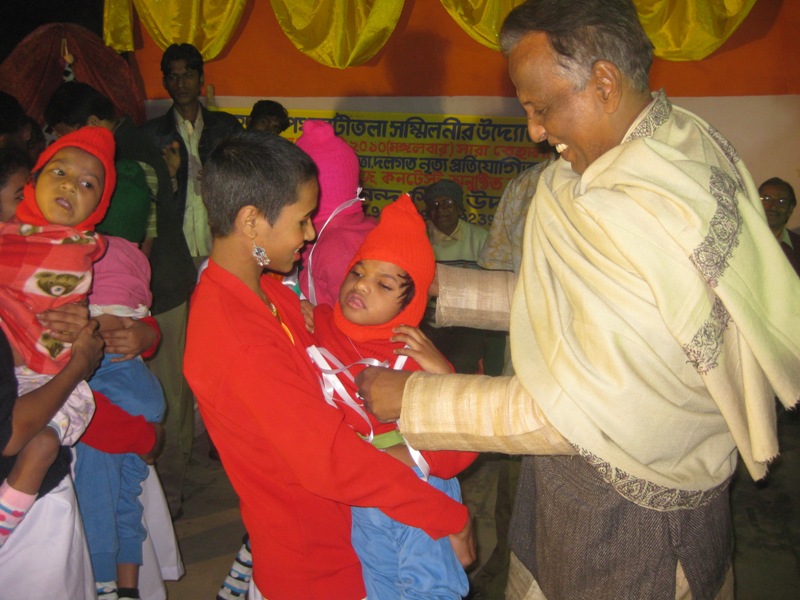
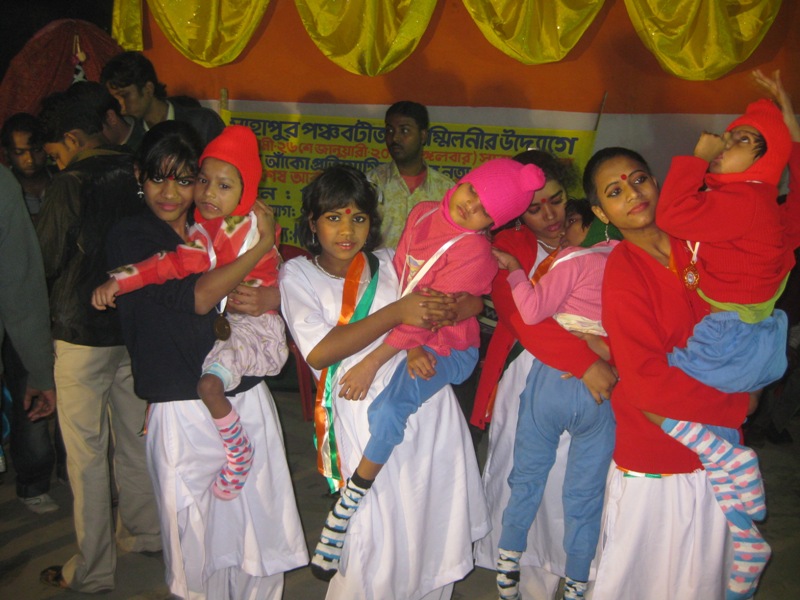
And then the little ones were called up for their special awards for participation in Sit and Draw.  Each younger girl was carried up by a didi to receive her award.  It was beautiful.

IMG_3726 

You see, the medal was originally placed around the neck of a big sister but she insisted it was for Sonali and asked the man to take it off and put it around Sonali.

IMG_3729 

IMG_3733 

The four little ones with four big sisters, always proud – so it's not about the art on this day.  I know that didn't matter.  But it is a celebration of acceptance, a recognition of common needs, a shared sense of what it means to be members of a community.  

Since I write this post from NY, I write also that I miss my children in India.  I've been on the phone with them several times already.  "How are you?", "I'm fine.  You fine?" With the handicapped, I spell their names on the phone and they recognize that:  G A N G A… Ganga!!! and she laughs.  B O N O Bono!!! and she laughs. 


By personality I'm someone who would prefer to have everyone I love close by, all together, in one city, country, continent.  It's funny, that's all.  I'm a very lucky mom, a very lucky human being. 


DEAR MR. XXX

This is a letter I sent by email last night to my most recent chartered accountant who did not show up as planned.  I really was thrilled when I met him.  He is a humanitarian.  I do not doubt that.  He runs an orphanage on his own money.  He has good values.  He said he would not charge.  But he hasn't been back. 

A few weeks ago my accountant left after some problems over the accounts and money that was "lost" and then "found".  His record keeping turned out to have been almost non-existent.  I've now brought in someone to go back and do the accounts for the full year.  I am also having developed an online package (a wonderful donation of time and skills from some supporters.  But overal structure and strategy requires meeting with the chartered accountant.  He agrees to come, doesn't call, doesn't show.

This email will make no difference.  It just helps me to say what I need to say.  I will start again.  I can't apply for grants until I get the records straightened out.  Always there is one thing piled on another on another – requirements that can't be met because I can't find the professional help.  This has nothing to do with my being a foreigner or a woman or white.  If I tell this story to old-timers here, they just shrug in sympathy and tell me this is just how it is.

Dear Mr. XXXX

Now four times you have failed to show up or call after agreeing to meet.  I truly appreciate your positive sentiments about Shishur Sevay, but I simply can't function this way.  On two of these occasions I had also arranged for the computer people developing the software to meet with you here.  This has been the story for three years… appointments, no show, no phone call.  You have a business to run.  So do I.  The end of the year is arriving quickly and you will be even more busy.  Last night I waited;  Your phone was switched off.  Mr. XXX thought you were out of station.  I know you weren't here.


I would say, please charge me your fees and then come, then take this work seriously, but my sad experience in Kolkata is that money makes no difference.  And even if I paid your fees, they are not in the range of the major businesses you represent.  I never despair about the children.  I constantly despair about trying to build infrastructure, find reliable people to work with.  Exactly one year ago I met with a partner from XXXXX &  XXXXXX.  It was a wonderful meeting full of talk of developing strategies for Shishur Sevay.  I never met that man again.  He  was always out of town.  He didn't even do the audit and NONE of the strategies were ever discussed again or carried out.  I was left to decide financial strategy in relation to taxes!  But this year I am no better off.  I was thrilled when we met.  I felt relief.  I don't feel relief now.  I'm just wondering when to place another ad… call the people who didn't call me, start all over again.


I'm sad because it seems in Kolkata whether I get referred by Board Members, internet searches, or the Hand of God as you expressed, it makes no difference.  For me this is a wasteland where I try to protect 12 children and run an honest home, and meet government requirements.  It is a lonely task.


Of course I hope to hear from you, but honestly, if you want to help, I need your presence.  If not, I really must start again.

March is a terrible time to look for a chartered accountant.  But it seems to be my ritual…. the children thrive.  I get very tired.

The Struggles of Running a Home

In a previous life, in this lifetime, I was an international expert on PMS, and published the first book in the US about PMS (Premenstrual Syndrome). I opened a practice where I had no nurse, only a secretary.  My experience was that if I had a nurse taking calls or interfacing regularly, I would never know as much about my patients or about the illness.  I put myself on the front line.  I knew that often the doctor knew the least about what was going on.

When I was at Johnson & Johnson, and in a position to fund charity work, I was never certain that ANY of the money actually got to services with direct impact on anyone's lives.  That's just how it is.  So when I founded Shishur Sevay I wanted to know what really happens, what are the real obstacles to getting services where they are intended.  So this is a report from the front line today — describing what has been a difficult though not unusual time.  I also owe my readers a really wonderful post about Sit and Draw, and my kids, but that will wait.

On the positive side I've been granted a resident permit to stay in India.  This is incredible, and releases energy needed to focus on Shishur Sevay.  I celebrate that.  I also celebrate that the girls have been here three years now — although I've not made that public here — but maybe next week we will celebrate.  It has a lot of meaning for me, including that I feel successful in my mission to care for orphan girls, educate them, help them grow from frightened little girls to self confident (sometimes too self-confident) young women.  And the handicapped children, whom I want to write about more, are thriving and growing in totally unexpected ways, beyond my hopes.

Teaching:  I'm not satisfied with the teaching program.  I have paid increasingly higher salaries for more experienced teachers, but I think they lack the commitment and harbor doubts about how much "these" children can learn.  I have one teacher who has recently returned, our first-ever teacher who grew up a few houses away, whose father is a rickshaw wallah who made sure his children were educated.  She left to get married and has come back.  She appreciates us, the children, and the work it takes to achieve education and respect.  I need more teachers like her.  

I will look for what we call "freshers" here, people just out of school.  I'm looking for well educated young women from poor backgrounds, coming from the strict schools, which usually means either the Ramkrishna, Sarada, or Christian schools. These are the places we will now look as a source for teachers.   Class differences (social class) present barriers, and we know that expectations are so much a part of children's' achievement.  Experienced teachers are very expensive here.  I have to compete with the income they receive from "tuitions," which is the parallel educational system.  This is how it works:  Teachers in the schools give out the work, but do not actually teach the material.  Then the same teachers see the students privately in their homes for "tuitions."  They will have various sized classes at home, charging individually, and making in one hour far more than I can pay.  Parents pay for tuitions because it is no secret that a teacher will give her tuition students answers to exams, or will prepare her students differently, so if you want your child to succeed, you have to put your child in tuitions.  This is not isolated.  Children come home from school and go to coaching, tutors, sometimes traveling long distances to the homes of their teachers.  So I need to find "fresher" teachers before they are making so much money they don't want a job.

We have been having meetings after meetings with teachers, but there is a level of passivity I have not been able to change.  Seriously I took a nap yesterday for one hour and the program fell apart.  Three teachers couldn't figure out how to split the class, although we had spent two hours discussing this the day before.  I've separated out disruptive from non-disruptive.  It's not about language, the lack of understanding.  One of them is fluent in English.  EVERYTHING is translated by our program director! I woke up to chaos because one of the disruptive girls was with the others.  And it's not good for her either.  She needs successful experiences.  She didn't belong in that class, but I took a nap.  This is a strain.

Yesterday one of my special ed teachers came to me in the morning.  One of the big girls wanted to watch tv.  She wanted to know if it was OK.  I asked if she could still teach with the tv on. (I knew the answer) and she said no, she couldn't.  So I asked her why she was asking me, why was I paying her to teach if she couldn't put teaching as a priority against a girl asking to watch tv.  Why did I have to answer?  Another teacher one day asked me, "Should I go home?  The girls said they don't want to study any more today?"  Truly I believe there is nothing pathological about girls asking for tv, or suggesting a teacher go home.  They were actually quite sweet to the teacher about suggesting she go home.  But it is pathological for middle aged adults to come listen to them.  For a long time people tried to tell me, and I believed them, that it was somehow all my fault.  But I know enough now about the culture that it's not my fault.  It's how the culture is.    In three years I have NEVER scolded or reprimanded a teacher for saying no to the girls.  I support my teachers.  It is so normal for children to say, "I don't want to study" and to me so normal for a mother or a teacher to say, "you have to."  Here no one wants to say "You have to."  And in addition the normal behavior is interpreted as pathological orphan behavior.  "These children" are bad.

Late in the evening I learned that one of the guards was doing business over kerosene with the dadas outside (the ones who have threatened me) and the kerosene was being stored under our generator.  The business is illegal and the kerosene is inflammable.  I flamed!  I called the security company.  I was up until 2 am on this.  About a week ago I told the company the guards were talking too much with the dadas and I was concerned.  Also about two weeks ago I received a warning letter anonymous — that there was a conspiracy among my staff, friends, and Board to take over Shishur Sevay and sell the girls.  This is probably from someone I fired but the nature of the accusations and the evil accusations of selling the girls required that we take some action, including clearing and defending those around me.  It was painful for them.  We met with one of the top criminal lawyers and through him met with the OC of the police.  The OC made a personal visit to Shishur Sevay.  The girls knew everything… as they had waited that first evening until everyone else had gone and then asked me what was happening.  I'm glad they trust me, come to me.  They know by now I won't polish the story or tell them they are too young to know.    But these things are consuming and exhausting.

Last night I wrote to the heads of the security agency, reminding them I'm a white skinned American woman who has had death threats and community agitation against me by former guards.  I wrote that they were mad for believing their people were competent and I was mad for paying them what I do.  Security is my single most expensive cost.

On another day recently, money was missing in the payroll process.  Actually the money was never really missing but miscounted.  The problem was that the people involved accused me of miscounting, which is a stupid thing to do in front of many other people, when the mistake is not mine.  So everyone around me thought I was being fooled and I didn't know it.  After my insistence, the money was "found" to be a computer mistake.  It's exhausting.  I brought in a team over the weekend to go into the computers for all financial records.  I have a new accountant now.  I've lost money and time over accounting.  The story repeats itself over and over.  It's exhausting.

We have worked hard to prepare the girls for their exams.  Today is the last one.  The girls were really psyched!  But the teachers in school gave them all the answers to the exams.  The school wants to keep up its rating.  This is common practice.  One of our girls is a daydreamer and rebelliously oppositional.  The school teacher asked why she wasn't listening and she said, "I'm busy writing.  I want to do my own exam."  The girls come home and we laugh about it and still prepare for the next day's exam as if it will be a real exam.  They know it's wrong.  I tell them to do what they must in school.  It's not their battle or mine.  I have to work and educate them within the system.  And the girls prepare themselves also by attending to the Gods who sit on our pandal, including my elephant God Sarmu.  The Gods have been fed well this week, bathed daily, dressed, re-arranged, prayed to.  I treasure that they can do this, that they can find their comfort here in ways that are meaningful for them.

One of the girls had a real emotional break-down a few nights ago and I thought I might have to hospitalize her.  She was in a rage, but then the tears came, the tears of being without her mother, the tears and anger at God that she must have so much pain.  We all sat around hugging her.  For the last two days we have been talking about pain.  I talk about my childhood, about sexual abuse, about rape, about my pain. They are not alone.  I understand them.  I tell them that.  It is all exhausting.

Oh, another conflict in the past week:  We started dance therapy with a well known professional group and it only lasted two weeks and I've not alienated another group of people in Kolkata.  I had to major problems.  The dances were too intimate and sexually provocative for my standards, done to Western disco music.  The second problem was that the class required violating some of the religious customs here among the girls and ALL of the staff, including teachers… namely stepping on paper, and touching people's feet.  If someone touches someone else's feet there are rituals to be performed, depending on the age/rank of each person.  I'm the oldest so I don't have to be worried about being the offending person but I still find myself doing some hand thing to indicate I know this has happened and it's ok.  So there in the dance, even after one of the girls protested, the therapists insisted this was just superstition.  I told her one person's superstition is another person's religion.  I objected because it wasn't discussed, put into the conversation, and "therapy" seemed to be about forcing bodies together in ways that violated personal space and religious customs.  The group leader said they had to have full control without my interference and I said I couldn't do that.  As I said, I'm on one more person or organization's bad list.  it's just how I am.  I wouldn't give that latitude with my first two daughters and I wouldn't give it to them.  There are class issues here in many organizations, and I find myself having to remind them of some of the Indian cultural and religious customs.  The girls and I laughed about it.  They were so surprised that I had noticed their discomfort with the foot touching.  They felt supported.

I now have permission for foreign funds, but I lack the time/energy/resources to apply for grants.  There are groups prepared to give me funds and I can't get the paper work out.  I should be doing that now, but I need to blog.  I need to say how it is, really, on the ground, on the front line.

I moved my cow, Bubbi, to a place I thought was safe.  But now there is community agitation there and I can't go to see her.  It is not safe.

The girls want to celebrate the end of the school year.  Maybe we will go to the Mall for ice cream.  Maybe we will go to Victoria Memorial Park.  That takes more supervision. 

I've left out TB, also consuming energy in the last couple of weeks.  One of our staff was diagnosed with TB, although the diagnosis had been missed for a long time, and therefore the kids were all exposed, especially at nap time.  I took all 12 to have chest x-rays, blood tests, and skin tests.  I was able to contact a national expert on pediatric TB, who kindly came and examined all the girls and set up a prophylactic treatment program for all of them, and for me as my age and past chemotherapy put me at higher risk.  The Indian public health, and WHO public health protocols do not call for prophylactic treatment of TB close contacts.  But I wanted us to work according to US, UK, namely developed world criteria for treatment.  We are all on treatment now and will be for the next six months.  It's all consuming and exhausting.

The dog was sick this week too.  At ten pm a couple of nights ago the guard called me to say the dog was scratching and crying.  Apparently this had been going on all day but no one told me.  They thought she had gotten into ants, but I think it was allergy as there were no bites but her hair was standing up in bunches all over.  I gave her some benadryl and we brought her inside for a while.  Now she knows if she scratches and whines she will be brought inside.  She is a quick learner.

Yes, all these things have happened in a very short span of time. 

It's 10:05 Saturday morning now.  The girls have to leave for their exam in ten minutes.  They are watching a movie about the origins of Indian civilization, a DVD I got for them.  Soon they will go out and put on their shoes. And then I will give them my personal blessings.  Some years ago, on impulse at an airport, I bought a small make-up case with gold blush.  It's almost invisible.  It reminded me of the years in the corporate world when I had to spend a lot of money on make-up to go to work looking "natural."  Anyway, I really enjoy my gold blush and I used it to bless the girls for exams, sports events, stuff like that.  They line up outside, each looking very serious, as I brush a bit of Chanel gold dust on their forehead, nose, cheeks, and send them off into the world.  People say I protect them too much, that they need to learn about real life.  But first of all, they already know about real life in its harshest terms.  Second, they are learning about real life as they go off to take an exam where the teachers will give them all the answers.

But they do go into the real world with a sprinkle of Chanel Gold Blush and this somehow makes me very happy.


Previous Older Entries Next Newer Entries

August 2026
S M T W T F S
 1
2345678
9101112131415
16171819202122
23242526272829
3031